


Every twist in the winding road of our politics brings a latest thing to say. These wisdoms usually survive a season or two before succumbing to the new thing to say, which often asserts the opposite. This summer we have ‘Britain is moving into an era of multi-party politics’. Allow me, therefore, to leap ahead with my candidate for its successor: ‘Reports of the death of two-party politics are greatly exaggerated.’
I don’t say our current governing party and principal opposition must always be the two parties in question. Labour may be dying. The Tories may be showing signs of life. In both cases I fervently hope so. But whether or not these remain our two options in elections to come, the tendency will always be for the choice to boil down to two. A first-past-the-post voting system discourages the persistence of more than two, or at the most three, options. Any of us who have canvassed on the doorstep in a first-past-the-post election know the force of the argument that the election in question will decide between A and B: so why ‘waste your vote’ on C?
Britain needs an intelligent, 21st-century party of the centre-left. Labour could never be that party
Multi-party politics tends to rear its head only temporarily, while one party is dying and another struggling to be born. Such transitions may take time, encouraging the supposition that the old two-party order is yielding to a new multi-party world, and we may be in for such a transitional period now.
The possible death of the Labour party, coupled with the still painfully slow recovery of the Tories, is creating temporary vacuums. But Labour’s collapse will not leave a neatly Green-shaped, let alone a Reform-shaped, hole; and the Conservatives’ lingering unpopularity has boosted Reform too. So I see the next 12 months as a confusing churn in which ‘we’re becoming a multi-party democracy’ remains a prevailing wisdom. But though the Greens and Reform may flicker, and Reform has recently flared, I doubt the staying power of either.
Let’s start with the Greens. Zack shrivels even as we speak. Polanski is essentially an entertainer, but as a personality he has exerted a certain weird magnetism. In the end he’ll go, but it will prove impossible to replace him with anyone as noticeable, and the Greens are horribly dependent on characterful leadership. They have no shared core ideology to fall back on. I believe their party will implode as fast as it exploded on to our scene – like those strange exotic fungal growths that sometimes rise overnight from ground beneath which something nasty is buried, and then are gone.
I take a bigger risk by predicting something similar for Reform. We’ve surely all noticed how, during these last few Makerfield weeks, something seems to have died in Nigel Farage’s grin. I do implore Spectator readers, some of whom may be a tiny bit Reform-adjacent in their sympathies, to stick with the Tories if they don’t want to look foolish before next year is out. End this wistful talk of a Conservative-Reform coalition. Reform is nothing without Farage, an intelligent, quick-witted and instinctive politician, a first-class communicator and a star turn; but like Antiaris toxicaria, the deadly Upas tree of legend, a shelter under which nothing else can live. The reason Farage is head and shoulders above Reform colleagues is that he cuts them off at the knees. He always does. He can’t help it. As with the scorpion that must sting and sink the frog carrying him over the stream, it’s in his nature. You can’t lead a party aspiring to form a government without a team, and not only has Farage no talent for team-building, his whole being actively repels the pares among whom he aspires to be primus.
He’s ageing. His party seems to have plateaued. And I think he’s self-knowing. Some element within him, some deep internal honesty, doesn’t really want to be prime minister, contemplates with a shudder a twilight sky darkened by the flocks of chickens – all the impossible things he promised – coming home to roost. He would rather be a could-have-been than a failure, and I think that before the next election he’ll have stepped aside. And that will be the end of Reform.
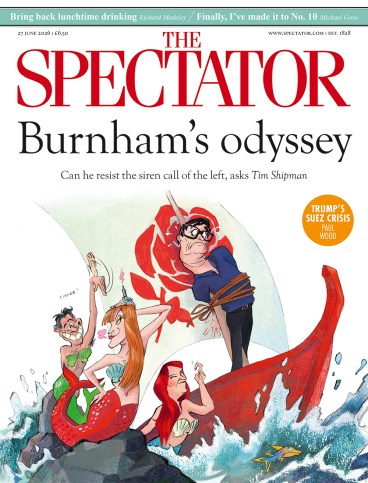
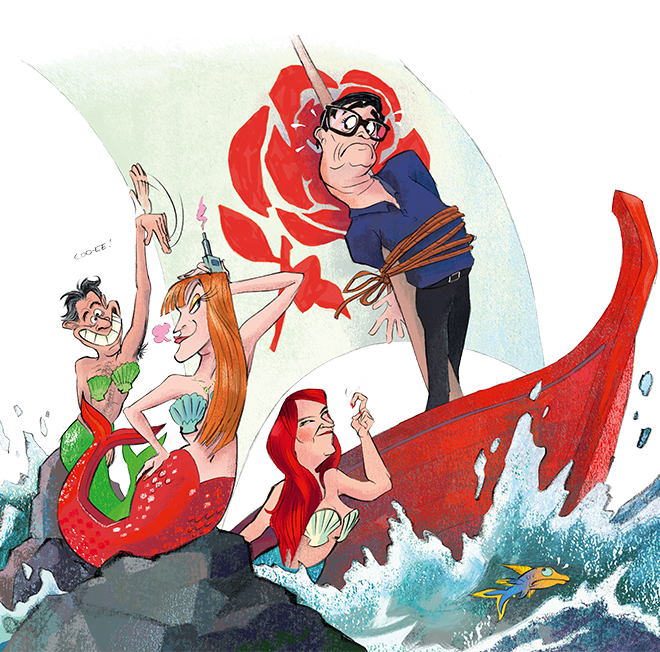
But the Conservative party will still be there. Who, then, in a first-past-the-post two-party system, will be the other party? Perhaps still Labour. But this Labour government faces an Everest of a fiscal debt, and is smiley Andy Burnham, all things to all men, the man to conquer it? Even if he were, his parliamentary party will never be his sherpas.
Britain sorely needs – and a two-party democracy absolutely needs – an intelligent, 21st-century, non-socialist party of the centre-left. I doubt Labour could ever be that party. Tony Blair made the attempt but the party lurched back into its confused soft-socialist comfort zone the moment he quit. Labour is all tangled up in its early 20th-century origins, its roots in organised labour and its deep, gnawing dislike of the capitalist system it has been fated to govern alongside.
Labour does not like the century it’s living in, and didn’t much like the last one. Ever since the second world war, it has squatted on the territory that could have been inhabited by a political force that married liberal economics with social justice. And there it remains, half a century beyond its sell-by date, simply getting in the way.
The accession to power of Burnham offers a last gasp to this dreary, class-obsessed incubus on the back of the modern force that Britain needs to face the centre-right across the Commons floor. I’ll always be on the Tory side, but I recognise that need, and Labour’s gut-incapacity to answer it.
Far, then, from moving to a multi-party politics, the death of Labour threatens to leave us with only one coherent ideological force, the Conservatives, and a vacuum where the second should be. Who could fill it? The inaptitude of our 72-strong Liberal Democrats to step up to this challenge is the quiet tragedy of the hour.
Oh – and next year’s thing to say? Crash and Burnham.

Comments