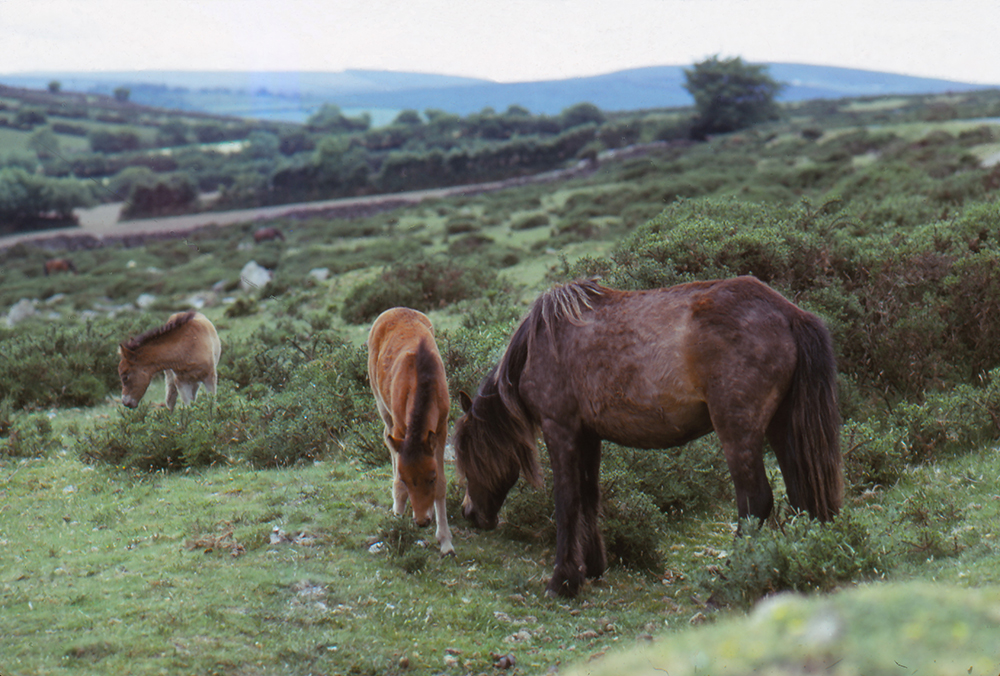

Try as I might, I cannot think of an animal welfare issue that is more misunderstood than the survival of Dartmoor ponies. Every maddening misconception about land management and every un-intended consequence of animal rights sentimentality is encapsulated in the sad reality of why the ponies will be culled in greater numbers than ever from this autumn, because the government has messed up the issue even more than usual.
The latest disaster to befall Dartmoor is the conflating of ponies with sheep and cattle by Natural England to produce a total number of grazing animals allowed on Dartmoor. Because sheep always sell for good money because people eat them, and ponies don’t (because people don’t and horse riding is sadly not the predominant pastime of this country anymore), farmers will choose to keep sheep and not ponies (yes, the ponies are owned) and the pony herds will be drastically reduced, to the horror of ramblers and nature buffs.
These ponies, the official emblem of Dartmoor, have been categorised as livestock no different to a cow
To read the gushing outrage, what animal lovers are asking is for farmers to keep herds of ponies on Dartmoor for no financial gain, so that visitors can look at them and say: ‘Ahh!’ Worse, Natural England is denying it has ‘ordered’ a cull, in a cowardly attempt to deflect from the reality of what will undoubtedly result from its arbitrary and ill-informed grazing limits.
The outpouring of grief that greeted the new policy last week was accompanied with myriad articles in which well-meaning journos cuddled ponies, which assumes the ponies enjoyed this more than a solution that might save their lives. The last time I attempted to spell out the problem, I had to run the gauntlet of the animal rights brigade for daring to allude to reality. Twelve years ago, I helped to herd and sort the ponies in what local farmers call ‘the drifts’. I rode a Dartmoor mare called Frolic and the builder boyfriend of my column rode a larger horse, and we galloped the misty moors like Heathcliff and Cathy, and he fell off his horse into a bog, most amusingly. We watched as the ponies were sorted in farmyards and we grasped misconception number one: Dartmoor ponies are semi-wild, not fully wild.
There are different herds of distinct bloodlines turned loose to roam, but owned by farmers who regularly bring them down off the moors and who know every single one of them by bloodline. The farmer we watched sorting his herd told us the lineage of every pony going through the crush, a corridor made by fencing so that herds can be sorted in single file.
He knew every pony, their parents and grandparents. It was an amazing experience. In that gloomy landscape, near to the looming shadow of Dartmoor prison, we got in a Defender with the redoubtable Charlotte Faulkner, who set up Friends of the Dartmoor Hill Pony. Clattering down bumpy tracks, we learned of contraceptive drives and attempts to place ponies in riding homes.
The ponies help with conservation of the moors by eating the invasive molinia grass. They have a place in the ecosystem. But the bottom line then, as now, is that there are not enough takers for the ones that need to come off the moors to meet the government’s grazing limits. The only way these plucky creatures might be preserved indefinitely is by putting a higher price on their heads.
Because of the way animals breed when turned loose, they were rounding up and culling 600 foals a year on Dartmoor before the charity got going in 2011. Five thousand ponies since then have been homed, which is wonderful.
Ms Faulkner, in tandem with those homing efforts she tirelessly pioneered, wanted to explore the philosophically pertinent idea of whether people might get their heads around the idea of some of those locally slaughtered moorland grazing animals – those being culled anyway, remember – becoming dinner table meat so their price would rise, encouraging farmers to continue keeping them. Well, you can imagine the reaction. If this was France, of course, there would be no problem with managing herds of ponies like deer. We’d rather incinerate horse-meat in Britain. Princess Anne once tried to explain what a bar to good welfare that was, and everyone denounced her.
So the long-term solution of how you graze ponies sustainably alongside sheep on moors continued to depend on charitable work to save some of the overflow by rehoming them for pets and riding.
Here we are more than ten years later and it’s Natural England under a Labour government which has put a target on a horse head, by reducing stocking density on Dartmoor by 50 to 89 per cent, based on a study not even done there, but in Cumbria I’m told, and categorising the ponies which are the official emblem of this beloved national park as livestock no different to a cow.
The herds, which total only 1,000 ponies, will have to be aggressively culled, and not for a decent price, since the ponies are heading for the dog food chain. So if anyone has made horse into meat, it’s this Labour government. (Since 2024 live export has been banned, mercifully, though I’m sure no Dartmoor farmers would have knowingly taken part in that.)
What we are left with is a microcosm of the general horse problem in Britain: over-breeding and lack of horse-riding homes adds up to disappearing markets.
The issue on Dartmoor is what do you do with a pony if you’re going to get hysterical about it being culled once the government has decreed it cannot be there? Ride it, would seem the obvious answer. I found the mare I rode to be an excellent trekking pony, nimble and sure-footed. But left-wing ideology has destroyed horse-riding. Cycling has pushed it out of the way on bridleways. Hunting is banned. Eventing, showing and carriage driving is increasingly targeted by extremists. Riding schools and trekking centres are closing everywhere, crippled by health and safety. Fewer people than ever know how to get on a horse, or know their way around one so they can keep it as a pet.
There might have been 101 uses for a Dartmoor hill pony, or at least five. The left will only allow one use: looking at it and going ‘Ahh!’ – before having it rounded up and quietly disposed of.
To home a pony, visit wildtowonderful.org.





Comments