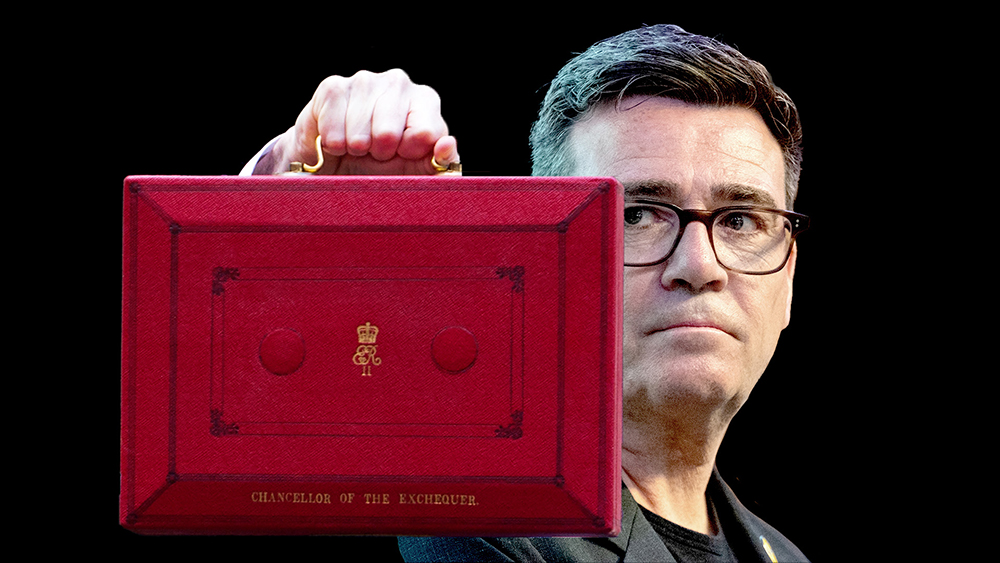


If I were Andy Burnham, I’d be terrified about the inheritance Keir Starmer has left. Yet instead of stepping gingerly towards Downing Street, he’s bounding along with glee. So delighted is he, in fact, that he seems not to have noticed that he’s walking into a trap.
The problem for Burnham is that the snare has been laid by his own supporters. ‘He was brilliant,’ an elderly Mancunian woman said in a documentary about the Greater Manchester mayor last week. ‘Ten out of ten – 12 out of ten if you want. [My son] had 18 things wrong with him and within a couple of days [Burnham got him] the top rate of PIP.’ Everywhere Andy goes and every time he bumps into a voter, his spending incontinence kicks in and a new promise is made. ‘It would be great if he could do something for working people. Like an increase in pensions,’ one voter told an ITV reporter.
Tot up the causes he has championed or spending requests he’s nodded at and you reach quite a bill: billions for council house building, billions more for social care, and a few hundred billion for renationalisations too.
Burnham is writing cheques Britain simply can’t cash. He has learnt nothing from the fatal mistakes Starmer and his team made when they entered office just two years ago. There was a confidence among the party’s new MPs that the task at hand was simple: remove the evil and sleazy Tories, and Britain would soon right itself. Burnham brings with him his own delusion: that Britain has been too neoliberal and suffers from too little interventionism. In short, a larger state has never been tried.
The reality awaiting him and his new chancellor is that we live in a poor country that believes it’s still rich, and that we’re governed by a large state we claim is too small – and which is already struggling to meet the costs of previous promises.
The average household contributes around £11,450 a year in income tax at present. On current projections that figure will rise above £14,000 by the start of the next decade – two and a half times what they spend on keeping warm and fed – while wages drift towards a third decade of stagnation.
This money can’t pay for the transformative change Burnham promises. Of that £11,450, roughly £4,400 disappears on welfare, pensions and debt interest before a single nurse has been hired, train run or pothole filled. So the frightening reality Burnham must confront is that, as gilt yields climb, the cost of borrowing becomes the cost of living. And with the tax burden already at post-war highs, there is little left to squeeze before growth is snuffed out. Britain’s spending has risen by five percentage points of GDP since 2019 while revenues have risen by less than two.
Don’t worry, Burnham’s team say, he gets it! Next week he’s due to give a speech in which he’ll guarantee growth, promise he’ll stick to the fiscal rules and pledge to get the debt falling. A Praetorian Guard of Lord O’Neill, the former Treasury minister and ex-Goldman Sachs banker, and the former Bank of England chief economist Andy Haldane will flank him in return for top jobs. While O’Neill and Haldane sit towards the sounder end of the scale, whackier voices are competing for Burnham’s attention too. And they’re drawing him towards lunacy.
Neal Lawson, a Gordon Brown bag-carrier who runs the centre-left pressure group Compass, has been a close Burnham ally since they first met playing for the Labour football team ‘Demon Eyes’. Lawson’s economic greatest hits include likening economic growth to cancer, describing the OBR as ‘anti-democratic and tyrannical’ and posing the question: ‘Do we need a fixation on growth at all?’
Then there’s Mathew Lawrence, who styles himself online after the guillotined French revolutionary Georges Danton and is involved with the Burnham-founded group Mainstream. In a paper published this week, he called for a larger state built around public ownership and state-backed competitors. His books Owning the Future and Planet on Fire go further. He calls for a re-imagining of the economy and ownership while warning ‘the transition will not be painless’. The state and workers should take over private firms because shareholder rights are ‘unjustifiable relics secured by power’. The only debate is where to draw the line between private property and ‘social control’.
Another brain behind Burnham, the New Statesman recently suggested, is the MP Miatta Fahnbulleh, former CEO of the left-wing New Economics Foundation and adviser to Ed Miliband and Angela Rayner. While running the NEF she campaigned for, among other things, wealth taxes, an even higher windfall tax on energy, and a cap on interest rates for all forms of consumer credit.
The Burnham campaign pushes back on how much influence the likes of Lawrence and Lawson have by pointing to ‘mainstream’ Haldane and O’Neill. But not everyone is convinced. ‘Jim and Andy are designed to reassure the markets,’ says one ex-Treasury official. ‘They’re serious people but they’re also long-term critics of [Rachel] Reeves’s fiscal rules.’
He brings with him his own delusion: that Britain suffers from too little interventionism
For that reason, some in Whitehall and the City suspect the rules may survive Burnham’s first Budget but will be quietly loosened later. One option under discussion is making greater use of public financial institutions, such as the National Wealth Fund, whose asset-holding balance sheets can make additional borrowing look more compatible with the fiscal rules. Yet this is no free lunch. Reeves tried a similar wheeze and gained little extra room for manoeuvre. And whatever accounting route is chosen, the government must still raise the initial investment upfront by issuing more gilts at a time when yields remain sky-high. ‘It’s going to make Liz Truss look like a fucking savant,’ predicts one Whitehall policy wonk.
With Labour having tried and failed to blame Tory incompetence and austerity for broken Britain, the Burnham gang offer up a new villain: privatisation. That is already doing damage. Look at Thames Water, where rumours of Burnham’s plans have sent corporate debt rocketing, potentially adding £625 million a year to household bills.
If water nationalisation isn’t going to be hard enough, housebuilders have been warned about a possible plan where, rather than ending up in No. 11, Miliband gets Housing and Local Government. There, Ed’s big policy will be using taxpayer cash to buy the troubled Vistry Group and turn it into a nationalised house-builder.
So, Burnham, even before his coronation, has boxed himself in. Unrealistic demands and unhinged hopes are propelling him towards power. But once he gets there, he’ll too quickly come unstuck from the realities of a near bankrupt Britain, starved of growth and doomed by astronomical spending demands on welfare, defence and debt. I can only wish him luck.



Comments