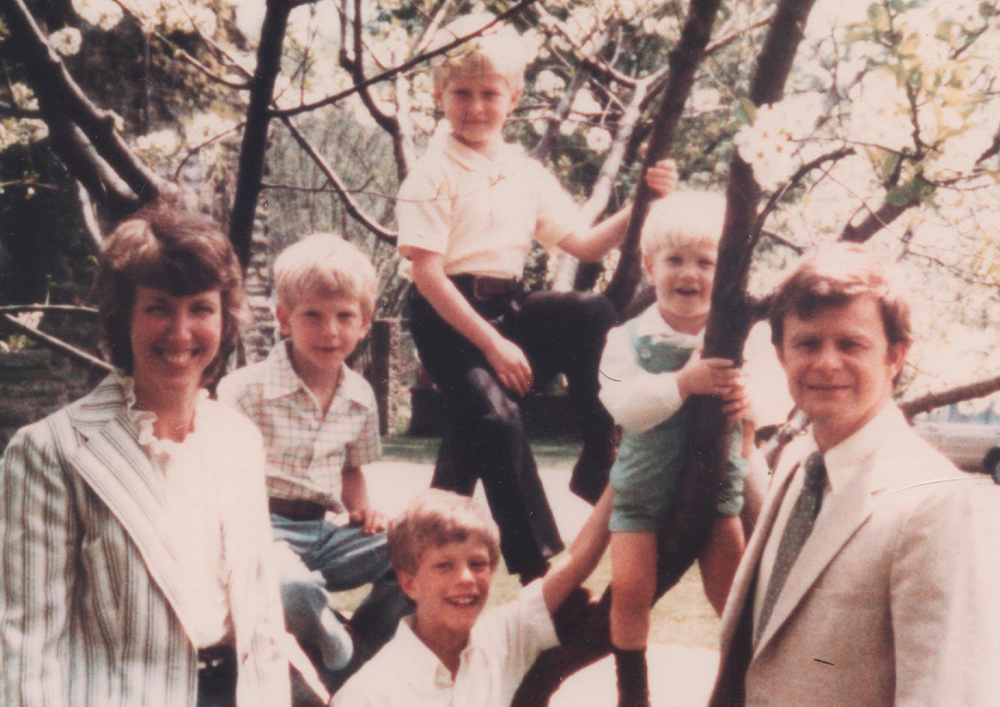
‘You can’t pick your parents, but they get to pick your life,’ Jonathan Tepper points out at the beginning of this extraordinary coming-of-age story. And: ‘If your parents are missionaries, it changes everything… They decide where you’ll live, when you’ll pack your bags and go, and you’ll get roped into their work saving the lost.’
In the 1980s and 1990s Jonathan’s parents, Elliott and Mary, were American missionaries in San Blas, then the poorest part of Madrid: ‘Our neighbourhood was the biggest drug supermarket not only in Spain but in all of Europe.’ At a time when Spain hadn’t started spending on prevention or rehabilitation, Jonathan, aged seven, along with his two older brothers – all of them blond and blue-eyed – saw junkies lying dead in ditches. They stepped over the syringes and handed the heroin addicts invitations to the mission centre. ‘What kind of life is this for your kids, exposing them to this? You will ruin their lives. They will never forgive you,’ Elliott’s mother warned.
But Elliott, a Harvard-educated convert from Judaism who could do 30 one-handed push-ups, had his own views on parenting. A strict disciplinarian, he insisted on silence and attention as he read to his sons from the Bible, C.S. Lewis, T.S. Eliot and St Augustine. And he followed through, spanking his sons with a paddle inscribed with biblical verses when they did not do exactly as they were told: ‘You’ll thank me… when you go to university and become great men.’
Though money was sometimes desperately short, books were ‘stacked randomly in piles on the carpet like stalagmites’. Mary, home-schooling the boys, announced: ‘My job is not to teach you. My job is to get you to love learning so you can teach yourselves.’ The brothers devoured encyclopaedias, National Geographic magazines and Roget’s Thesaurus. They were also growing up bilingual.
Meanwhile, Mary and Elliott (‘nothing stopped my father when he wanted something’) were establishing a groundbreaking drug rehabilitation centre in San Blas, ‘a rescue shop within a yard of hell’. A trickle of addicts – many of them thieves and murderers – began to find their way there. Some drifted back to drugs but others, tired of jail and terrified of overdose and death, listened to Elliott’s sermons and began, in their own ways, to pray: ‘Thank you, Lord, that while we were stealing from the slot machines last night you didn’t let the police catch us… Amen.’
Soon the trickle became a flood. Everyone at the centre had to work, usually repairing and restoring unwanted furniture – a metaphor for the addicts’ lives; and ten-year-old Jonathan was manning the phone, scheduling deliveries and sharing in their meals and games of football. In order to understand its appeal, he briefly considered trying heroin. But – unsurprisingly, after all he’d seen and heard – fear triumphed over curiosity. Instead, a reformed bank robber who had taken to heart Romans xii 2 – ‘Be ye transformed by the renewing of your mind’ – encouraged him to read Don Quixote and, later, Dante.
Then Aids arrived. Before long, Spain had the most cases in Europe – two thirds involving heroin addicts. And San Blas was the epicentre: ‘Almost every addict I had grown up with was HIV+.’ Jonathan was in despair, until he saw the extraordinary courage with which his friends faced imminent death: ‘We must make each day count…we have to live a life of quality instead of quantity.’
A reformed bank robber encouraged the young Jonathan to read Don Quixote and Dante
Tragedy struck again when Jonathan’s youngest brother, nine-year-old Timothy, was killed in a car crash. Beside themselves with grief, the parents and the three remaining sons ‘stood in a broken circle… We could not sleep and heard each other weeping in the dark’. Suddenly the family was as broken and as hurting as the people they were trying to help. Jonathan, then 15, was overwhelmed with survivor’s guilt: ‘The real and only reason I never killed myself was that I did not want my parents to lose another son.’
Those were terrible years. Soon most of Jonathan’s friends, including the bank robber, had died of Aids. But, despite everything, his grief-stricken parents continued their work. When Jonathan left for university in America, his mother told him: ‘You know our values… If you need me to tell you what to do now, I haven’t done a good job as a mother.’ After winning a Rhodes scholarship (thanks to his knowledge of Dante) he decided that the ‘complete, utter euphoria’ he experienced must be what shooting up felt like. He and his brothers all graduated on the same day from Oxford.
The rehabilitation programme his parents founded has now helped more than 100,000 addicts in 20 countries. And, Jonathan says, he has nothing to forgive. On the contrary: ‘Without my parents’ calling, I never would have grown up in San Blas and my life would be all the poorer.’




Comments