Spain has refused outright to support the United States and Israel’s military operation against Iran. The move has been applauded by Iran’s ambassador to Spain: ‘They have rejected the aggression and that is valuable to us.’ The Pentagon meanwhile has withdrawn aircraft deployed at its bases in Morón de la Frontera (Seville) and Rota (Cádiz).
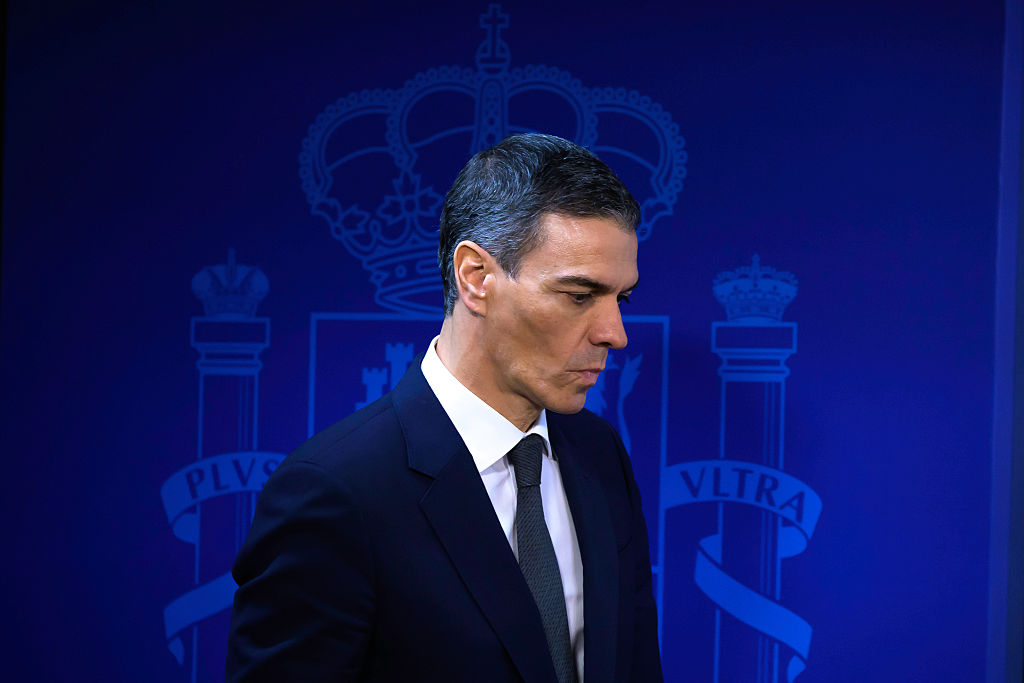
Pedro Sánchez, Spain’s socialist prime minister, rarely misses an opportunity to goad Trump
Justifying Spain’s refusal to cooperate, José Manuel Albares, the foreign minister, insisted that, ‘A logic of violence, as we are seeing, only leads to a spiral of violence, when unilateral military actions outside the United Nations Charter… have no clear objective. Europe must defend international law, de-escalation and negotiation,’
Pedro Sánchez, Spain’s socialist prime minister, rarely misses an opportunity to goad Trump. On first hearing of the US-Israeli offensive, he declared: ‘Our fears have been confirmed. The US and Israel have attacked Iran unilaterally, without consulting the international community… violating international law, causing hundreds of innocent victims and plunging an entire region into terror that will bring much more global instability… and risk taking us towards an even greater disaster.’
The Spanish government is confident that Trump has made a fatal mistake. El País, Spain’s centre-left newspaper of record, reports another member of the government as saying: ‘It seems that Trump is self-destructing. There have already been American casualties. We warned that the precedent set by the intervention in Venezuela was very dangerous. Well, now we have it. This will provoke greater animosity towards the West in the Arab world in the Middle East, with the risk of increased terrorism and instability.’
Meanwhile the government’s parliamentary allies even further to the left have labelled the US-Israeli offensive as another ‘imperialist attack’, yet another example of Trump’s bullying ‘might is right’ approach and have called for Spain to leave Nato which they describe as a ‘genocidal and evil instrument.’

But Alberto Núñez Feijóo, leader of the right-wing Partido Popular, Spain’s main opposition party, sees things differently: ‘The world is better when a tyrant falls. In Iran, for decades, the ayatollahs have maintained a regime of repression and constant threat. Millions of citizens have suffered persecution, imprisonment and death for defending basic freedoms… The fall of such a system is good news for freedom and democracy.’
For Feijóo human rights should be a ‘permanent’ criterion in Spain’s foreign policy: ‘Without exceptions, without tactical calculations and without self-serving silences.’ Lest his meaning was unclear he added that ‘those who have remained silent in the face of systematic repression in Iran are in no position to give lessons… Something is clearly wrong when Hamas, the Houthis and the Iranian regime applaud our government.’
Meanwhile Santiago Abascal, leader of Vox, Spain’s most right-wing party, has stated that if the ‘tyrannical’ regime of the ayatollahs falls, ‘the world will be freer,’ and has framed the conflict as ‘the battle of the free world against the darkness of the ayatollahs’. The present government, he says, is taking Spain closer to ‘anti-Western darkness’ with positions contrary to Western interests, receiving applause from Hamas and the Taliban.’ The government, he says, is seeking to ‘confront the United States while cosying up to China and Iran’. Spain, Abascal maintains, is now ‘in a delicate position’ on the international stage, but he expressed his confidence that that will change when Spain has a new government.
He may soon have his wish. It’s true that Sánchez’s anti-Trump stance plays well in Spain where, according to a YouGov poll, 81 per cent of Spaniards regard the American president unfavourably. But it also shows that 65 per cent regard Sánchez unfavourably. And since that poll, a plan to regularise over half a million illegal immigrants has seen the government’s popularity fall even further. In last month’s regional elections in Aragón – known as Spain’s Ohio because it serves as a bellwether for the national mood – the socialist vote collapsed. Vox meanwhile doubled its seats.
A general election is due by August 2027 at the latest. It looks very likely that the Partido Popular supported by Vox will then form the next government. If so, there will be, to put it mildly, a radical change in Spain’s foreign policy.





Comments