In the boiling August of 1919, a 27-piece African-American jazz outfit called the Southern Syncopated Orchestra was summoned to play at Buckingham Palace as part of a royal command concert. The orchestra was Britain’s first introduction to black music. Their hothouse syncopations and Mississippi washboard rhythms were a balm after the first world war, and they went down a storm on the concert circuit.
A decade or so later, in the swing era of the 1930s, the clarinettist Benny Goodman adapted jazz for white tastes, toning it down and cleaning it up – much as Elvis Presley would do for the postwar generation with black rock ’n’ roll. By the time Miles Davis arrived in the 1950s, jazz was an increasingly white enthusiasm. He became a fashion icon for blue-eyed Mods and white soul brothers of one kind or another. Even today style magazines exalt the photograph of him on the cover of his 1958 Milestones album. What louche insouciance of dress. (Yes, Miles was way past cool.)
We Were Here, Stephanie Phillips’s thoughtful survey of a century’s worth of black alternative music from the blues to hip-hop via jazz and black heavy metal, has its own agenda to push. Phillips is not the first to point out that western popular music would not exist without a black precedent, but she does so with verve and argues that black musicians and singers have been purposely ‘left out of the story’. The Rolling Stones (as Mick would be the first to admit) stole many a riff from the Louisiana swamp blues maestro Slim Harpo; the screaming ‘woos’ of the Beatles in their mop-top incarnation imitated the on-stage yelps of their hero Little Richard.
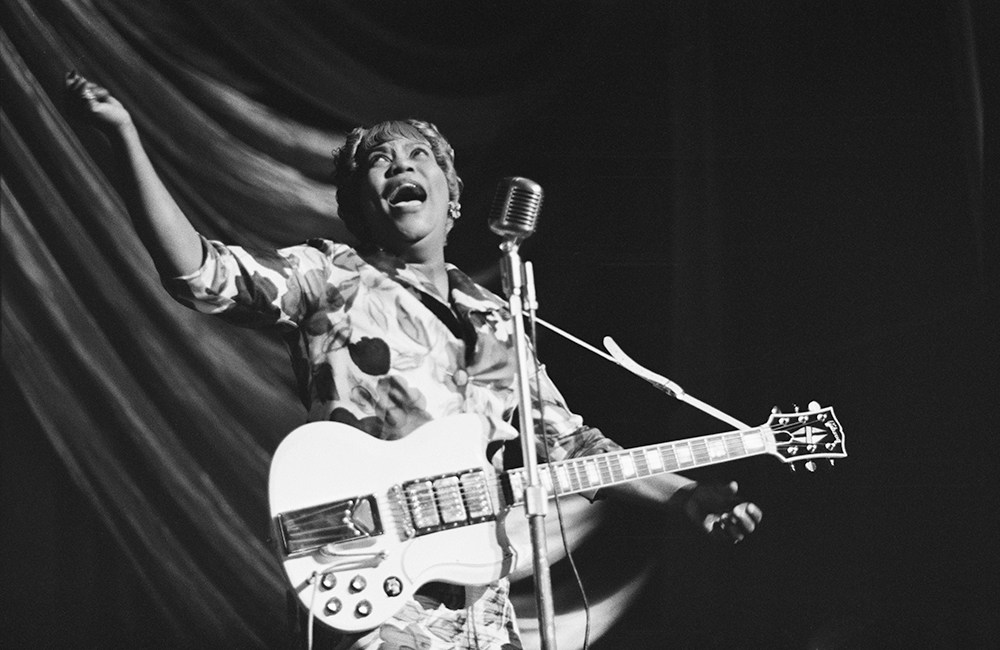
Phillips is the singer and guitarist for the British black punk band Big Joanie. From an early age she was drawn to ‘black weirdo’ (as she puts it) music figures. In a fascinating chapter, ‘Back to the Root’, she considers the life of rock ’n’ roll’s godmother Rosetta Tharpe, who may have been bisexual or queer. Her high-energy guitar rhythms and gospel delivery were channelled by Elvis in his early, hip-swivelling performances. Though Tharpe was omitted from standard music history for decades, she has now been rediscovered by a younger generation.
Los Angeles would have to wait until the 1980s for a uniquely black music: rap. Before rap there had been, briefly and gloriously in the early 1970s, the multiracial funk outfit Sly and the Family Stone, whose single ‘Don’t Call Me ***, Whitey’ used blunt racial slurs to counter prejudice. Phillips writes engagingly on Sly and is good, too, on the mixed-race LA band Love, whose astonishing 1967 album Forever Changes combined baroque folksiness with spooky allusions to blood transfusions and a sickness in the city.
The author has an eclectic taste in music and some of the black pop-punkers, grunge and new wave singers under her review were lost on me (the Bolokos – the only punk band in Guadeloupe?). However, many older readers will remember Poly Styrene of X-Ray Spex, whose rousing single ‘Oh Bondage! Up Yours!’ was a hit in the UK in 1977. Joan Armatrading and Prince, of course, need no introduction. We Were Here, a thoroughly enjoyable cultural history, captures the excitement and daring of a music that changed the world for good.
In Jamaica, music influences every aspect of life, from dress to speech and food. Old-school reggae, with its righteous pre-slave ship spirituality, offered hope of deliverance to ‘down-pressed’ Jamaicans and encouraged a generation of British-born black Caribbean citizens to embrace a part of their heritage – Africa – that their parents had often shunned. Dub reggae, in David Katz’s estimation ‘the most playful and confounding of reggae subgenres’, is a form of electronic music with a heavy bass underlay. The great dub albums of the 1970s – Keith Hudson’s Pick a Dub, Garvey’s Ghost by Burning Spear – have a hymnal, incantatory quality. They are mostly instrumental. Jamaican sound engineers, such as King Tubby and Lee ‘Scratch’ Perry, experimented at the mixing board by removing the vocals from existing tracks and emphasising the drum and bass component. They called it dub music.
Katz is an old Jamaica hand. His oral history of reggae, Solid Foundation, is one of the great music books. Dub Revolution, its sequel, relies heavily on interviews he conducted more than 30 years ago with dub and reggae practitioners in Jamaica and the UK. King Tubby was not among his interviewees as he was murdered by a lone gunman outside his home in Kingston in 1989. Having studied electronics at Kingston Technical College, King Tubby (real name Osbourne Ruddock) began his career by building voltage adapters and repairing televisions. With not much more than a soldering iron and pliers he went on to create abstract dub soundscapes dense with reverb, echo and delay.
Jamaican dancehall, an offshoot of reggae, is a digital, DJ-led music often called ‘ragga’. Much of it is generated from pre-set drum-machine rhythms and computerised keyboards. The British music journalist Derek A. Bardowell regards dancehall as a misunderstood genre. In Fire Inna Dancehall, he traces its origins to the sound-system culture of 1950s and 1960s Kingston, where DJs talked and scatted over records (‘toasting’, Jamaicans call it) while energising the dance floor. At neighbourhood dancehall jams, or ‘bashments’, a skilled DJ was required to chant in time with the beat and spin witty nursery-rhyme phrases and nonsense lyrics (‘Aba-shanti, boom-shaka-lacka. Skiddly-iddley. Biddy biddy bong’). Over its 40-odd years of existence, dancehall has developed a louche jargon, ‘dancehallese’, as vivid as any 18th-century thieves’ cant. Bardowell is disappointed by the homophobia expressed by dancehall singers such as Elephant Man and Beenie Man, but he exalts the vernacular patwa in which they sing as a salty language all its own.





Comments