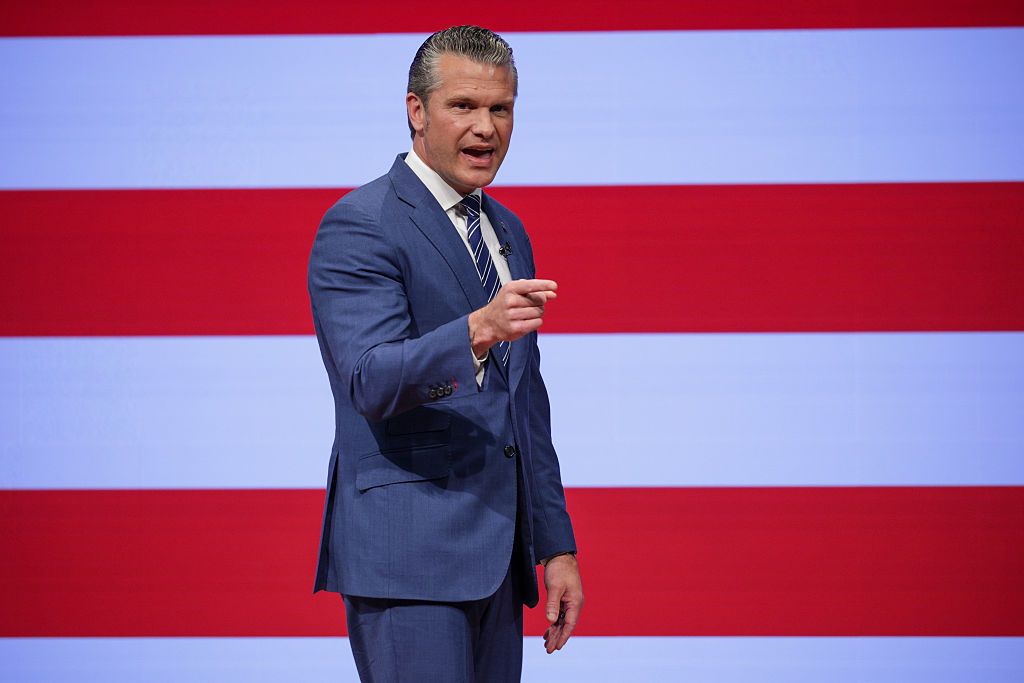
The recent US adventures in Venezuela and Iran have not, on the American side, wrought the same losses of life and limb as those of Vietnam or the Second World War. No field medics ferrying the dying and the dead. No trenchfooted cripples waiting for their commanders to find the difficult words for the difficult hour. Nobody in front of whom one might feel it inappropriate to begin a speech with: “Warriors, good afternoon.”
Hegseth reached for an epic register only to be let down by his B-movie rhythm and hiccupy delivery
Or, as Pete Hegseth, the self-styled Secretary of War, put it last month: “We are no longer the ‘Woke Department’ or the ‘Weak Department.’ Simple translation of that: No fatties. No trannies. No beardos. No weirdos. No wimps. No radicals. Just warriors. […] The patriotic cowboys are in – with testosterone testing on top.”
There’s a note of paintball instructor machismo here. Hegseth speech, his inaugural “State of the Force Address,” reached for an epic register only to be let down by his B-movie rhythm and hiccupy delivery.
The words are all too heavy for the sentences: there are fifteen instances of “warrior,” half a dozen of “lethal” or “lethality,” and another half-dozen “warfighters.” It’s all very high octane. It’s all very “action stations.” It all desperately wants to deploy that very manly phrase: “boots on the ground.” But of course, there are no “boots on the ground” in Iran. It’s the absence of “boots on the ground,” and all that might cost, that lets Hegseth get away with expressions such as “patriotic cowboys.”
Why does Hegseth talk like that? As Trump’s second term approaches its halfway point, we might begin putting together a picture of its house style; what are its cliches, its tics and tells

One of the more unpleasant motifs is a strange, sneering insistence that the enemy camp are driven by resentment of their betters. All opposition is pathological. Social rejects, “trannies” “weirdos” and “wimps,” taking revenge on the prom kings and queens – the “normal” people, as Stephen Miller defines them.
“It’s not a coincidence that when you look at these violent Antifa demonstrations … not one looks like a normal person,” declared Miller in his remarks on The Opening of the Ministerial on the Resurgence of Political Terrorism. “Not one looks normal. … Why is there not one normal-looking person among them? … You know what normal is. You know what beautiful is. You know what good is. You know that families are right… You know that the criminal and the junkie and the predator is a threat to normal, healthy living. This is so much deeper than issues about taxation and regulation… It’s about normal, healthy, ordered living. And the violent leftist, for these deep-seated reasons, covets people who are morally superior… who are happy and ordered and peaceful.”
Note the turn after the fifth “normal.” Suddenly, we are in the lofty, Platonic register of “the beautiful and the good” – and what is Miller’s idea of the Beautiful and the Good? “Normal, healthy, ordered living.” As is often the case in the language of the Late Trump Era, there’s a gap between the grandiosity of the rhetoric and the banality of the politics to which it is attached – here, a family values conservatism with which Trump himself has never had much to do.
I am not as convinced as Miller that the Beautiful and the “normal” have all that much to do with one another. I hear Miller’s rousing praise of suburban living and somehow fail to see the Beautiful with a capital B. What I see, somewhere between the third and forth “normals”, is fat people. Herds and herds of fat people, crawling backwards and forwards over the face of the earth in enormous cars, lining up to ask if I’ve watched Succession and what I thought of the Superbowl Halftime Show. And what I feel is not jealousy but a crushing sense of boredom.
Toward the end of his State of the Force address, Hegseth strikes a similar pose: “The Ivy League faculty lounges, they’ll never understand you… the media will mischaracterize you, and that’s okay … They envy you because you do real things.” The same speech begins with Hegseth joking that “hyperventilating media” showed up to last year’s address worried he was about to make them do an impromptu PT test. The press takes a bit of a beating from the Trump cabinet. Asked for comment on allegations of corruption against the US Ambassador to Greece at a recent press conference, Rubio snaps back: “I’m not playing this game with you, okay? … I’m sorry to tell you that. … That’s not the way the process is going to work.”
If there’s an overarching note in all this it’s of Trump’s inimitable style imitated poorly – a prickly condescension toward the media, the happy bravado, the showy lack of decorum towards one’s opponents. These are all things that Trump can get away with but others can’t. A good portion of today’s prominent Republican politicians – Hegseth, Rubio, Cruz, Vance – were vocal, sometimes histrionic, critics of Trump back in 2016, and perhaps their aping of the Trumpian manner is their way of showing they’ve had a real change of heart. But it doesn’t feel the same in their voices.
“Ancient Greece, the birthplace of – and you know what this is – democracy. Right? The birthplace of democracy and of, really, western civilization.” That was Trump in 2018, on Greek Independence Day.
Reading the transcript of Marco Rubio’s recent address in front of the Acropolis, it’s hard not to feel that something of the original has been lost.“Today, we find ourselves at a crossroads,” he said. “The course we take will determine whether the West maintains its place at the head of the world or resigns itself to a future of atrophy and servitude and decline.”
The Secretary of State is just too polished, too professional to channel his boss. The pomp and posture just haven’t been earned. It’s all a few sizes too large – it comes off as bullying and fake and stupid.


Comments