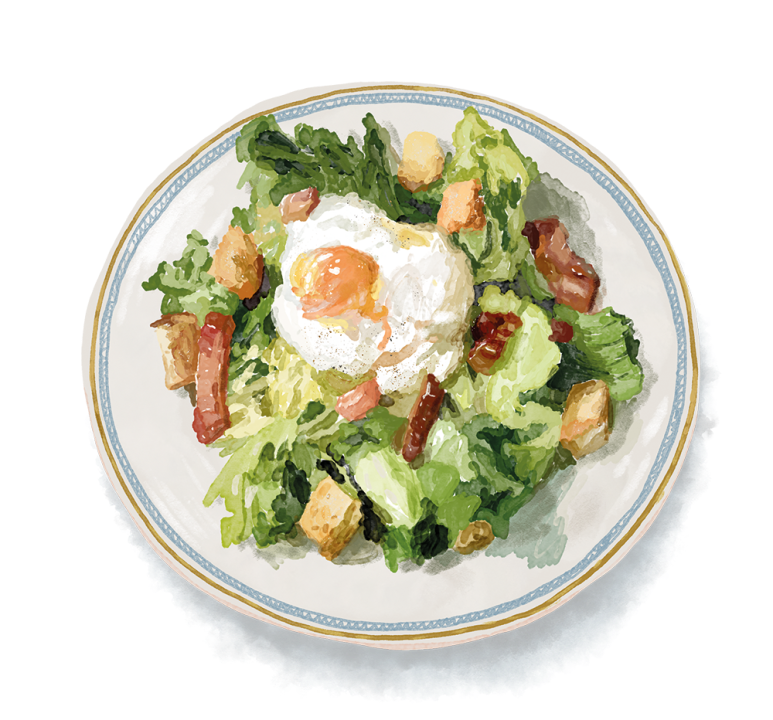

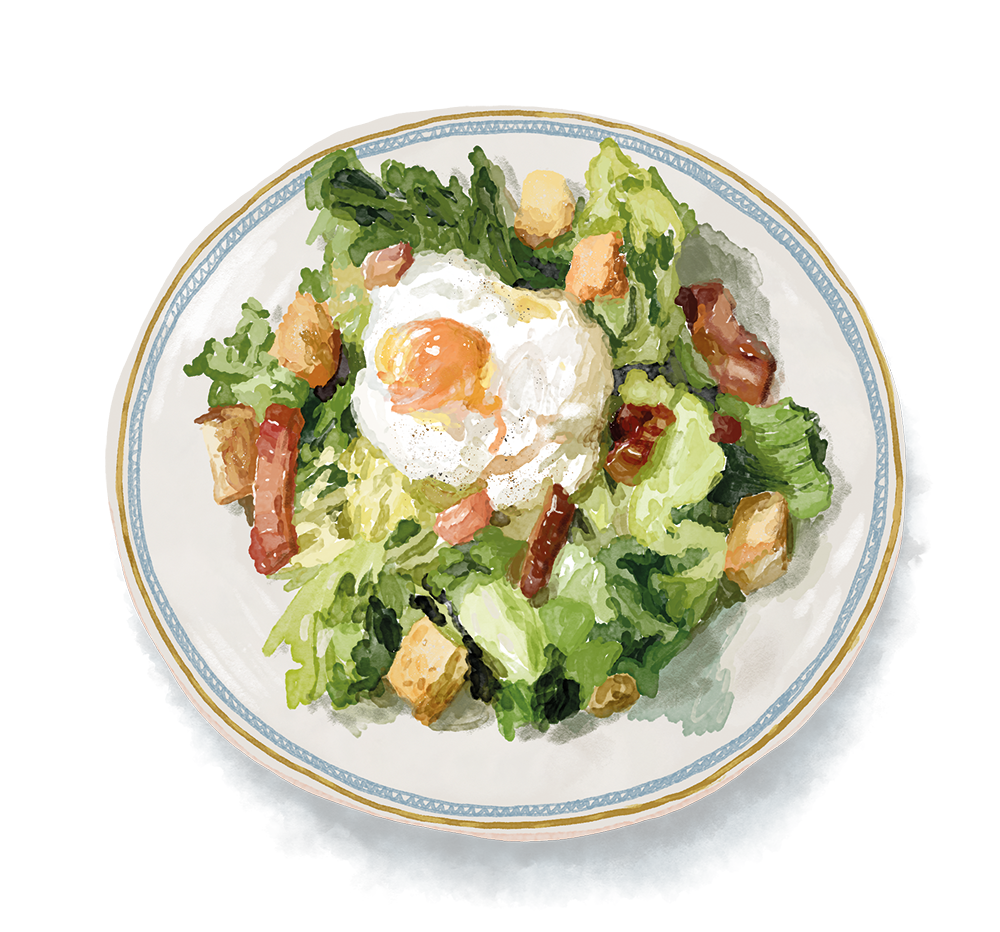
Salade Lyonnaise is often translated as ‘bacon and egg salad’ and I can’t stand it. Not because it’s inaccurate – beyond the salad leaves and the dressing, the only other non-negotiable elements of the dish are, indeed, bacon and eggs. But it feels like it misses the point. To the English ear, bacon and egg salad sounds like a lacklustre version of a full English – two items chucked into a bowl of leaves because we’re trying to cut carbs. It also – and I am aware this is just me – makes me picture the egg scrambled, and the thought of scrambled egg in a salad is horrible. ‘Bacon and egg salad’ doesn’t do the elegant, balanced and punchy salade Lyonnaise justice.
The salad comes from Lyon of course, a city renowned for its excellent food, often called the gastronomic capital of France. It is filled with bouchons, rustic bistros that serve traditional Lyonnaise fare and have fed the local and travelling silkworkers since the 17th century. These were often run by les mères Lyonnaises, a group of female chefs who began opening their own restaurants in the 19th and 20th centuries, and shaped the food of the region. The dishes tend to be simple and hearty and use local ingredients, including cured pork. Today, this salad is found all over France, and is emblematic of straightforward French cookery, relying on the good treatment of good ingredients.
Frisée lettuce with lardons, a poached egg, croutons and a mustard vinaigrette
A little about the constituent parts. A salade Lyonnaise combines frisée lettuce with lardons, a poached egg, croutons and a mustard vinaigrette. Unlike the other elements, croutons are not technically an essential part of the salad, but they’re a regular guest star and, for my money, bring much needed texture and crunch. The quality of the lardons is important, not just because their flavour is dominant but because their fat is the base of the mustard vinaigrette, so do use the best that you can find, chunky and solid, with a good layer of creamy white fat. They’ll taste better and, cooked slowly, will release the pool of rendered fat that you need for the dressing. Otherwise you’ll just end up with salty bacon water to whisk your vinegar into, and nobody wants that.
You can stagger the poaching of the eggs. Simmer the water gently, and crack them one by one into a cup or ramekin, lowering each egg into the water in turn. Using fresh eggs makes this a lot easier, because the white of the egg hasn’t lost its moisture and is jellyish – this means it won’t go all wispy when it hits the water. But remember: professional chefs just snip off any unattractive bits of cooked white before serving – easy!
Frisée – or curled endive – is, as the name suggests, frizzy, frilly, and ranges in colour from a deep, vibrant grass-green to a washed-out yellow, because the sun only reaches the outer leaves as it grows. Besides its voluminous texture, it has a distinctive flavour, slightly bitter and earthy. It is perfectly suited to a salade Lyonnaise, where it can figuratively hold its own against the saltiness of the lardons and the richness of the egg, and literally hold its own against the weight of the warm mustardy dressing.
It can be hard to track down in the UK if you don’t have a good greengrocer local to you. But it’s the base and bulk of the salad, and using lettuce or baby spinach is going to give you a different (soggier) end result. It is, however, widely available in those bistro bags of salad you can get from the supermarket. You could pick out the curly bits, for authenticity, but that would seem to be a step too far.
The dressing itself is simple but effective and very French: Dijon mustard, red wine vinegar and tiny minced shallots are added directly to the pan in which you have rendered the lardons, and quickly whisked into the fat, which will emulsify into a smooth, opaque vinaigrette that is used to dress the leaves while still warm. A few years ago I bought a small spiral whisk for just this kind of job, and immediately berated myself for adding yet another item to my kitchen. It turned out to be one of the best bits of kit I own. And once you’ve made a warm dressing in the pan, you’ll never look back.
Serves: 2
Hands-on time: 10 minutes
Cooking time: 10 minutes
- 1 medium shallot, minced
- 1 tbsp red wine vinegar
- 1 tbsp Dijon mustard
- 2 tbsp olive oil
- 120g thick white bread, staled
- 200g lardons
- 150g frisée, or other bistro greens
- 2 eggs
- Before you make the rest of the dish, mix the minced shallot into the red wine vinegar.
- Slice the bread into chunky cubes. Heat the olive oil in a large pan over a medium heat, then add the bread cubes. Cook, turning often, until the bread is golden on all sides. Remove from the pan and set to one side.
- Put the lardons in a large, cool pan over a low heat, and allow to render slowly. They are ready when they have turned golden, much of the fat has melted out, and the lardons are soft and squidgy. Lift them out with a slotted spoon, set to one side, and leave the fat in the pan.
- Wash and dry the salad greens, then tear the leaves into a large bowl.
- Whisk the mustard into the warm lardon fat, then do the same with the vinegar and shallots.
- Bring a pan of water to a gentle boil. Crack one egg into a cup. Swirl the water with a whisk to create a vortex in the centre of the pan. Gently drop the egg in – the vortex will cause the white to wrap around it as it cooks. Crack the other egg and drop it in too. Cook the eggs together for three minutes until the white is set, then lift them from the water and drain on a piece of kitchen paper.
- Coat the salad leaves in the dressing, then fold through the lardons and croutons. Divide the salad into two plates for serving, piling it high. Place a poached egg on each heap of salad, and serve immediately.
Join Olivia Potts for Truffles and Trattoria in Rome on 2-6 December 2026. For more details about this Spectator Club trip, go to spectator.com/tastings.






Comments