

Once upon a time, the export crop of Martha’s Vineyard and Nantucket was whale oil. Nowadays it is money, harpooned by visiting campaigns from deep-pocketed donors at anchor in their summer seaside retreats. In the peak season of July and August, the islands’ social rhythms are dictated by money-harvesting events, wrangled by local hosts jostling for the social éclat that comes from securing a high-profile honoree.
By late August this year, the territory had already been worked over by a series of hopeful visitors with hands outstretched, such as the rising Texas Senate hopeful James Talarico, Hakeem Jeffries in eager pursuit of the House Speakership that is almost in his grasp, Maryland Governor Wes Moore and others questing the donor dollar. Finally, at the end of August, there appeared Jon Ossoff, the boy Senator from Georgia and the latest great white hope of the Democratic party. With tickets at a minimum $1,000 a head, he was a huge hit.
“I hope he runs in ’28,” a politically savvy dowager commented to me enthusiastically the next day. “I’ll definitely vote for him!” She had been particularly struck by an “equivocal” answer he had given to a question on Israel and Gaza. “It was deft,” she said admiringly, “and that’s why I think he’d be a great candidate in 2028.”
Like Obama, Ossoff is young, relatively unknown, good-looking and eloquent as a public speaker
“He’s definitely being propped up right now by the Democrats as their ideal candidate,” a Republican political operative told me after a gloomy rumination on his party’s dimming midterm prospects. “This happens once a cycle. There’s always one candidate that the Democrats try to put a really big shiny polish on and who doesn’t usually live up to expectations.”
This called to mind other political meteors who have flared across the media skyscape and then faded, such as Beto O’Rourke, once the great white hope for a blue Texas, subject of a famously fawning Vanity Fair profile, exponent of liberal values – gun control, climate change, single-payer healthcare; or Pete Buttigieg, articulate and ambitious, proudly gay, studiously centrist and prized for his presumed ability to mobilize young voters. “Mayor Petebot,” as many call him, still ranks second in polls of potential 2028 Democratic nominees that accord the lead to Kamala Harris and should therefore be deemed worthless.
Today, we have fresher faces, such as the indecisive Alexandria Ocasio-Cortez, or Pennsylvania’s Josh Shapiro. Even Virginia Governor Abigail Spanberger has been putting out the word to local politicos that she is going to run once her undistinguished term in Richmond ends. Of course, the greatest example of a Democratic “ideal candidate” was Barack Obama – and, like Obama, 39-year-old Ossoff is young, relatively unknown, good-looking and eloquent as a public speaker. Most importantly, he shares the crucial attribute of being lucky. Obama, it should be recalled, ascended to the US Senate thanks in large part to the serial implosion of his Republican opposition candidates (notably one who allegedly has a yen to have his wife perform sex in public) and thence to the White House once the September 2008 Wall Street crash finally sank the chances of John McCain, another deeply flawed candidate who had nonetheless been level-pegging him in the polls.
Ossoff’s career has similarly benefited from fortune’s smile, starting with his first campaign, an April 2017 special election for Georgia’s 6th district congressional seat. It was an early opportunity for Democrats to vent their rage and disgust at Donald Trump’s presidency. Thanks to endorsements from national figures such as civil-rights icon John Lewis and Bernie Sanders, Ossoff scored well in the first round. Despite voters’ recent rejection of traditional “moderate” policies disastrously touted by Hillary Clinton, Ossoff ran a cautiously centrist campaign, telling the New York Times he would not support raising income taxes, even for the wealthy, and would oppose “any move” toward a single-payer healthcare system.
Otherwise, he did his best with a thin résumé to claim national security expertise and was easily beaten by Republican Karen Handel in the runoff. But at $55 million it had been the most expensive congressional race in history. Ossoff himself raised$23 million, a record for a House candidate. It left him with the inestimable benefit of a national mailing list and the affectionate esteem of party leaders gratified by his fundraising prowess. So when he ran for Senate against Republican David Perdue in 2020, he raised $153 million, making him the best-funded Senate candidate in history.
Outpolled by Perdue in the November election, he edged ahead in the runoff held on January 5, 2021, in the midst of Trump’s flailing attempts to reverse the presidential election result – another case of fortuitous intervention by outside events.
In his current Senate reelection campaign he is again lucky in his opponent, Mike Collins, a Trump-endorsed Representative encumbered by staff picks that include one convicted criminal and another with a taste for swastikas and Klan garb. A year ago, Ossoff was rated among “the most vulnerable” Democratic Senate contenders. As of July this year, he had north of $40 million cash on hand, having already raised almost $78 million.
Collins is “not super impressive,” my Republican source conceded. “It doesn’t seem to me that there’ll be much money thrown against [Ossoff]. So it’s a wave year for Democrats and he’s going to easily ride that wave.” All of which boosts talk of 2028. Discounting the absurd (even she seems to think so) notion of a Harris rerun, the press is salivating at the prospect of a Gavin Newsom campaign. This seems an increasingly unlikely prospect as Newsom himself has been signaling his lack of interest in running by taking steps to alienate Democrats, such as by his opposition to the proposed California wealth tax and by helping torpedo the effort to stop the Ellisons’ takeover of Warner Brothers. He may indeed have strong personal reasons for avoiding a presidential race, since he and wife Jennifer Siebel Newsom are under a serious DoJ investigation in connection with the finances of the nonprofits she managed. (Newsom believes the investigation is politically motivated and says they have nothing to hide; he has said federal employees have been speaking to his friends, family and former employees “not because they found a crime, because they’re simply trying to find one.”)
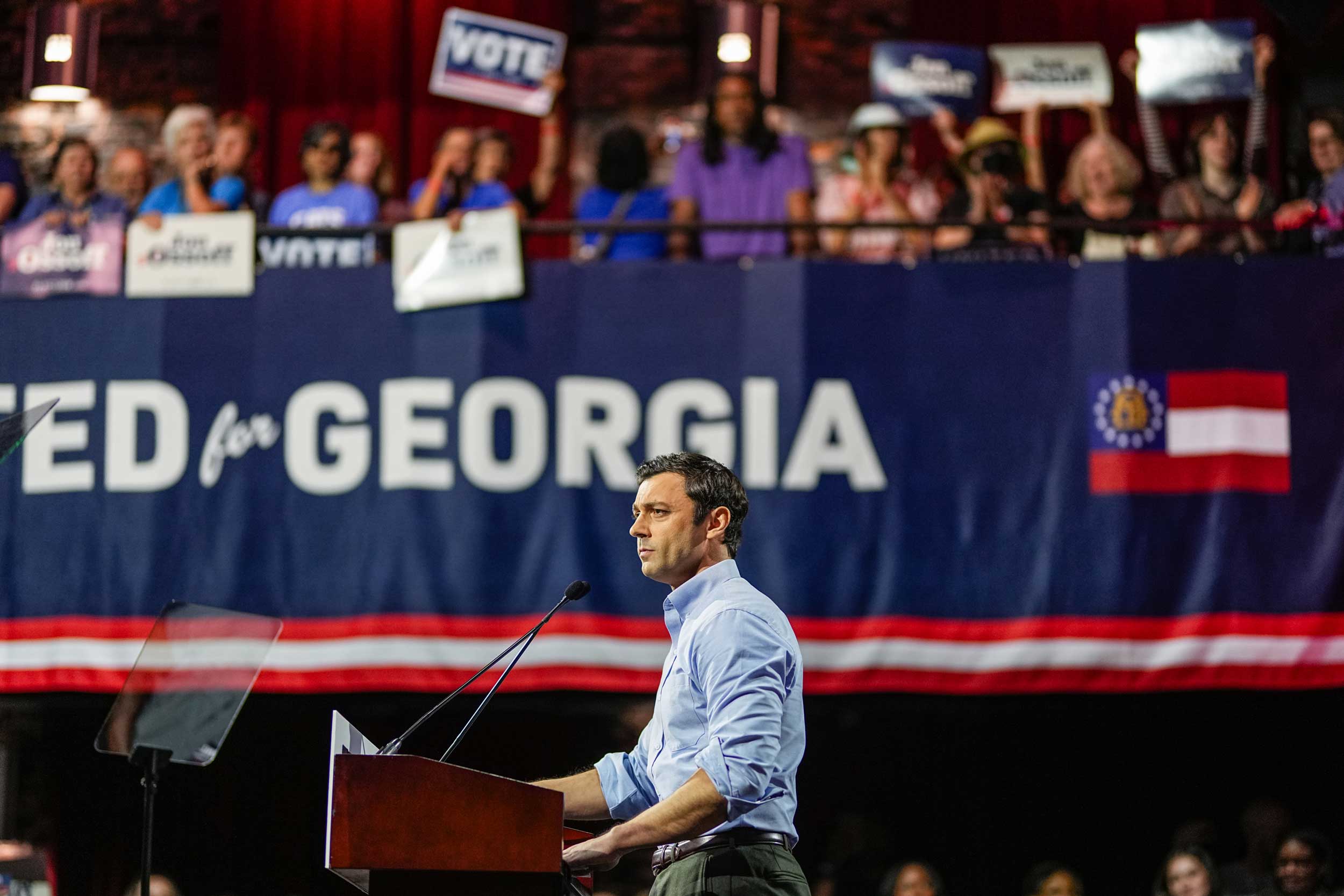
Ossoff’s background is international and progressive enough to give him kudos among the tastemakers of the post-Obama Democratic party. The son of a successful publisher father and an Australian management consultant mother, he grew up in Atlanta and interned for John Lewis while in high school. He graduated from Georgetown in 2009 before completing an MA at the London School of Economics. Before politics, when he was still in London, he used money inherited from his grandfather to help establish Insight TWI: The World Investigates, a TV company that produced BBC documentaries about war crimes and corruption.
His legislative record is best described as “modest” – having contributed to legislation aimed at prison reform, capping insulin prices for elderly diabetics and Biden’s infrastructure projects. He has nonetheless garnered plaudits as a probing inquisitor for plying administration witnesses in hearings with simple “gotcha” questions: “Who won the 2020 election?”
As a Jewish senator, Georgia’s first, he has had a slightly tougher time than most navigating the moral reefs and shoals of US-Israel policy. Earlier in his career he saw less need for equivocation. “Democratic pro-Israel clone fails to take Georgia seat” headlined the pro-Palestinian Electronic Intifada newsletter after his 2017 loss.
Any worries about Jewish support, or potent Republican opposition, seem far behind him now
Events in Gaza have definitely called for more deftness. In November 2024, Ossoff voted for a Sanders resolution blocking certain categories of aid to Israel, a vote in which he was joined by his politically impregnable fellow Georgia Senator, Raphael Warnock. The pair were vehemently denounced by local and national Jewish organizations, some of which pledged to support the Nazi-affiliated Collins. In July last year, Sanders introduced two more resolutions in the Senate. One sought to ban a proposed sale of 20,000 rifles to the Israeli police. Ossoff voted for it, issuing a statement replete with moral outrage at the “extreme mass deprivation in Gaza” and the “intolerable starvation of children” consequent on the policies of Prime Minister Benjamin Netanyahu’s government. Sanders’s second resolution banned a proposed $675 million sale of thousands of bombs and missile-guidance kits to Israel. Ossoff voted against that one, explaining in his statement: “I believe the United States must continue to support the Israeli people… Israel’s capacity to strike those who would launch missiles and rockets at Israeli civilians depends upon the deterrence provided by the Israeli Air Force.”
Any worries about Jewish support, or potent Republican opposition, seem far behind him now. Flush with money, a steady eight-point poll lead, an admiring national press, as Republicans seriously contemplate pulling their money out of the race: he is definitely riding a wave.
His campaign speeches and ads make it clear that he has opted for a very obvious theme, though it is one that politicians and the commentariat have long skirted as indecorous. Thus NPR commentator Mara Liasson has professed herself “shocked” to learn that, according to polls, 89 percent of Americans cite corruption as a major problem and two thirds of them believe that a corrupt system is rigged in favor of the rich and powerful. Ossoff appears to understand this ubiquitous sentiment very well, and relays it back to his audience, eloquently tying the evident corruption of “the crook president and his crook family” to the miseries of everyday life. “The Mar-a-Lago mafia really has taken American corruption to spectacular new heights,” he tells applauding crowds. “Cancer patients lose insurance while the rich get another tax cut… This corruption is why nothing works for ordinary people.” And Ossoff’s quip that the President would rather “travel with Natalie [Harp] than do his job” prompted an avalanche of commentary and social-media excitement – about both the nature of the President’s relationship with his aide and the ability of Ossoff to “call out” the sordid nature of Trumpism.
Democrats across the board have woken up to corruption as a core issue although, true to form, the consultants have been advising candidates to avoid talking about Trumpian crookery and to stick to denouncing generic corruption and the need to “clean up Washington,” lest they antagonize Trump-friendly voters. Hence, it seems the majority of Democratic TV ads avoid mentioning Trump-as-grifter at all. Ossoff himself gives deference to this theme: “Even before he came on the scene, American politics was coin-operated… it’s been running on corporate money, secret money, billionaire money – both sides,” he says. But his aggressive posture, bereft of challenging demands such as Medicare for All and modulated by his light southern drawl, is surely more politically remunerative, especially on Martha’s Vineyard. Politics has long been coin-operated, after all.





Comments