
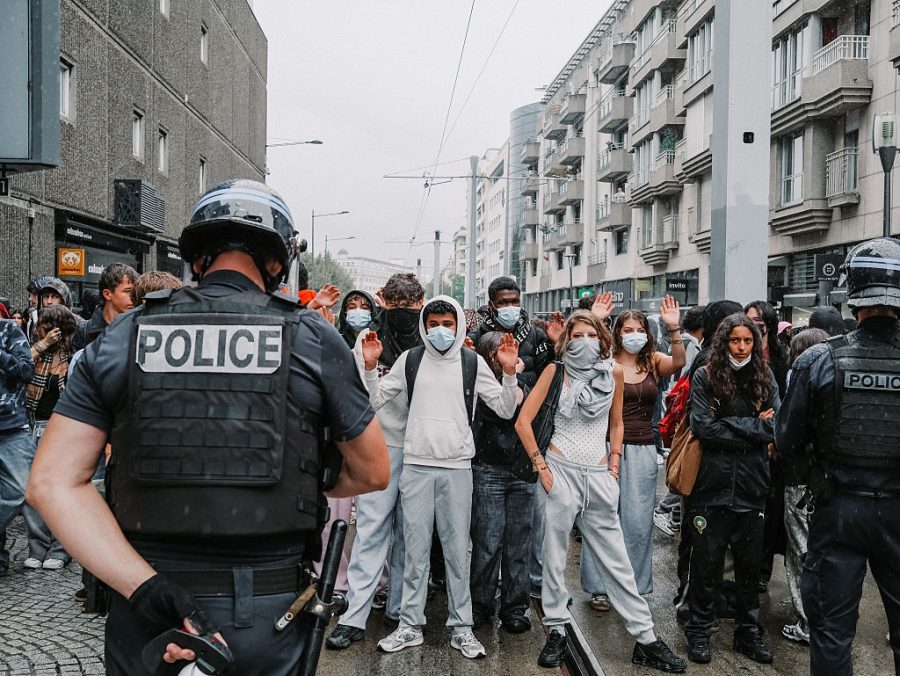
The government of France held a crisis meeting yesterday afternoon as a school protest movement intensified in violence. On Wednesday, 625 people were arrested and 83 gendarmes and police officers were injured as youths protested outside hundreds of schools nationwide. Yesterday, a school in Nantes was severely damaged after being firebombed and a fire engine was destroyed in Marseille. In the city of Reims there were fierce clashes between protestors and police, and only the use of tear gas dispersed the demonstrators. In some cities, such as Rennes, it was reported that university students were protesting alongside the high school pupils.
The government claimed yesterday that the movement has been hijacked ‘by LFI and its far-left proxies’. LFI – La France insoumise – is the party led by Jean-Luc Melenchon. One of its prominent members, Bally Bagayoko, the mayor of Saint-Denis in northern Paris, declared at a protest on Tuesday that ‘violence, at a certain point, can be legitimate’. A complaint has been lodged with the public prosecutor’s office accusing him of ‘incitement to commit an offence’.
The protest movement began in the middle of September in a school in Créteil, south-east of Paris. Students and staff were angry about the lack of resources for the new school year, particularly the shortage of teachers.
The fear among the Paris elite is that the school protest movement may be contagious
Pupils demonstrated peacefully outside the school and uploaded videos of their protest on social media. It quickly went viral and inspired many of the other 3,700 French high schools to stage their own protest. ‘It’s taken on a staggering scale,’ said one of the pupils who launched the movement in Créteil:
It gives me a sense of satisfaction, but not necessarily in every way, because I can see that in some schools, they’re just having fun causing damage, setting fire to bins, and so on. That’s not the point.

My wife teaches in a state school in Burgundy and her pupils have joined the protest. So far it has been peaceful and many of the teachers sympathise with the youngsters. The school is short supply of teachers and support staff.
When she went to school yesterday, two police cars were parked outside the entrance. More are expected today after reports circulated on social media warning that a mob of outsiders would attack the school.
The teaching sector is demoralised in France, and has been for a number of years. Teachers are under-resourced and overworked, and the environment has become ever more stressful since two of their colleagues were murdered by Islamists in 2020 and 2023.
At the start of this school year it was reported that 69 per cent of secondary schools were understaffed. But this has been the case in much of France for years, prompting questions to be asked in the Senate as long ago as 2018.
Nothing has been done and Emmanuel Macron is to blame for this inertia. How can one expect vision, clarity and strong leadership when he has appointed seven different education ministers in the last four and a half years?
The fear among the Paris elite is that the school protest movement may be contagious. Every French politician knows that the protests of May 1968 began at Nanterre university over the seemingly innocuous issue of access rights to the women’s dormitory. Within a fortnight ten million workers had joined the uprising.
In recent weeks, police officers, firemen, fishermen and administrative civil servants have demonstrated on the streets because of their deteriorating working conditions. There is deepening anger across the country at the rising energy bills and the cost of filling one’s car with diesel or petrol. Inflation reached 3 per cent year-on-year in September, its highest level since early 2024.
The French are reaching the end of their tether. A poll this week reported that 82 per cent of the country judge Macron to be a poor president. It’s his arrogant detachment that particularly grates. In a speech in August, he scolded the French for their pessimism. Buck up, he said, ordering them not ‘give in to this creeping spirit of defeatism’.
For most French, Macron’s final day in office can’t come soon enough. As Le Monde put it this week in a blistering analysis of his presidency: ‘After ten years in power, Macron’s movement, which emerged as an attractive mirage…has turned into a fiasco.’
Macron has also turned France into a fiasco, a country where even the kids are out of control.






Comments