Peter Hoskin

Laws gives another signal on 50p

Usually, the task of David Laws Watch is to judge just how close the former minister is to a return to government. But, today, his article for the FT is worth highlighting for a different reason altogether. Referencing George Osborne's signals on the 50p rate in the Budget speech, Laws has this to say (my emphasis): "The chancellor also signalled that excessive marginal rates of income tax – of 50 per cent, even 60 per cent – are on their way out. The Treasury believes that the majority of expected revenue from the current top rate is lost in avoidance. But the government is rightly cautious about the timing of the removal of these high rates: this cannot be our highest priority when those on low incomes are facing a real squeeze.

The big question: has Osborne done enough to deal with inflation?

"We understand how difficult it is for so many people across our country right now." If you weren't sure which direction George Osborne's Budget was going to head in, then he clarified it right from the start of his speech. This was one to tackle the rising cost of living. And much of it — such as the raise in the personal allowance and the fuel duty cut — was welcome. But there is a nagging question hovering above Osborne's announcement today: has he done enough? The Chancellor will certainly hope so. After all, by scrapping the fuel duty escalator he has effectively encoded a tax cut into all of his Budgets from now on.

Budget 2011 live blog

1348, PH: And Ed Miliband comes to a close, still sounding the same note: that the growth downgrades prove the coalition is bad for the nation's health. We'll come to a close there, too. Thanks for tuning in. More Budget coverage on Coffee House all afternoon, starting with these graphs. 1244, PH: Ed Miliband is suggesting that Labour were tougher on the banks because their bonus tax raised £3.5 billion. Problem is, it's esimated that, after other tax effects, the actual amount that ended up in Treasury coffers was more like £2 billion — if that. 1342, PH: Oh, Miliband's back on growth again: "The OBR has factored in every single policy announced today, and still downgraded its growth forecasts.

PMQs live blog | 23 March 2011

1232: And that's it. And here's my quick verdict: a solid performance from Cameron is what was, on the whole, a sedate session. The Main Event starts now, follow our live blog here. 1228: More fire from Cameron on the NHS. "Do you want to save ... lives," he quivers," or do you want to stick with the status quo." The PM's rhetorical confidence in this area is striking, particularly given that it is one of his most criticised policy areas. 1226: Matthew Hancock questions why the Labour government used PFI contracts to build hospitals, when there were better value alternatives. The Tories have spent the past few days emphasising Labour waste, as the blame game heats up ahead of the Budget.

Budget morning

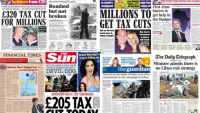
George Osborne couldn't really have expected a much better set of newspaper covers than the one before him this morning. Despite the dreary background picture – war, confusion, higher inflation, lower growth, the ruinous state of the public finances, etc – a handful of papers are leading on the goodies in his Budget, and specifically the £600 rise in the personal allowance that James mentioned last night. Judging by the movements of the grapevine, this will come into effect in April 2012, and will benefit more people than will the £1,000 rise already announced for this April.

The state of public opinion ahead of the Budget

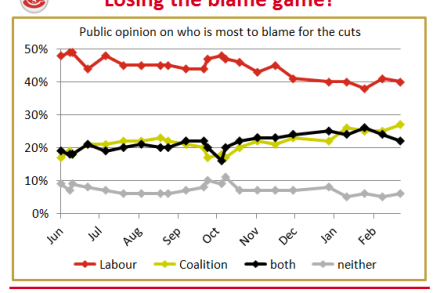
It's a point that I've made before, but here it is again: Budgets don't tend to shift opinion polls, at least not the headline numbers. But opinion polls can give some insight into how Budgetary decisions will go down with the public. So by way of a catch-up with some recent polls, and ahead of tomorrow's Main Event, I thought CoffeeHousers might appreciate a quick overview of public opinion on matters fiscal. Here goes... 1) Who's to blame? When it comes to the overall flow of British politics, the question of who's to blame for the cuts carries clear — and dangerous — implications.

Your five-point guide to tomorrow’s Budget

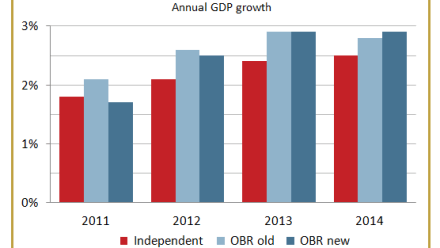
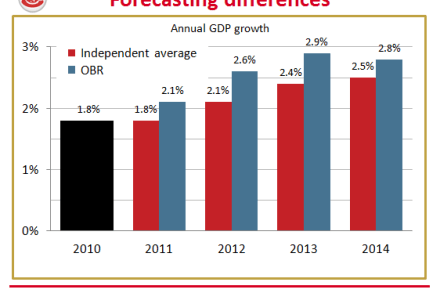
From rescue to recovery — that's how George Osborne is selling his Budget ahead of its release tomorrow. But what might we see beyond the rhetoric? Here's a five-point guide for CoffeeHousers:   1) Growth. It almost feels like a tradition now: a new Budget, and a new set of forecasts from the Office for Budget Responsibility. Chief among them will be what the OBR says about growth. Its previous forecast for 2011, made last November, was for 2.1 per cent growth in 2011 — but that will almost certainly be downgraded after the mini-slump in the fourth quarter of last year. As this graph shows, the average of the 39 forecasts collected by the Treasury is now at 1.

Putin rages against the “crusading” West

A gold star for Vladimir Putin, for providing us with one of the most extraordinary interventions of the day. While we knew that the Russian Prime Minister is opposed to military action in Libya — and also that he is no natural friend of the West — it is still striking to hear him talk as he does in the video above. "It reminds me," he says of the UN resolution at hand, "of the medieval call for a crusade." Ever the pacifist, he then goes on to rail against the "steady trend in US policy" to get involved in conflicts abroad. Meanwhile, our government is doing its part to assure Parliament, and the public, that their policy on Libya is more multilateral than medieval. Their note on the legal basis for action in Libya has just been published.

The Yemeni domino totters

Call it the domino effect, if you like. After Tunisia, Egypt, and Libya, Yemen is the latest country to drag its rulers to the precipice — and it could push them over, too. The latest news is that several Yemeni generals have joined the protesters in calling on President Saleh to stand down. One source tells al-Jazeera that 90 per cent of the army could do likewise by this evening. The broad consensus is that the current regime is wheezing to a close. So what next? From this vantage point, Yemen is certainly one of those countries where change should be greeted warily. It's not so much the emerging prospect of a military junta, but more the encroaching presence of al-Qaeda in the margins (aka "the mountains").

Obama’s nervousness makes life difficult for him and his allies

Gingerly, gingerly — that's how the Americans are approaching the presentational battle over Libya, if not the actual campaign itself. There is no bombast in the official broadcasts from Washington, nor categorical intent. Instead we have Robert Gates emphasising, as he did yesterday evening, that the US will soon handover "primary responsibility" for the mission to us or the French. Or there's Mike Mullen, the Chairman of the Joint Chiefs of Staff, saying that "potentially one outcome" is for Gaddafi to stay in power (see video above). The idea of regime change, or of deeper US involvement, is being downplayed all round. What's clear, perhaps even understandable, is that Obama & Co. are eager not to exhume the ghosts of Iraq.

The UN decides to take “all necessary measures” against Gaddafi

"There will be no mercy. Our troops will be coming to Benghazi tonight." Perhaps it was the murderous threat contained within Gaddafi's latest radio message that shocked the United Nations into action today — because shocked into action they have been. After sweating and toiling over the precise formulation of a resolution on Libya, the UN Security Council finally reached the voting stage this evening. And it has now voted 10-0 in favour of member states taking "all necessary measures … to protect civilian and populated areas, including Benghazi, while excluding an occupation force." Brazil, India, China, Russia and — staggeringly — Germany all abstained. What this means, in practice, is a no-fly zone — and more.

Another Budget snippet

Benedict Brogan's latest post is built around an observation from Jo Johnson on the 50p rate, yet it is Brogan's own observation that gets a place in our Budget scrapbook: "Some people I have spoken to think George Osborne might be sufficiently worried about the growing exodus of entrepreneurs to put down a marker on 50p in the Budget next week." Whether this "marker" transpires — and what it might look like, if it does — is something we shall have to wait for. In the meantime, it's worth noting that Labour have already set a marker on 50p: that it will have to remain for the duration of this parliament, at least. There is a clear opportunity for Osborne to define himself, and the coalition, against that.

Actually, there’s some solace for Miliband in today’s poll

Much excitement, today, about the fact that Ed Miliband is just as unpopular as Nick Clegg. A pre-Budget package by Ispos-MORI contains the finding that both party leaders are actively disliked by 51 per cent of the public. It's a striking result, particularly after the tuition fee furore — yet, sadly, it isn't new. It actually comes from the political monitor that Ipsos MORI released in January. They didn't ask the question for their March political monitor. So far as the Clegg-Miliband divide goes, the latest Ipsos MORI figures actually have this to offer us: net satisfaction with Miliband's performance as party leader is at -5 per cent, whereas it's at -22 per cent for Nick Clegg. So, not great for either leader, but considerably better for MiliE.

Osborne’s grand merger?

George Osborne's Budget — his plan to deliver us from “rescue to recovery," apparently — is less than a week away, and the wildfire of speculation is taking hold. Perhaps the most intriguing titbit in today's papers is one that also appeared in the Express last Saturday: that Osborne is considering merging income tax and national insurance. This is a measure that the Office for Tax Simplification recommended in a report last week, suggesting that it would ease the administrative burden on small businesses. Yet that simply echoes a viewpoint that stretches back decades.

Not great, not a disaster

Last November, the OECD forecast — as it does — that the UK economy would grow by 1.7 per cent in 2011. Today, it has downgraded that figure to 1.5 per cent. I wonder, does this matter? Sure, it's not an encouraging sign. And Ed Balls will be slathering at the thought of the OBR doing likewise next week. He has barely been able to contain his excitement already. Yet it's worth pointing out two things. First, that the OECD is just one forecaster among many. The Treasury monitors no less than 39 independent organisations, and collects their forecasts on a monthly basis. Here's what the picture looks like today: Which is to say, the average growth forecast for this year is unchanged at 1.8 per cent. For next year, it is 2.1 per cent.

David Cameron’s dreams and nightmares are written into today’s employment figures

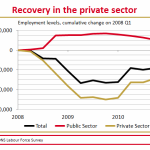
It is almost a cliche to describe jobs figures as a "mixed picture" — and yet that's exactly what today's are. Beneath the headline finding that the number of unemployed people has risen above 2.5 million, are numbers that will fuel not only David Cameron's happiest dreams, but also his most paranoid nightmares. Let's start with the nicer stuff first. The graph above shows the cumulative change in employment levels since the recession started to take hold in 2008. What it shows is something that often goes ignored: that is was the private sector, not the public sector, that took the greatest hit from the crunch.

PMQs live blog | 16 March 2011

VERDICT: A more evenly-matched PMQs that we have been used to, with both leaders parrying and thrusting to some effect. Miliband's chosen topic — the NHS — was a surprise, particularly given today's unemployment figures and the persistent flurry of bad news from abroad. Yet it did open up a clear divide between him and Cameron. On one side, the Labour leader claiming that the the coalition is taking undue risks with a beloved health system. On the other, the PM painting Miliband as Brown Mark II, a roadblock to reform and change. Neither side really won, or lost, the argument today, but you can expect them to return to it in future.

Another hurdle for Lansley’s health reforms

And so it came to pass. After sniping at Andrew Lansley's health reforms from the day they were announced — at one point describing them as a “slash and burn approach” — the British Medical Association has today voted to call on the Health Secretary to withdraw his Bill entirely. The speech that the BMA Council Chairman, Hamish Meldrum delivered this morning captures the tenor of their opposition: “…what we have is an often contradictory set of proposals, driven by ideology rather than evidence, enshrined in ill-thought-through legislation and implemented in a rush during a major economic downturn.” So what to make of it all?

The pace of the schools revolution

What a difference a year makes. When Michael Gove spoke at a Spectator conference on schools reform twelve months ago, his policy ideas were just that: ideas, to be deployed should the Tories reach government. Today, at a follow-up conference, they are being put into practice in the fiery crucible of state — and doing quite well, at that. As tweeted by Andrew Neil, Gove has announced that the number of academies — existing state schools that have seized on the independence being offered to them — now stands at 465. That's some way up on the 203 academies there were last year. And it's even a significant rise on the 407 in January of this year. The rate of growth is really quite astonishing.