Peter Hoskin

Winners and losers | 6 April 2011

The birds chirruping in the sunlight clearly didn't get Ed Balls's memo. Otherwise they'd know that today is "Black Wednesday," the day when the coalition's tax and benefit policies swoop in to leave the average household some £200 a year worse off. This is the message that the shadow chancellor is broadcasting this morning, be it on Radio 4 or in a post for Labour Uncut. His claim is that the coalition is — by going "too far, too fast" on the deficit — merely squeezing the "squeezed middle" even more. Only that's not quite the full picture. The Treasury, for one, is pointing out that today's measures will actually leave 80 per cent of households better off. So who's got it right?

Does Davis have a point about grammar schools?

David Davis has been relatively quiet for the past couple of months, perhaps nursing a hangover after this. But he's back making a seismic racket today, with an article on the coalition's social mobility report for PoliticsHome. He dwells on the education side of things, and his argument amounts to this: that the government's school reforms — from free schools to the pupil premium — will not do much to improve social mobility, and may actually make the situation worse. Michael Gove may be praised as "intelligent, dedicated and wholly admirable," but there is enough gelignite elsewhere in the piece to ruffle some coalition feathers.

Your five-point guide to the coalition’s social mobility report

The government's new report into social mobility is, it tells us, all about "opening doors" and "breaking barriers" — but it's probably taxing attention spans too. 89 pages of text and graphs, offset by the same pea soup shade of green that's used for all these coalition documents. To save you from wading through it all, here's our quick five-point summary: 1) The same story… Much of the report, as James suggested earlier, is familiar territory. After all, the coalition's two most developed policy areas — welfare and education — are precisely designed to improve opportunities for the least well-off; so here they are again, restated and slightly reframed.

Miliband may be punished for his contempt for Clegg

Ed Miliband's hand of friendship has to be one of the shakiest body parts in British politics. Sometimes it's extended to the Lib Dems, sometimes it's not. Sometimes it's extended to Nick Clegg, sometimes it's not. Sure, the Labour leader does appear to have finally settled on a position: that he will only shake the hands of a Cleggless Liberal party. But that has come after constant wavering on his part, and could well be subject to change. I mention this now because of a claim in Rachel Sylvester's column (£) today. I'm not sure whether it has been made before — but it neatly encapsulates how Miliband has lurched one way and then t'other, and deserves pasting into the scrapbook.

The health select committee delivers its verdict

Grenades are seldom expected – yet Andrew Lansley knew that one was going to fall into his lap this morning. The Health Select Committee has today released its much trumpeted report on the government's plans for NHS commissioning. In normal circumstances its dry take on an even drier subject would evade public notice. As it is, with the coalition rocking and reeling as they are, this is fissile stuff. It is yet another voice in the chorus of opposition to Lansley's reforms.

Ed Balls ties himself in knots

The Most Annoying Figure in British Politics™ is spread absolutely everywhere today: in the newspapers, on Twitter and, most notably, in interview with the New Statesman's Mehdi Hasan. The interview really is worth reading, not least because it pulls out and probes some of Ball's arguments, both for himself and for Labour's fiscal reasoning. Guido has already dwelt on the former — "I'm a very loyal person," quoth the shadow chancellor — but what about the latter? Three things struck me: 1) Oh, yeah, there was a structural deficit. The Big News here is probably Balls's admission that Labour did run up a structural deficit (i.e. a deficit that remains even when the economy is functioning as well as it should) after all.

PMQs live blog | 30 March 2011

VERDICT: What happened there, then? The Prime Minister often has a confident swagger about him when it comes to PMQs — but today it went into overdrive. He simply couldn't conceal his glee at taking on Eds Miliband and Balls; the first over his appearance at the anti-cuts demonstration, the second for just being Ed Balls. It was a little bit Flashman from the PM, perhaps. Yet, on this occasion, it also helped him sail through the contest more or less untroubled. Aside from the theatrics, the serious talk was reserved for whether the coalition should help arm the rebels in Libya. The PM's official position was that we shouldn't rule it out, although, if anything, he sounded as though he quite favours the idea.

The yellow bird of liberty stretches its wings

Remember when Nick Clegg said that the coalition was shuffling into a new phase? One where his party would would make their presence, and their differences with the Tories, more acutely felt? Turns out the Lib Dem leader wasn't kidding. Judging by this report of a press briefing he has given in Mexico, the brave new phase is very much in effect. For starters, Clegg luxuriates in the anti-nuclear hysteria that has arrived in the wake of Fukushima — emphasising not just that our planned nuclear power stations will be more costly and difficult to build now, but also his party's policy that no public money should be used to fund their construction.

Ed Miliband and Justine Thornton to marry

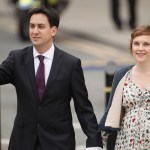
A scoop-and-a-half for the Doncaster Free Press, who were first with the news of Ed Miliband and Justine Thornton's wedding date. It is 27 May, lest you hadn't heard already, and will take place at a country hotel near Nottingham. Here's what the Labour leader tells the paper: "'This is going to be a fantastic day for us both and I feel incredibly priviliged to be marrying someone so beautiful and who is such a special person. It’s the right time for us to do this and I’m really looking forward to a lovely day. 'We’re going to have a party in Doncaster when we get back from honeymoon — which will be in an undisclosed location!

Another Libyan question

Far from quiet on Libya's shifting battlefront. The latest reports are that the rebel advance has stalled, and is now moving backwards in the face of Gaddafi's overwhelming firepower. Yet as disheartening as this development may be, it is hardly unexpected: America's General Ham all but described it as an inevitability only a couple of days ago. And so the rebels' representatives have now made an equally inevitable demand of the politicians congregating in London: arm us, and we can make progress once again. In which case, there's another question for the pile: to arm, or not to arm? And it is not clear-cut, either way.

Memo to Johann Hari: this government isn’t planning to “pay off our debt rapidly”

What is the biggest lie in British politics? According to a new post by Johann Hari, it's that our debt is at dangerously high levels. "As a proportion of GDP," he writes, "Britain's national debt has been higher than it is now for 200 of the past 250 years." He makes some pugnacious points that will have you nodding enthusiastically, or groaning wearily, depending on your political persuasion. But he also undermines his argument right from the off, in his description of the Big Lie itself. Here it is: "Here’s the lie. We are in a debt crisis. Our national debt is dangerously and historically high. We are being threatened by the international bond markets. The way out is to pay off our debt rapidly.

Obama sketches out the limits to American involvement in Libya

There was one aspect of Barack Obama's Big Speech on Libya last night that was particularly curious: for a President who is trying to downplay American involvement in this conflict, he sure went in for good bit of self-aggrandisement. The amount of references to his and his government's "leadership" — as in, "At my direction, America led an effort with our allies at the United Nations Security Council to pass an historic Resolution" — was really quite striking, at least to these ears. I suppose it's all about mollifying those voices who argue that the US Pres hasn't done enough, quickly enough. But it's hardly going to endear him to some of his more proactive partners in this fight.

Clegg weaves more divides between himself and Miliband

“He’s elevated personal abuse into a sort of strategy.” So says Nick Clegg of Ed Miliband in one of the most noteworthy snippets from his laid-back interview with the FT today. Another sign, were it needed, that Labour's animosity towards the Lib Dem leader is mutual — if they won't work with him, then he almost certainly won't work with them. And a sign, perhaps, that the coalition is keen to undermine Miliband's claim to post-partisanship (or whatever). Labour constantly criticise Cameron for being more Flashman than statesman. Now the same charge is being levelled at their leader too.

The rebels press on in Libya, but questions remain

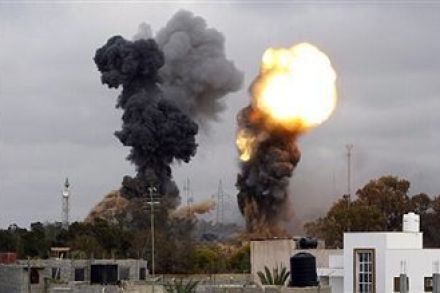
As Nato takes full military responsibility in Libya, the rebels surge onwards in the direction of Tripoli. According to one of the group's spokesmen, Gaddafi's hometown of Sirte — some 280 miles east of the capital — fell to their attacks last night; although there are reports, still, of explosions there this morning. In any case, the tidal shift that took hold at the beginning of the weekend is continuing. The rebels are now seizing ground, rather than ceding it. All this is, if not vindication for the Western leaders who pressed for a no-fly zone, then at least encouragement. It suggests that the one-two combination of Nato air support and rebel ground attacks can leave Gaddafi reeling.

Signs of nerves from the Lib Dems

Judging by today's reports, it's fear and self-loathing in Lib Dem Land. And it's not just that one of their Scottish candidates has quit the party in protest at its, ahem, "draconian policies" and "dictatorial style". No, according to this insightful article by Melissa Kite and Patrick Hennessy in the Sunday Telegraph, there are more manoeuvrings going on than that. Here are some passages from it, by way of a summary: 1) Chris Huhne, waiting in the wings. "Mr Huhne, who ran Mr Clegg close in the last Lib Dem leadership election, has told colleagues privately that he would be interested in leading his party in the future." 2) A rebrand (back to the SDP?).

From the archive: the consequences of Nato bombing Kosovo

There are two reasons to return to the Kosovo Conflict for this week's hit from the archives. First, of course, the surface parallels with Libya: Nato involvement, bombing raids, all that. Second, that yesterday was the 12th anniversary of Nato's first operation in Kosovo. Here's Bruce Anderson's take from the time: Milosevic has Kosovo, Nato has no idea, Bruce Anderson, The Spectator, 3 April 1999 There is a precedent for Kosovan conflict: Suez. Then, as now, our indignation was inflamed by misleading historical analogies; Milosevic is not Hitler, any more than Nasser was. Then, as now, we were afflicted by geopolitical tunnel vision, and lost all contact with the wider strategic realities.

Miliband’s two big risks

Who would have thought it? Miliband's short speech in Nottingham today went largely unheralded, and doesn't seem to be getting a whole lot of attention now — and yet it tells us more about his approach to Opposition than almost anything he has said previously. Fact is, the Labour leader is taking two risks that may be either bold or foolhardy, depending on your point of view. These risks could come to define his Labour party. The first is splashed right across the entire speech. Miliband dwells on three "challenges" that the country will face over the coming decade: the "cost of living crisis"; declining prospects for the next generation; and the erosion of the "Merrie Englande" that David Aaronovitch wrote about this week.

Now the questions are Nato’s to answer

Now, at least, we know: Nato will be taking charge of the no-fly zone that has been erected around Libya. And we might even welcome the news. As soon as the Americans made it clear that this was not their conflict to command, a new leadership arrangement was always going to be required — and Nato were the obvious choice. The only real barriers to their assumption of power have been French enthusiasm and Turkish reluctance, but they now appear to have been reconciled. In so far as this has clarified the next steps in Libya, it is a good thing. But confusion remains, and in wholesale quantities.

Will the government break its health spending pledge?

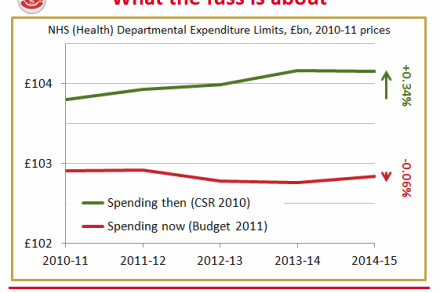
Let's make one thing clear right from the off: the IFS did not just say that the government would break its pledge to increase health spending in real terms. What it did say is that the government is coming close to breaking it — and that's the truth. Here's the graph that we've put together to compare the real terms health spending figures in last October's Spending Review (the green line, calculated using last November's inflation figures) with those in yesterday's Budget (the red line, calculated using yesterday's inflation figures):   Hang on. Doesn't that show health spending going down in real terms, after this fiscal year? Well, yeah, kinda. But the IFS was reluctant to describe this as a definite "real terms cut," and for three main reasons.

The IFS delivers an ambivalent judgement on the Budget

Away, away from Drill Hall in central London, where the Institute for Fiscal Studies has just delivered its briefing on yesterday's Budget. And, as useful as this event always is, there's no denying that another independent body — the Office for Budget Responsibility — has taken some of the sting and surprise out of it. Not only did the OBR poach the IFS's former director, Robert Chote, for themselves, but their supplementary Budget document has already done an IFS-style job on the government: highlighting the trends and tremors that might otherwise go unspoken. And so we heard, again, about how overall spending has risen slightly after yesterday's Budget; about the higher borrowing forecasts; about inflation outstripping wages for a couple of years; and so on.