Peter Hoskin

Osborne goes on the offensive

Attack, attack, attack. That's the temper of George Osborne's article for the Guardian this morning, which sets about Labour's economic credibility with a ferocious sort of glee. Perhaps the best passage is where he asks how many times Labour can spend their ubiquitous "bank tax," but this is more pertinent to the recent debate: "Where does all this leave Ed Miliband's newfound enthusiasm for the "squeezed middle"? Let's pass over his failure in every interview to define it – his last effort included around 90% of taxpayers. Where we can all agree is that these are difficult times for family incomes. There are two root causes. One is global: rises in food and commodity prices.

Boris: give us a referendum on Europe

Boris kicks off his Telegraph column today by observing that Colonel Gaddafi and Gordon Brown "look vaguely similar". And yet the really provocative copy, at least so far as the government is concerned, is reserved for the final paragraph: "It is bonkers [by pushing for AV] to be pursuing the last manoeuvre of a cornered Gordon Brown. By all means let us have a referendum – the one we were promised, on the Lisbon EU Treaty. Have you noticed the EU policy on North Africa? Have you heard much from Baroness Ashton? Shouldn't we have a vote on all that?" It's hardly a secret that Boris wanted a referendum on Lisbon: he said as much in an interview before the 2009 Tory conference, and irritated the party leadership in the process.

Miliband’s latest break with the past

As an independent creature, the Resolution Foundation's new Commission on Living Standards isn't doing Ed Miliband's work for him. But, boy, must the Labour leader be glad that they exist. At their launch event this morning, the "squeezed middle" – aka low-to-middle earners – suddenly took shape. There were graphs, such as those in James Plunkett's post for us earlier, setting out the very real problems facing a segment of British society. And there were even definitions explaining what that segment is: 11 million adults, by the Resolution Foundation's count, too rich to benefit from measures for the least well-off, and too poor to be entirely comfortable. This was a decent platform for Miliband's speech, and he used it to make a fairly important leap forward.

Will Cameron have a Brown moment over petrol?

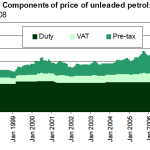
Remember when Gordon Brown came up against Fern Britton in a TV interview? I've pasted the video above to remind CoffeeHousers of two persistent truths: how tricky a subject petrol costs can be for a serving Prime Minister (watch on from around the 0:50 mark), and how Labour are hardly blameless when it comes to the current cost of fuel. As Britton asks in the interview, "How much tax do you put on the fuel?" And the answer that Brown mumbled to avoid, from a House of Commons briefing note at the time, was this: In other words, for a huge portion of the New Labour years, fuel duty accounted for over half of the petrol price at the pumps. For a typical litre of fuel, duty was 36.86 pence when Labour came to power, and 57.19 pence when they left.

Labour sets about warning of a “cost of living crisis”

Ed Balls has been warming up to this one for a while, and now it has finally come: an all-out attack over rising prices. In an interview with the Sunday Times (£), the shadow chancellor warns of Britain's "cost of living crisis," and demands that George Osborne reverse the VAT increase. Much of his pleading is made on behalf of motorists, who – as I pointed out a couple of days ago – face punishment at the petrol pumps. He doesn't even mention spending cuts once, especially not where his own party's are concerned. Rising costs, clearly, are the new weapon of choice. And it's not just Balls.

Are right-wing politicians better looking? Discuss…

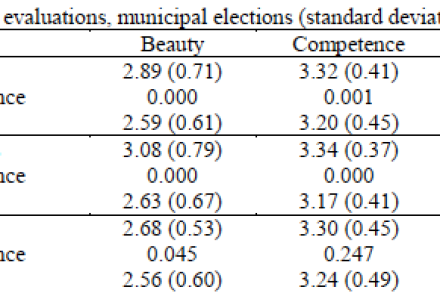
Did any CoffeeHousers hear this discussion between Bill Cash and Stephen Pound on whether the left or the right have the most attractive politicians? It was inspired by a recent Swedish research report that came down in favour of the latter. You can read the whole thing at this link – but, seeing as it's the weekend, I thought a summary might be in order. So here, to help you form an opinion on this most crucial of issues, are four points taken from its pages. Whether their generalisations are correct or not is another matter entirely: 1) The right is better looking. The report dwells, for a whole host of technical reasons, on the 2004 municipal – aka local – elections in Finland. It reviews around 8,00 candidates, and comes up with the following table.

Why Ed Balls shouldn’t brag if the OBR downgrades its growth forecasts

Some speculation (£) today that the Office for Budget Responsibility will shortly downgrade its 2011 growth forecast – and hence the growth forecast in next month's Budget. If so, then you can expect Ed Balls to crow on and on about it. He did, after all, prime the attack in his recent clash with George Osborne across the dispatch box: "With consumer confidence falling, with inflation rising, with no bank lending agreement, no plan for jobs, no plan for growth, no plan B - does he really expect us to believe he can meet this forecast for economic growth this year or will he have to stand here at the Budget in six weeks' time and downgrade his very first growth forecast?

Fine Gael’s unenviable, uncertain victory

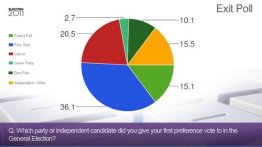
Oh look, the ruling Fianna Fail party is set for defeat in the Irish election. Unsurprising, for sure, but the scale of their drubbing will still be something to behold. An exit poll conducted by RTE has them in third place on only 15.1 percent of the vote – which, as Sunder Katwala points out over at Next Left, is some way down from both their traditional 40+ per cent support and the 41.6 per cent that they achieved in 2007. The same exit poll has the centre right Fine Gael party in the lead (on 36.1 per cent), their best performance for 28 years, although not enough for an overall majority. The probable outcome, as Alex details, is a coalition between them and the second-placed Labour party.

What difference will sanctions make?

Slowly, haltingly, the West decides what to do about Gaddafi. The latest news is that, having broken his silence over Libya a few days ago, Barack Obama is now imposing sanctions against its despicable regime: freezing assets, blocking transactions, that sort of thing. It follows a package of sanctions, including an arms embargo, that Britain and France have proposed to the UN. Although these sanctions are better than nothing – the West shouldn't house Gaddafi's slush funds, nor transfer weapons in his direction – they are of limited actual worth. Yesterday, the Mad Dog was parading the parapets once again, promising death for the protestors. You suspect he is unlikely to be put off by restrictions to his and his country's finances.

From the archives: Saif Gaddafi in conversation

No need to explain why we're disinterring this interview with Saif Gaddafi, by Justin Marozzi, from out of the archives. Given his "rivers of blood" warning this week, his claim that "I'm very enthusiastic to see Libya as an oasis of democracy, a society that respects the environment and human rights and so on, and is a model in the region," below, is now blackly hilarious. Son of Mad Dog, Justin Marozzi, The Spectator, 27 July 2002 Saif al-Islam Gaddafi glides into the Royal Suite at Claridge's looking like an Italian football manager: all suit and no hair. A white handkerchief sprouts from his breast pocket. His silk tie is a muted red and green, and the slim black lace-ups look hand-made.

It’s the Q1 2011 growth figures that matter now

The Office for National Statistics' preliminary figures for Q4 growth, released a few weeks ago, were a curious beast. They they were, suggesting that because of a snow-laden December our economy had started shrinking again, to the tune of -0.5 per cent. And yet so many other indicators were doing rather nicely: from activity in the services sector to the Exchequer's tax take. Many people, myself included, suspected it was only a matter of time before the ONS revised that -0.5 figure into more positive territory. Now time has passed, and the ONS has just revised the Q4 figure downwards, not upwards. Their preliminary figure wasn't quite right, they say. It should have been -0.6 per cent. Given that the snow was thought to reduce GDP growth by 0.

What price a fuel duty stabiliser?

Last we heard, the government was considering what it should, and could, do to suppress rising fuel prices. I wonder whether they have now pencilled something into March's Red Book. You see, after a swell of speculative fear triggered by events in the Middle East, the cost of oil is going up, up, up. Brent Crude touched $120 a barrel yesterday, the highest price since August 2008, although it eventually settled to around $111. Some observers predict it will soon exceed the previous record price of $150. Naturally, this threatens to unstitch the delicate fabric of the global economy – drastically rising oil prices could bring pervasive stagflation in their wake. But there are also more parochial concerns, not least what all this means for motorists.

A fraternal fix

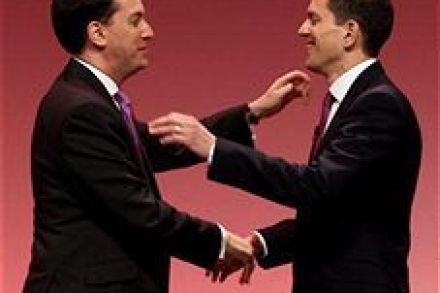
"Now he and his leader know what it’s like to be people’s second choice," trilled George Osborne during his recent encounter with Ed Balls over the dispatch box. But might Balls actually have been Miliband's third choice for the shadow chancellorship? That's the implication of a delicious little story in today's Sun, which claims that Miliband first "tapped up" his brother, aka MiliD, when trying to replace Alan Johnson: "A Labour insider revealed: 'Ed's people were desperate not to give the job to Balls.' However, Ed stopped short of offering his brother the job when David made it clear he wanted to stay on the backbenches." If true, then it's revealing on two counts.

Downing Street’s bureaucratic burden

Do head over to ConservativeHome, where Tim Montgomerie has put together a comprehensive guide to the revamped Downing Street operation. I won't spoil its considerable insights here, except to highlight this: "An analysis of papers sent to Downing Street and the Cabinet Office has revealed that just 40% are directly related to the Coalition's programme. Roughly 30% come from the Whitehall bureaucracy and another 30% from the EU." James makes the point in his latest politics column that Tory ministers are becoming more and more Eurosceptic as they face the EU in government. That pile of European directives in the in-tray must just be getting too much.

Gaddafi’s lethal sort of madness

If Muammar al-Gaddafi weren't still in charge of a country, then his speech for Libyan State TV would have been straight-up hilarious. There he was, all spittle-flecked bombast, rattling on and on about the "bunch of rats and cats" who are trying to depose him, and blaming their actions on, erm, hallucinogenic drugs. "We Libyans have resisted the US and Britain in the past," he said, "and will not surrender." He also, predictably, mentioned Israel. It was like some living caricature of a mad dictator. As it is, though, we ought to dwell on some of the more ominous aspects of Gaddafi's address. He is not standing down, he said – giving the remarkable excuse that, as he is not a President, he has no position to resign from.

Tehran’s latest provocation

The people of Egypt and Libya may have swung the spotlight onto their respective countries – but it is a spotlight that Iran is keen to exploit. Two of their warships have just passed through the Suez canal en route to Syria, the first to do so since 1979. They were given clearance by Egypt's new military stewards a few days ago. On one level, Tehran's actions are unimpeachable: Egypt cannot forbid access to Suez unless it is at war with the country at sail. But they are also, of course, designed to provoke. Why choose to do this now, other than to suggest something about the new latticework of power, and of power relationships, in a turbulent Middle East? Israel, for its part, is less than impressed.

Libya catch-up: Gaddafi on the precipice

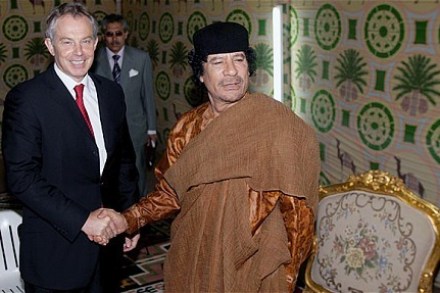
Aside from official – and provocative – proclamations from Saif al-Islam Gaddafi, the news from Libya is still arriving piecemeal. The latest reports are that the protestors have prevailed in Zawia, in the west of the country, to add to their "liberation" of Benghazi last night. And there is some speculation that Gaddafi Senior has fled the country, which would certainly reinforce the sense that his power is being whittled down, potentially to naught. As for Britain, the questions about our prior relationship with Libya still hover awkwardly over proceedings, and over the heads of the last government in particular. There was the al-Megrahi deal, of course, as well as all those meetings in Gaddafi's tent.

How far will Cameron go to break the state monopolies?

Call it the Big Society, decentralisation, people power, whatever – but David Cameron's vision for society just became a good deal more concrete. In an article for the Telegraph this morning, the Prime Minister makes a quite momentous proposal: that there ought to be a new presumption towards diversity in public services, whereby the private, voluntary and charitable sectors are as privileged as the state is now. Or as he puts it: "We will create a new presumption – backed up by new rights for public service users and a new system of independent adjudication – that public services should be open to a range of providers competing to offer a better service.

On the road with an alien

Slam one down on the bar, scoop in some crushed ice and finish with a slug of grenadine. Paul is straight from the cocktail school of cinema. Which is to say, it contains a handful of familiar ingredients — the buddy movie, the road movie, Star Trek, stoner gags, granite-jawed FBI agents — all swept into the blender and spun, shaken and stirred into something that, in the end, turns out quite differently. Even by the brash standards of other sci-fi comedies, from Abbott and Costello Go to Mars (1953) to Galaxy Quest (1999), this film has chutzpah, delirious chutzpah. Most of that chutzpah, and a good slice of the deliriousness, comes from the central pairing of Simon Pegg and Nick Frost — Paul’s leading actors, as well as its authors.

Doubts remain over al-Megrahi

The morning after the day before, it seems that some of the murk around Abdelbaset al-Megrahi's release has lifted. In particular, one thing is explicit that wasn't before: that the policy of the Brown government was to "do all it could" to facilitate the convicted Lockerbie bomber's transfer to Libya. We might have surmised the same from David Miliband's statements at the time. But now, at least, we know for sure. Naturally, this is tricky news for Labour, and especially for the Ghosts of 2008 whose names are splashed across the papers today: Brown himself, Jack Straw, Des Browne, etc. And yet Gus O'Donnell's report has also absolved them of the worst sin of all: lobbying the Scottish government to release al-Megrahi.