Culture

Culture

The good, the bad and the ugly in books, exhibitions, cinema, TV, dance, music, podcasts and theatre.

Death wish

Opera

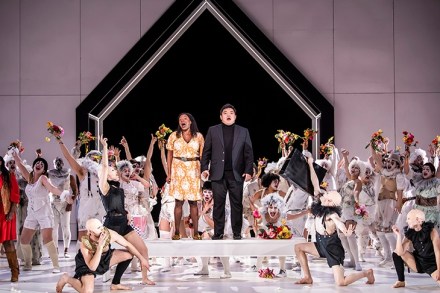
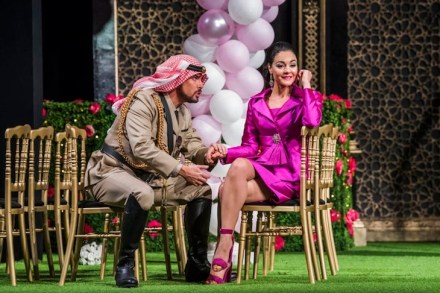
Anyone who thinks they have experienced absolute boredom, or even doubts that such a state can exist, should go to Glyndebourne’s first offering of the season, Cavalli’s Hipermestra. The first two acts, played without any break, last for 130 minutes, the third for a mere hour. The audience broke into its normal rapturous applause at the end, no doubt to reassure itself that it still existed. This opera of the inordinately productive Cavalli has been revived only once since its first outing in 1658, and I can only hope that its present resurrection is temporary and its second death final. Arriving at Glyndebourne, we saw a couple of Arabian newlyweds strolling round the grounds, then another pair, then another, at which point my companion twigged that they were part of the act.

False start

Opera

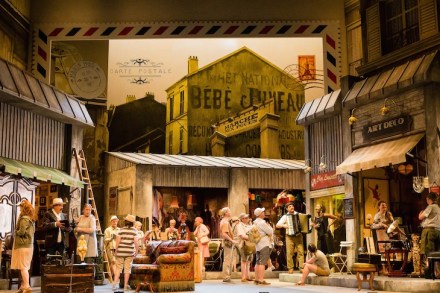
When a composer begins an opera, they create a world. You don’t need a full-scale overture: the tear-stained violins that Verdi drapes over the opening bars of La traviata do the job perfectly. The orgasmic upswing that launches Der Rosenkavalier, the cosmic hum that sets the Ring on its course — those very first notes tell you exactly where you are and what’s at stake. Puccini gets it just right at the start of La bohème: a cheerful orchestral clap on the shoulders that shoves you straight into the boisterous, bantering world of these four incurable optimists. Not here. André Barbe & Renaud Doucet’s new production for Scottish Opera opens in modern Paris, with no Puccini to be heard.

Mild things

Opera

English Touring Opera is playing safe this spring, with Tosca and Patience, and was rewarded, in Cambridge at least, with full houses. Its Tosca has been moderately reviewed, and that is about what it deserves. There is only one set, designed primarily with the tableau of chorus and soloists at the end of Act One in mind. Not at all atmospheric, it has to conjure up for us a church, a room in a palace, and dawn at the Castel Sant’Angelo, but scarcely succeeds with any of them. The soloists have a heavy weight of responsibility, which only the Tosca of Paula Sides fully managed. She is fine-looking, slim, good at acting temperamentally, and a powerful singer, though a slightly short-breathed one.

Stand and deliver

Opera

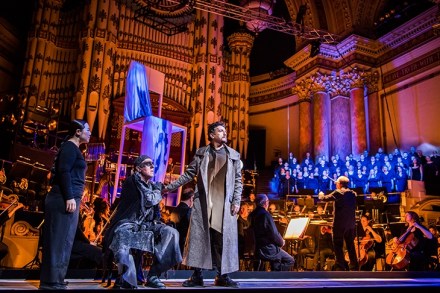
Some opera-lovers prefer concert performances to full stagings. I don’t. It’s that whole Gesamtkunstwerk thing: opera needs to be seen as well as heard. There’ll always be circumstances in which concert performances are welcome — to rescue a neglected score, say, or if a symphony orchestra wants to stretch itself. But when a major company presents standard repertoire in concert, it feels like an admission of defeat. Opera North recently mounted a magnificent concert version of Wagner’s Ring — but for all the brave talk about a ‘radically stripped-back’ production, who seriously doubts that, if funds had allowed, it’d rather have gone the whole way? Now it’s doing Turandot in concert.

Fallen angel

Opera

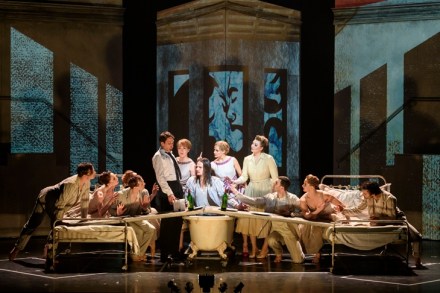
The Adèsives were out in force at Covent Garden last Monday for the UK première of their hero’s third opera, The Exterminating Angel, unable to contain their rapture until the piece was over, yelling their excitement even at the interval. Thomas Adès’s opera is closely based on Buñuel’s film of 1962, with the text adapted by the composer and Tom Cairns, who also directs the production, which was first seen last July in Salzburg, with a cast mainly identical to the Royal Opera’s. I hadn’t seen it before Monday, but have listened several times to my pirate recording and hoped that seeing it (with indispensable surtitles) would clarify the opera for me and help me to sort out my responses.

Take a bow

Opera

Monteverdi 450 — the Monteverdi Choir and English Baroque Soloists’ tour of his three operas to 33 cities across two continents — began with his penultimate work Il ritorno d’Ulisse in patria, at Bristol’s Colston Hall. It was a marvellous occasion, uplifting and entertaining. I hadn’t been to the Colston Hall before, and was most impressed by its acoustics. Apparently it is due to have a £48 million makeover next year (call that £75 million) but it seemed new and with agreeably hard seats which counteracted any tendency the hall’s tropical heat might have to induce drowsiness. The opera was performed in a semi-concert version, which I am more and more inclined to hope is opera-in-general’s way forward.

Country pleasures

Opera

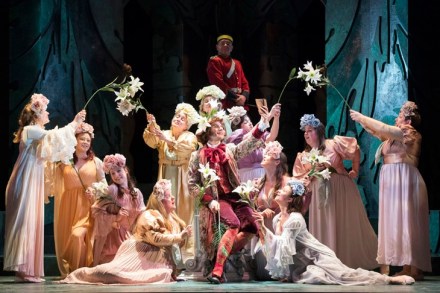
The English weren’t the first cowpat composers. Jean-Philippe Rameau raised the art of frolicking in the fields to such heights he filched pastoralism for the French. Rameau’s mastery of landscape is not just a question of orchestral colour, though that’s a large part of it — those goaty oboes, lowing bassoons, cooing flutes transport you straight to the manger. It’s that the very shape of his music, the softly curved lines that slide into burbling ornamentation, follows the contours of the rolling field and riverbank. The glory of his opéra-ballet Les Fêtes d’Hébé (1739) is the final act’s woodland romance that unfurls like a sunrise in the sexy Musette.

Blowing the bloody doors off

Opera

As we waited for curtain-up on Scottish Opera’s new production of Bartok’s Bluebeard’s Castle a member of staff walked out on stage. Don’t worry, he reassured us, he wasn’t about to announce that a member of the cast was indisposed. Nervous laughter from the auditorium. Still in the same matter-of-fact tone, he carried on, and I’ll admit that only at this point did I twig that this wasn’t a member of staff and that he was actually delivering a cleverly skewed version of the librettist Bela Balazs’s spoken prologue to the opera — something more often omitted than performed.

Death becomes her

Opera

Opera is littered with the bodies of abandoned women. Step over Dido and Gilda, and you’ll still stumble into Donna Elvira, Euridice, Elisabeth, Ariadne, Alcina. The list goes on. Pop music might have ‘50 Ways to Leave Your Lover’, but opera has 500. Call it chauvinism or voyeurism if you like, but opera’s women are at their most powerful in despair, even death. Their anguish might be aestheticised, but it shouts louder and more truthfully than the corpses of the endless female victims of television’s police procedurals, as two arresting performances attested this week. It’s her feet you notice first. Flexing and arching convulsively, rubbing up against one another as though to scrape flesh from bone.

Denial has rarely looked so good

Opera

Ceci n’est pas une Partenope. Forget the warring classical kingdoms of Naples and Cumae: this is surrealist Paris in the 1930s and imminent invasion is the stuff of conversational parenthesis, barely worth interrupting a rubber of bridge for, let alone an embrace. Man Ray, Lee Miller and their androgynous associates slink and affect their way around a monochrome salon with its suggestively curved central staircase, offering up the performance of themselves as a living exhortation to make art, not war. As a response to Handel’s most Shakespearean of comedies, Christopher Alden’s production is inspired — more now, if anything, than in 2008 when it was new.

Fatal distraction

Opera

I don’t think that I have left a theatre many times feeling as depressed and irritated as after the Royal Opera’s Die Meistersinger, in the new production by Kasper Holten. The run of the Royal Opera’s recent productions of Wagner — appalling Tristans, a dire succession of Parsifals, mediocre Rings — hadn’t prepared me for so deep an abyss of irrelevant idiocy as this. I thought I had reached the stage where, having seen so many fearful operatic productions of works I love, I was able to enjoy myself purely on account of the music, almost inured to what I was seeing.

Scottish power

Opera

‘Perhaps in this world nothing ever happens without purpose,’ sings old, blind King Arkel in Debussy’s Pelléas et Mélisande, and that at least is something to hold on to. God knows, you need it. Peel away the fairy-tale trappings of Maeterlinck’s original play, and the world of this opera is profoundly cruel. Its characters are often passive observers of their own fate (Pelléas admits before his final scene that he’s never yet returned his beloved Mélisande’s gaze). And yet Debussy pretty much compels you to feel for them, in a score of all-but-unbearable tenderness and beauty.

Statue-esque

Opera

Why set a supremely great play to music? The Winter’s Tale, the play of Shakespeare’s that I love most, has much of his most beautiful and intelligent poetry, as well as some of his most condensed and puzzling lines. Ryan Wigglesworth, in several of the innumerable interviews about his new opera, says he has been obsessed by the play for decades. So have I, but if I were a composer I think that would be a reason for leaving well alone. Wigglesworth has made his own libretto by using snippets of Shakespeare, enough to remind one of the original, but frustrating, most of the time, in producing a strip-cartoon version of the text. The idea, presumably, is to amplify this telegrammatic digest with the music.

Tough love | 23 February 2017

Opera

Frank Martin is one of those composers whose work seems to survive only by virtue of constantly renewed neglect. His quite large body of work is well represented in the CD catalogues, but rarely performed in the UK. One of his most powerful works is Le Vin herbé, though his fully-fledged opera on The Tempest also deserves revival. Welsh National Opera, ever adventurous, has mounted a staged version of Le Vin herbé, and despite its being more of a cantata than an opera and in English. The text is based on Joseph Bédier’s version of the Tristan myth, so some reference to Wagner, in discussing it, is inevitable.

British sea power

Opera

The story so far: in 1986 English National Opera hired Jonathan Miller to direct Gilbert and Sullivan’s The Mikado. The result was so fresh and funny that it’s been a mainstay of the ENO schedule for more than three decades, to the indignation of hardcore opera fans who can’t understand why audiences keep flocking to hummable melodies and humour instead of, say, Berg’s Lulu. Attempting to repeat the formula, ENO then made the rookie error of engaging Ken Russell who, being Ken Russell, promptly updated Princess Ida to the 21st century and set it in a futuristic sushi bar. Finally, in 2015 they entrusted The Pirates of Penzance to Mike Leigh, whose G&S biopic Topsy-Turvy seemed to guarantee a safe pair of hands. Good call.

Losing the plot | 9 February 2017

Opera

Fully to enjoy Opera North’s new production of Humperdinck’s Hansel and Gretel you need to take a trinocular perspective on it, but you can enjoy it a lot anyway. You could be mystified, if you don’t know the story, by the setting and action, as indeed I was some of the time despite having recently watched a straightforward account of it from Vienna on DVD, and having seen countless productions of it. So I would advise at least reading the plot. As so often with contemporary operatic productions, the synopsis in the programme book bears only a passing resemblance to what you see on the stage.

Notes on a scandal | 2 February 2017

Opera

Kids: who’d have them? Certainly no one who has ever been to the opera. If they’re not murdering you, they’re betraying you, defying orders or throwing themselves into the arms of the nearest unsuitable suitor. What happens when that suitor is a god, or — god forbid — their own brother or sister? Answers came on the back of two very different operatic postcards this week. At the Barbican, bathtime gone bad. A claw-foot bath sits centre stage, a cold, white womb in which monstrous twins writhe in fleshy ecstasy. Backs arched, legs flexed into Priapic verticals, they coalesce the clenching pulse of orgasm and the surging agony of childbirth into a single, exquisitely choreographed moment.

Snow blindness

Opera

Rimsky-Korsakov’s The Snow Maiden has not received a professional staging in the UK for 60 years. Think about that for a moment, and what it says about British operatic priorities. Sixty years of Massenet and early Verdi, of Manon Lescaut and Donizetti ‘rediscoveries’. Not that those aren’t worth having, as part of a healthy and balanced operatic diet. But the fact that during those six decades no major company showed any curiosity about an acknowledged masterpiece by one of the 19th century’s most prolific and original musical dramatists is perverse, to say the least.

Death rattle

Opera

The Barbican website warns us that Ligeti’s opera Le grand macabre ‘contains very strong language and adult themes’. The strong language consists of the four-letter words that are known to everyone and used by most people, and the adult themes are sex/love and death, which this opera has in common with almost any non-comic opera you can think of, and without which the genre would certainly never have been conceived or added to over more than four centuries. But while love and sex have often also provided the stuff of comedy, death is another matter, and presumably it is Ligeti and Michael Meschke’s robust treatment of this (superbly translated into English by Geoffrey Skelton) that we might need to be warned about.

Giving it both barrels

Opera

In Joseph Roth’s The Radetzky March, the ageing Emperor Franz Joseph regrets the drab field-grey that has replaced his army’s once-colourful uniforms, seeing in it a premonition of an empire — a world — soon to be defeated and broken up. Franz Joseph is present in Act One of Robert Carsen’s new production of Der Rosenkavalier, right there in the Marschallin’s boudoir: I counted at least four portraits of the old man, gazing phlegmatically down on the sexually charged capers below. And the men in grey are there too. In Carsen’s conception, Baron Ochs and his yobbish retinue are cavalry officers, plotting on one side of the room, while on the other gorgeously dressed fashion models resembling drawings by Erté parade and pose.

Gardeners’ world

Opera

For the past few weeks I have been working my way through Decca’s gigantic set of every note Mozart wrote and quite a few that he probably didn’t — 220 CDs in a monumental hernia-inducing box. Chronological listening is not recommended. Mozart was technically a phenomenon, of course, but he didn’t reach maturity of expression, with one or two extraordinary exceptions, until he was in his early twenties. La finta giardiniera (or Die Gärtnerin aus Liebe, in the composer’s singspiel version — both are included in the Decca set) was written when he was 18, by which time he was exceptionally fluent in composition. Uncut it lasts three and a half hours — why do people always go on about how long Wagner’s operas are?

From first to last

Opera

As the dreaded season of goodwill approaches, the Royal Opera has mounted two revivals of pieces that are interestingly contrasted: Puccini, in the first characteristic and successful opera of his career, though with a lot still to learn, and Offenbach, with the incomplete last work of his career, but a radical departure from all the successes he had had before, and a work that is ultimately a noble flop. Les Contes d’Hoffmann is one of the Royal Opera’s most venerable productions, dating from 1980 and having its eighth revival, with William Dudley’s elaborate sets.

All’s well that ends well

Opera

The last ten minutes of any Don Giovanni tell you more about a director than the previous two hours. Mozart’s elastic ‘dramma giocoso’ can take a lot of pulling about, can be stretched taut into tragedy or squeezed into the tight confines of a farce, but whatever option (or combination of options) you choose, those final moments are the test of success — the point at which the dramatic threads either sag, snap or hold firm. Oliver Mears’s production — first seen at the Bergen National Opera and now at NI Opera in Belfast — lets them fall limp. Seemingly unsure which choice to make, he makes no choice at all, leaving us with an ending that isn’t so much elusive as it is evasive.

Another fine mess

Opera

I wonder why ENO has invested in a new production of Berg’s Lulu, when the previous one, which we first saw in 2002 and then in 2005, was so brilliant as to be virtually definitive. (Of course, that last word is anathema to operatic ‘creative’ teams, for obvious reasons.) Not that this new one, directed by William Kentridge, isn’t good too, though it is excessively busy, compounding the hyperactivity of the score and action. It doesn’t do anything to clarify matters, though almost all the questions one is left asking are ones that the composer-librettist has set.

Brief encounters

Opera

When Mozart was commissioned to write an opera for the coronation of Emperor Leopold II, he produced La clemenza di Tito: a hymn to the benevolence of a Roman despot. When Matt Rogers and Sally O’Reilly were commissioned by the Inner Temple, they came up with an opera in which the protagonist is a law student who tries to obstruct the emergency services. The Fire of London is spreading, you say. And the only way to save life and property is by creating firebreaks? Sorry, I think you’ll find that, under Section 15 (4) of the Irresponsible Pettifogging Jobsworth Act 1661, you can’t do that. Truly, an operatic hero for our time.

Buried treasure | 3 November 2016

Opera

Wexford is to opera-goers what casinos are to gamblers. The uncertainty, the hope, the exhilaration — they’re all a crucial part of a festival that annually rolls the dice, plucking three obscure, often all but unknown, operas from the repertoire and giving them a staging. Dealing the cards is David Agler, the artistic director whose canny choices ensure that not only the house but also the audience always wins. Add to the mix Wexford’s ear for an up-and-coming star (Juan Diego Flórez, Mirella Freni, Joseph Calleja and Daniela Barcellona have all made their mark here), and you can understand the festival’s uniquely addictive quality.

A night at the circus

Opera

The Royal Opera’s latest production is Shostakovich’s The Nose and to paraphrase Mark Steyn, whatever else can be said about it, you certainly get a lot of noses for your money. Noses are tossed from character to character, noses kneel in prayer and noses stroll casually past in the background. They poke through curtains, mingle in crowds, and form a high-kicking, tap-dancing all-nose chorus line. At one point, a little tiny nose toddles unaided across the vast, almost-empty stage. Around them swirls bustling, multicoloured madness: bearded ladies and moustachioed cops, women dressed like dayglo matryoshka dolls, and a couple of pigtailed cartoon Chinamen who might have wandered in from an Ellen Kent production of Turandot. It’s a regular circus.

High and low

Opera

‘Besides feeble writing, there is a mixture of tragic-comedy and buffoonery in it, which Apostolo Zeno and Metastasio had banished from serious opera’. You can always rely on Charles Burney (the celebrated musicologist, who spent most of the 18th century being professionally underwhelmed) to find fault. But writing here about Handel’s Xerxes he has a point. The opera’s blend of lighter and more serious elements, though typical of Venetian opera, was by no means the norm for the Londoners who were its audience. They didn’t like it then, and nearly 300 years later it’s something we still seem to struggle with, as English Touring Opera’s latest season makes unexpectedly clear.

Sinful treat

Opera

Shiny swags of gold cloth hang in front of the curtain before David McVicar’s production of Der Rosenkavalier, and that’s good. You want a touch of luxury in a Rosenkavalier. This is 20th-century opera’s great sinful, indulgent treat. Think of it and you think of Karajan and Schwarzkopf: huge creamy voices, silken Viennese strings, and New York Met production budgets. In truth, when Der Rosenkavalier gets under your skin, none of that matters. It’s not the glittering set pieces that turn out to be the real heart of the thing; not even the final Trio or the justly famous sequences in which the Marschallin ponders the transience of youth.