Culture

Culture

The good, the bad and the ugly in books, exhibitions, cinema, TV, dance, music, podcasts and theatre.

Bigmouth Strikes Again

Johnny Marr's at it again. ‘David Cameron is not allowed to like my music,’ he fumes. He revives his disgust for Cameron's love of The Smiths at least once every three months. God knows why he bothers. A bid to get his once famous name back in the papers? Or perhaps he likes to madden Tories? Ever since Cameron appeared on  Desert Island Discs, Tories have winced at the furious and occasionally bemused response from musicians name-checked by Dave. Marr was, as we know, most put out to find 'The Charming Man' on the list; and Paul Weller of The Jam was lost as to why Cameron liked 'Eton Rifles'. Weller memorably said: ‘Which part of it doesn't he get? It wasn't intended as a fucking jolly drinking song for the cadet corps.

Making music

Music

Since the birth of the peer-to-peer file-sharing service Napster in the late 1990s, the record industry has been the unwilling poster child for entire businesses being overthrown by the march of technology. The major labels, once all-powerful, now stand Ozymandias-like, looking out over their barren empires; an ailing HMV, long ago diagnosed as terminal, is finally in its death throes; and it looks increasingly unlikely that music will ever be paid for again. An industry that’s resorted to The X Factor is an industry in trouble. Michael Breidenbruecker is the co-founder of the music streaming and recommendation service Last.fm, one of London’s big tech success stories. ‘When we started in 2000,’ he says, ‘there was no market.

Why can’t the British pop industry launch new acts that last?

Music

It’s all been happening in the pop world since I was last here. David Bowie released a new song, arguably his best in several decades. Wilko Johnson announced that he had terminal cancer, and a lot of men in their fifties wept for their own lost youth. HMV went belly up, and I ripped my £5 HMV voucher into shreds, hours before they decided they would honour the damn things after all. Is it my imagination, or have prices for CDs risen ever so slightly on Amazon these past few weeks? For them, I suppose, the job is done, and monopolistic practices can now creep in and grab hold of the market by the throat. A music lawyer I know is very pessimistic about the future of recorded music, not least because if there is no more money to be made, she won’t be making any either.

Changing habits

Music

The question of who is going to buy EMI Classics has arisen once again in the past few days with the collapse of HMV. This followed on from the collapse of Comet, Jessops and Blockbuster, the film rental chain — all indicative of a fundamental shift in our purchasing habits. A spokesman for HMV, while delivering the bad news, characterised this shift as ‘seismic’, going on to opine that ‘it is quite heartbreaking to see all those great brands disappearing from the high street’. Whose heart was being broken was not made clear, since presumably we are all getting what we want by other means, but it is interesting that the HMV story has some of the same ingredients as the EMI one, in particular length of service and all the nostalgia that goes with it.

BBC Radio 2 Folk Awards: bottom of the class

You would think that asking for and receiving the names of the judges of a set of BBC awards would be a straightforward matter. The corporation’s own awards guidelines, available on its website, demand transparency. So it was surprising that when I asked who chose the winners of the BBC Radio 2 Folk Awards, thinking I’d write about them in my music blog, The Glamour Cave, I was told it was a secret. It was a more unpleasant surprise that a follow-up Freedom of Information request was denied on the grounds that the award ceremony, in the view of the BBC’s FoI department, was protected as 'journalism'. If an awards ceremony qualified as journalism, I was left wondering, then what could they possibly consider my blog to be? Did I want to know?

Rediscovering Spotify

Music

All my life I’ve wanted to be able to write confidently about orchestral performances and I think I may have cracked it. So forgive me while I show off for a paragraph. In the last movement of Bruckner’s Seventh, Mariss Jansons and the Bavarian Radio Symphony Orchestra capture the jauntiness of the opening theme; there’s a twist of Haydn amid the grandeur. But it takes a long time for the brass and woodwind to settle down, and when Bruckner gathers his forces for a climax the conductor leans heavily on the gas pedal, as if he’s nearly missed a turning. No such problems with Karajan and the Berlin Philharmonic, where from the first bar the sheen of the violins tells you that every twist of the score has been mapped out, not to say ironed out, well in advance.

Real life | 17 January 2013

Real life

André Léon Marie Nicolas Rieu is a Dutch violinist, conductor and composer best known for creating the Johann Strauss Orchestra. So says Wikipedia. But I know better. André Rieu is a cunning hypnotist who has lulled my mother into a zombified trance from which I cannot waken her. His televised open-air concerts, which now take up an entire Sky channel, play constantly in her home. The rapt hysteria of the assembled thousands is reflected in my dear mother’s visage and I fear for her, I really do. The dangers of the genre known as ‘popular classical’ are already well documented. Richard Clayderman, Vanessa-Mae, Lang Lang, the Classic FM chart with its endless Air on a G String…I used to think, ‘If it gives people pleasure, why not?

Wielding the axe

Music

I’m sure I’m not alone in feeling a bit sorry for Mike Harding. The long-serving host of BBC Radio 2’s ‘folk, roots and acoustic’ show was given the heave-ho last month, and the far-from-underemployed Mark Radcliffe took his place last week. One might ask what Harding had done wrong, and indeed Harding has been asking it repeatedly. He says he was sacked by phone and given no sensible reason for his dismissal. Ah, the freelance life! I have been sacked so many times from so many supposedly cushy numbers that they all meld into one vast megasacking, but as far as I remember, they rarely give a reason, or at least they almost never give the real reason. On one occasion, though, someone did.

If the price is right …

Music

The question of who is going to buy EMI Classics took up most of 2012 and seems destined to run well into the new year. Given that the catalogue in question is probably the most extensive ever put together, containing priceless recordings from the earliest days of so many great artists that it would be otiose even to start listing them in this confined space, you might think that here was the sale of the century let alone of the year. In fact, no one seems to want it. The reason for putting such a property up for sale is that Universal, which already owned much of the music industry, last March began negotiations to acquire EMI as well.

Chorus of approval

Music

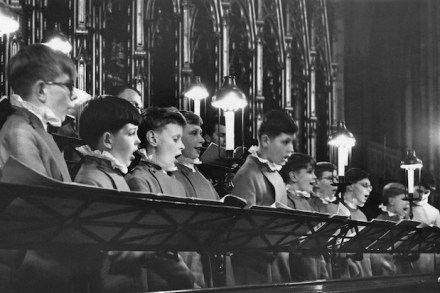
Is there anything more essential to one’s well-being than the sound of an English choir at evensong? Is there, for that matter, any word in our language more beautiful than ‘evensong’, with its evocation of architecture, music and the Anglican liturgy? This is the season to reflect on such matters. On Christmas Eve, Cambridge once again becomes the centre of the world for two hours as the choristers of King’s College celebrate the famous festival of carols and lessons and two days before, in St John’s, Smith Square, the choir of Trinity College will perform Bach’s Christmas Oratorio with the Orchestra of the Age of the Enlightenment. Moreover, they will be singing from memory.

The quiz biz

Music

Come December, I often find myself writing a lot of quizzes. Not that I’m complaining: I love writing quizzes, and I really love being paid for writing quizzes. There’s a definite skill in crafting a decent question, and therefore considerable satisfaction in getting it right, tempered only by the unceasing fear of getting it completely wrong. (Like all writing, therefore.) All of us who toil in the quiz mines are naturally aware that we have our favourite subjects, our home territories if you like. I could go on writing increasingly abstruse questions about cricket or pop music far into the night, but I don’t, because the audience simply isn’t as interested in those subjects as I am. If you are a quizmaster, your job is to entertain people.

Talking dirty

Music

Attached to the ménage of every artistic outfit these days will be an employee who believes there is a magic formula which,  once found, will bring in millions of everything: fans, column inches, money. Perhaps all artists secretly believe that what we do must have universal appeal: our insights are simply too significant to be overlooked. The only reason why other people don’t come to our concerts, buy our discs, or otherwise frequent our places of high culture is that it hasn’t yet got through to them that we exist. They only have to be drawn in by the right kind of publicity and everybody will love what we do. To find this publicity is the job of expensive professionals who spend their lives identifying the perfect image or coining the irresistible slogan.

Matchless mono

Music

Record companies: if you insist on sending CDs to my home address without so much as a covering note or a press release, well, that’s just fine by me. West Hill Radio Archives, I can’t say I’d heard of you, but the discs of Toscanini and the BBC Symphony Orchestra that landed on my doormat last week were a lovely surprise, in more ways than one. Toscanini refused to allow these concerts at the Queen’s Hall in June 1935 to be recorded, but thank goodness HMV ignored him. In the case of Elgar’s Enigma Variations the result is a revelation.

Golden oldies | 8 November 2012

Music

Old blokes make records too; they just take their time over it. Graham Gouldman of 10cc has one out, his first for 11 years. Jeff Lynne of Electric Light Orchestra has two out, but they’re his first for 11 years too. Donald Fagen’s new one is his first for six years, but he may be in a bit of a hurry. How long have any of them got left? How long have any of us? It’s a race to the line, for each artist and his audience. Because I doubt that any of these three are adding many young people to their fanbase. We are all ageing together. It’s a little low on dignity, but there are worse ways of living your life. Graham Gouldman is the last man standing in 10cc. Godley and Creme left in 1976, so long ago that even they probably can’t remember why.

No more heroes | 1 November 2012

Music

The Wharf is an unpretentious venue in Tavistock which offers a menu of entertainment whose criteria are difficult to fathom but are probably linked to the fact that Tavistock is near Plymouth and therefore miles from anywhere and quite an arse to get to. I saw a fat girl in an anorak screaming out loud with excitement at a poster advertising The Wurzels, so there isn’t too much going on for the under sixties. The venue stands 300 and seats about 30, which is pretty much what Hugh Cornwell would have been playing to when the Stranglers first drove their van around pubs in Guildford. All those years ago. He was old then. As a teenager doing A-levels I remember being more shocked by the fact that he was 30 than by the fact that he shouted out the word clitoris on Rattus Norvegicus.

Bolivian treasure

Music

Every so often in my line of business one reads heartwarming stories about manuscripts from the past turning up in unlikely places. The most favoured of these places over the years has probably been bricked-up chimney stacks in Tudor manor houses, where one supposes the terrified owners once thrust documents that would have incriminated them with the prevailing religious authorities. These documents might well have included music written for whichever Church was currently out of fashion; and so it is that pieces of music thought to be long lost have reappeared centuries later, both Protestant and Catholic. There is every chance that further discoveries will be made. Other places have included municipal and monastic libraries.

Blind spot

Music

Do you have a mysterious and slightly embarrassing musical blind spot? One of mine is for Dvorák, whom I don’t need to be told is a great composer. Maybe it was overexposure to the New World Symphony as a child; or maybe I’m unreasonably irritated by his Czech bounciness, just as some people write off Vaughan Williams because he reminds them of that jibe about the ‘cowpat school’. Anyway, it’s a problem. One way to tackle a blind spot is to listen to a superlative recording of a work by your ‘difficult’ composer. So, a couple of weeks ago, I bought a CD of Dvorák’s Cello Concerto played by Pieter Wispelwey and the Budapest Festival Orchestra conducted by Ivan Fischer.

Teenage fanclub

Music

As I entered the O2 Academy in Oxford last Saturday, something felt strange. The air was thick, the bar was crowded and the DJ was already playing in anticipation of the headline act. It all seemed perfectly normal. Yet, something was amiss. And then my friend turned round to me; her face pale, a mildly disturbed look in her eye. ‘Why is everyone here aged 12?’ Oh, yes. While 12 is possibly a slight exaggeration, it was clear that a substantial portion of the audience at Azealia Banks’s seventh UK show in her 2012 Fantasea tour were teenage girls, all dressed in Banks’s signature style: wool hats, cut-off shorts, dark lipstick. In many ways, it made perfect sense.

Sweet serendipity

Music

‘If you liked that, why not try this?’ Such tempting words, so hard to resist. I love the idea that some immeasurably complex computer algorithm, lovingly created by nerds, can sift through the teeming piles of new music out there and find something for me that I didn’t know I was going to like. One day this glorious state of affairs may even come to pass. For the moment, though, these links always lead you to (i) music you already own and enjoy, (ii) music that sounds a bit like the music you already own and enjoy but isn’t as good, and (iii) music you wouldn’t touch with a bargepole attached to another bargepole. For me it’s always little Jamie Cullum or Michael Bublé.

Night and day

Music

It is 0422, pitch black outside and pouring with rain. The candles are being extinguished one by one as the last of the congregation leave the chapel. They look tired but determined. I notice that, for the first time in my adult life when awake at this hour, I am sober. We have just sung the night Office of Lauds, which began at 0400, in the chapel of Keble College Oxford. Matins, which we sang at 0100 in Christ Church, is already a dimming memory, soon to be further overlaid by Prime, Terce and Mass, Sext, None, Vespers and Compline, each sung at its traditional time throughout the 24 hours. Since those times are spaced, punitively, at approximately every three hours for 22 hours without ceasing there is going to be little chance for sleep.

Panic attack

Music

If you want to make yourself unpopular with a classical musician, bring up the subject of performance anxiety. You can ask soloists how they remember tens of thousands of notes, so long as you make it sound like flattery. But don’t ask how they do it in front of an audience of strangers and critics without dying of fright. Because some of them nearly do. And they don’t like to talk about it — their own nerves, that is; other people’s are fair game. The world of classical music can be as Darwinian as the tennis circuit. Memory lapses are not forgotten. The Wigmore Hall holds a special terror, because it’s often the venue for an artist’s first big recital.

New light

Music

The third concert I went to at Lucerne last week was under two aegises: first ‘Faith’, the theme of this year’s Festival, and second ‘Pollini Perspectives’. Maurizio Pollini coined this phrase or concept several years ago, as indicating his project of giving concerts in which he combines music we know and love with music we don’t know and hate — not that he put it in those terms, but that’s what it amounts to. The latter is always in the first half, naturally. At Lucerne it was not Maurizio, but his gifted pianist son Daniele who took part in the first half, which was the first performance of Carnaval Nos 10, 11 and 12, by the distinguished Italian composer Salvatore Sciarrino.

Fame game

Music

The summer is over, the Olympians have gone, and Lord Coe has been put back in his box for another year. But some memories will linger on, like a stubborn cold. Music fans, in particular, will struggle to forget George Michael’s performance in the closing ceremony. Other acts came out and played their most famous song for a TV audience of somewhere between nine and ten billion, according to industry insiders. George, wilful to the last, gave us his execrable new single. No one wanted to hear it, everyone was just waiting for it to end, but George wanted to play it, and afterwards he wanted us to buy it. Maybe you need to be that famous to misjudge your audience so acutely. Anyone whose ego does not travel separately would realise that people only want to hear the hits.

Keeping the faith | 6 September 2012

Music

Faith is the theme of this year’s Summer Festival in Lucerne. Not that I would have guessed it from the three concerts I went to in the Concert Hall on consecutive evenings last week. But the programme books insist on it, and there are, besides the musical events, lectures and discussions on Faith, with a cardinal and theologians participating. Why the need to justify having a festival, inflated prices for tickets, hotels, etc. being taken for granted by the majority of the well-heeled patrons? And how many of the patrons are led to reflect more intensely than they normally do on the nature of Faith, or of their faith if they have one?

Prom power

Music

As the whole world knows, London has been putting its best foot forward this summer, and has done it very impressively. From the success of the Olympics to the best-contested Test Match I’ve ever been to (the final result, notwithstanding) it has been a pleasure to be part of the scene. But of all the glamorous events on offer the ones that have probably received the least publicity — because they happen every year — are those that unfold nightly in the Albert Hall. There, without fail, unbelievable numbers of people go to hear all kinds of classical music, some as challenging as anything in the canon.

Glorious Grieg

Music

Eternally fresh. That’s how Grieg’s Piano Concerto is described by programme notes, Classic FM, etc. Though, to be honest, eternally stale is nearer the mark. No 19th-century warhorse has been submitted to such regular thrashing since it was written in 1868. In the early days of the Proms, where I heard it last week, they would sometimes schedule it twice in one season. Don’t get me wrong: the work is a masterpiece. Edvard Grieg’s only masterpiece, indeed, which is sad, considering that he composed it at the age of 25 and produced nothing of comparable stature in the remaining 40 years of his life.

Band of brothers | 11 August 2012

Music

Do rock stars buy life insurance? If so, there must have been payouts aplenty this summer, as several more breathed their last. Levon Helm of The Band croaked in April, followed in May by Adam ‘MCA’ Yauch of the Beastie Boys, the famed session bassist Donald ‘Duck’ Dunn, and Donna Summer, no longer feeling love, or indeed anything very much. Then, a couple of weeks ago, it was the turn of Jon Lord of Deep Purple, whose terrifying white ponytail I once spotted at a River Café quiz. Although his team didn’t do very well, you could see that he was the sort of person you would want to have on your side.

Choral cull

Music

The Myerscough report about the future funding of the BBC, entitled Delivering Quality First, is another classic in the long-running serial about how everything will be much better once the Corporation has made further cuts to its staff and programming. This one, which follows on from another published what seems like just the other day, is the direct result of the BBC having acquiesced in freezing the licence fee until 2017 while taking on new costs, such as the World Service and the switchover to digital services. Two thousand jobs must go and this time the funding of the Performing Groups — the five full-time orchestras and the BBC Singers — is not protected.

Ferry and Marr dream team

Bryan Ferry CBE was on form last night, for his only UK appearance this year, at Guildford’s terribly middle-class Guilfest — the only festival I have ever seen that had a Pizza Express on site. The sixty six year old rocker still has it, even if he did have to ruin the look with a cashmere scarf after the sun went down. Mr Steerpike was not alone in wondering why the set had an edgier feel to it than the greying Roxy Music fans might have been used to. All was revealed toward the end when Ferry announced the extra guitarist with the badly dyed black hair, and the worst outfit on the stage, was none other than Smiths strummer Johnny Marr. I hear that Marr has collaborated on Ferry’s new album, due out next year.