Culture

Culture

The good, the bad and the ugly in books, exhibitions, cinema, TV, dance, music, podcasts and theatre.

Sado-erotic review

Theatre

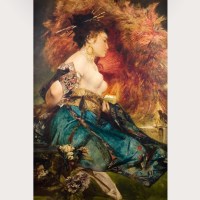
The Olivier describes Salomé by Yaël Farber as a ‘new’ play. Not quite. It premièred in Washington a couple of years ago. And I bet Farber was thrilled at the chance to direct this revival at the National’s biggest and best equipped stage. She approaches the Olivier’s effects department like a pyromaniac in a firework factory. She wants everything to go off at once. And it does. Goatherds yodel. Bells bong. Flutes warble. Birds parp. A revolving conveyor belt twirls spare actors around the stage in dizzy circles. Chord surges swell and fade on the soundtrack. Kneeling shepherdesses sift mounds of soap powder into mahogany salad bowls.

Around the horn

Music

The concert began with a flourish and a honk. Well, of course it did. Telemann wrote his last Ouverture-Suite in F major for the Landgrave of Darmstadt. The Landgrave loved hunting, and in the 18th century hunting meant horns. And horns mean honks. If you’ve ever played the horn — applied 12 feet of coiled metal tube to your face and tried, through a combination of lip muscles and willpower, to make the damn thing sing — you’ll know that no amount of hoping, praying or practice can prevent the occasional squawk. The two excellent players in Florilegium’s concert at St John’s Smith Square, moreover, were using 18th century-style horns — without the valves and additional plumbing that render the modern beast just about controllable.

Crime and punishment | 25 May 2017

Radio

‘Hell is better than what I personally witnessed,’ says Ben Ferencz, who was one of the American troops sent in to the Nazi death camps to collect vital evidence. ‘Dead bodies mingled with those alive. Piles of bones waiting to be buried. The smell of burning flesh. Those who were still alive pleading with their eyes.’ All of which we have heard many times before, perhaps too many times. But then Ferencz added, ‘SS men trying to flee, running away, and the inmates, those who could still walk, trying to chase them, grabbing at them.’ It was an unusual, vivid detail that captured the attention. Ferencz was talking to Emma Barnett in her slot Eye of the Storm on Radio Five Live last week. Not that Barnett had much chance to say anything.

Period drama

Music

Harpsichordists are supposed to make love, not war: Sir Thomas Beecham famously compared the sound they make to ‘two skeletons copulating on a tin roof’. But now two masters of the instrument, the Iranian-American Mahan Esfahani and the German Andreas Staier, are locked in mortal combat. For connoisseurs of finely tuned insults, it’s riveting stuff. For their colleagues it’s a wretched business, because one of the two musicians is setting fire to his own reputation. Also, a third harpsichordist — a gifted young Frenchman, Jean Rondeau — has been cruelly dragged into the feud. It goes without saying in period instrument circles that Esfahani picked the fight.

The great rock’n’roll swindles

Television

Birds have been giving me a lot of grief of late. There’s Tappy — the blue tit who has built his nest just underneath my bedroom window and makes rat-like scuffling noises that bother me at night and wake me early in the morning. And Hoppy, a mistle thrush fledgling who can’t quite fly yet, which means we have to keep the cat indoors, which means I have to deal with its horrible shit in the litter tray every day before breakfast. And the rookery in the big ash, whose inhabitants are very vocal, especially when one of their babies falls out of the nest and gets devoured by the dog. I may be only a couple of dawn choruses away from losing it altogether, as my fellow Brummie Ozzy Osbourne once famously did with a pair of white doves.

Impeccable filmmaking from Michael Haneke: Happy End reviewed

The title is ironic. The end is not happy for Michael Haneke's bourgeois French family, whose hamper of festering secrets the Austrian director unpacks with glee. His twelfth feature, which is vying for an unprecedented third Palme d’Or at this year’s Cannes Film Festival, features an acting masterclass from French veteran Jean-Louis Trintignant as Georges Laurent, a dotty patriarch who has lost the will to live. For added piquancy Haneke has set his latest tale in the northern French city of Calais where po-faced immigrants stroll silently about the streets - their lack of menace no doubt intended as a counterpoint to the dastardly doings of the Laurent family.

Amusing, waspish take-down of Jean-Luc Godard: Redoubtable reviewed

Jean-Luc Godard’s famous dictum was: 'all you need for a movie is a girl and a gun'. In Redoubtable, French director Michel Hazanavicius’s jaunty biopic of Godard, set during the student insurrection of 1968, which premièred yesterday at Cannes Film Festival, there is plenty of the first and none of the latter. The girl is Anne Wiazemsky, Godard’s teenage bride and one-time muse, who wrote an elegant memoir of their time together, Un an après, which is the basis for Hazanavicius’s film. Wiazemsky’s role is taken by French-English actress Stacy Martin who reveals almost as much flesh here as she did in Lars von Trier’s Nymphomaniac.

Coffee, mist and brilliance: Sky Atlantic’s new series of Twin Peaks reviewed

So much coffee. Just like in the original, the characters in the new series of Twin Peaks get through so much coffee. Major characters huddle around it in diners. Background characters raise mugs to their lips. Entire scenes revolve around the stuff. There’s just so much coffee. And, I’m proud to say, I played my part too. I knocked off an entire cafetière so that I’d be awake for the two-part opening to the series, which aired at 2am this morning on Sky Atlantic. And I finished another cafetière to write this post. This is not an occasion I was going to miss. Not only is the return of Twin Peaks, after an absence of 26 years, a big deal in itself; it’s also happening at just the right time.

League of nations

Exhibitions

‘Are you enjoying the Biennale?’ is a question one is often asked while patrolling the winding paths of the Giardini and the endless rooms of the Arsenale. It is not easy to answer. The whole affair is so huge, so diverse and yet — in many ways — so monotonous. Like the EU, an organisation with which it has something in common, La Biennale di Venezia believes in the principle of subsidiarity. Therefore individual nations are allowed to do what they like within their own pavilions. However, there are also strong homogenising forces at work — so much of what is on view in the national pavilions and elsewhere tends to fall into certain approved categories: notably video art, photography (often rather dull) and messy installation.

A method to his madness

More from Arts

I first came across the extraordinary creations of the artist and illustrator William Heath Robinson at least 60 years ago. I loved them, even though I may not have understood every nuance. When I look once more at old favourites such as the machine for conveying peas to the mouth I often spot in the corner some little twist or joke that I had not seen before. What also wasn’t clear at the time is how prescient some of his contraptions were — in one illustration you can see a prototype selfie stick; in another he invents the silent disco. Many of his madcap solutions were semi-serious responses to societal problems. Some weren’t far off what serious inventors were coming up with themselves.

The play’s the thing | 18 May 2017

More from Arts

Donald Winnicott once told a colleague that Tolstoy had been perversely wrong to write that happy families were all alike while every unhappy family was unhappy in its own way. It is illness, Winnicott said, that could be dull and repetitive, while in health there is infinite variety. Winnicott was reared in an environment of plain-speaking west-country Methodism. He was a people’s doctor who earned his spurs in the crowded children’s wards of east London’s wartime hospitals, allergic to dogma and fearless of being labelled a heretic. He believed that mothers did not need experts to tell them how to care for their own babies and, equally, that artists didn’t need to be justified or understood by psychoanalysts.

Killing time | 18 May 2017

Theatre

Jez Butterworth’s new play The Ferryman is set in Armagh in 1981. Quinn, a former terrorist, has swapped the armed struggle for a farming career and now lives with his sick wife, their countless kids, his sister-in-law and her only son. But the IRA, who murdered his brother as punishment for his disloyalty, are due to pay a visit with unknown intentions. More violence, perhaps? Protection money? Or both. Well, neither, it turns out. They merely want Quinn to refrain from blaming his brother’s death on them. Rather a low price to ask. And yet Quinn is willing to defy them even though he knows they repay disobedience with murder, and he now has a dozen vulnerable dependents to protect. These plot elements don’t quite stack up.

Police force

Television

I’ve often thought that a good idea for an authentic TV cop show would be to portray the police as neither dazzlingly brilliant (the traditional approach) nor horrifically corrupt (the traditionally subversive one) — but just a bit hopeless at solving crimes. There is, though, one thing that prevents the idea from being as original as I’d like: this is how the police already come across in many true-life dramas. Take, for instance, the harrowing and — given its high-profile scheduling — extremely brave Three Girls (BBC1, Tuesday to Thursday), which provided an unsparing and wholly believable account of the Rochdale child-grooming scandal.

False start

Opera

When a composer begins an opera, they create a world. You don’t need a full-scale overture: the tear-stained violins that Verdi drapes over the opening bars of La traviata do the job perfectly. The orgasmic upswing that launches Der Rosenkavalier, the cosmic hum that sets the Ring on its course — those very first notes tell you exactly where you are and what’s at stake. Puccini gets it just right at the start of La bohème: a cheerful orchestral clap on the shoulders that shoves you straight into the boisterous, bantering world of these four incurable optimists. Not here. André Barbe & Renaud Doucet’s new production for Scottish Opera opens in modern Paris, with no Puccini to be heard.

Moment of truth | 18 May 2017

Radio

Two extremes of the listening experience were available on Monday on Radio 4. The day began conventionally enough with Start the Week, chaired by the deceptively genial Amol Rajan (now in charge of The Media Show), whose warm, inviting voice fronts a keen, intense intelligence. He guided his guests through a conversation about our post-truth world which, apart from the subject-matter, could have graced the airwaves in the 1950s. This was a masterclass in elevated discussion, so graceful were the exchanges, so theoretical the ideas, yet so clear the meaning.

An artist of the quickening world

More from Arts

What is it about Yorkshire, particularly Leeds, that it has bred or trained such a succession of famous modern sculptors? Moore, Hepworth, Armitage and, although it stretches the point, Hirst. All attended Leeds art schools and Armitage was born there on 18 July 1916. Everyone knows Moore, Hepworth, Hirst. But Armitage? How many under 60 remember him? Conventional opinion confines his relevance to the 1950s. The Kenneth Armitage Foundation (of which I was a trustee) has marked his centenary with an overdue restoration. There have been two books — Kenneth Armitage Sculptor, edited by Ann Elliott, and The Sculpture of Kenneth Armitage by James Scott — and three exhibitions.

Roving eye

More from Arts

Photography has many genres, even more than painting, and most photographers achieve fame by focusing on one of them. There are technical reasons for this. Armed only with a bunch of brushes and a palette of colours, a painter can achieve a variety of effects — close-up, distance, soft or sharp focus, motion — for which a photographer needs a battery of cameras and associated paraphernalia in the form of lenses, films, lights and filters, and the technical know-how to get the best out of each. There is also professional snobbery. Jobbing photographers who work across genres for magazine assignments are less likely to be taken seriously as artists. The distinction may be artificial (pun intended) but it exists, and it explains why New York photographer Marvin E.

Animal magnetism

Arts feature

‘I frequently went to bullfights with Picasso,’ Sir John Richardson remarked, quite casually, as he showed me around the exhibition Picasso: Minotaurs and Matadors, which he was installing at the Gagosian Gallery, Grosvenor Hill. He mentioned this by way of explaining why a large and splendid linocut was inscribed to him by the artist: ‘à mon cher ami.’ They saw many fights together in the 1950s, either in Nîmes or Arles. Picasso took these occasions seriously. ‘If the fight was going well he was silent, concentrating totally. What he couldn’t stand was people talking. He would sigh and say, “Oh, I wish they’d shut up.” All around him people were shrieking if something went wrong, but he was absolutely cool as can be.

Blondie: Pollinator

More from Arts

Ah, Blondie. Those happy days of glorious power pop, chilly disco and rich, fruity vocals — Debbie Harry yearning away like a very bad alleycat on heat. ‘X Offender’, ‘In the Flesh’, ‘Picture This’ and that one where she’s in the phone booth, apparently gagging for it. People knock it, but the late 1970s wasn’t a bad time to be a teenager. And while Blondie may have been a rather calculating act, cleverly positioned on the fringe of punk and the fringe of pop and the fringe of disco and later even rap, they were at least likeable and the tunes were, largely, effortlessly and simplistically terrific. And then there was Debbie.

Bingeing on Bach

Music

Coined in 1944, ‘completism’ is a modern term for a modern-day obsession. What began as a phenomenon of possession — whether of comic books, records or stamps — has evolved in the age of Spotify, Netflix and cloud computing. No activity defines current cultural trends better than binge-watching, completism taken to its logical extreme: art turned extreme sport. It’s an attitude that has found a natural home in the concert hall and opera house (what is Wagner’s Ring Cycle, after all, if not the original box set?) where length has long been fetishised and endurance accepted. But just as new media has changed the way we make art, so new contexts have changed how we consume it.

Mild things

Opera

English Touring Opera is playing safe this spring, with Tosca and Patience, and was rewarded, in Cambridge at least, with full houses. Its Tosca has been moderately reviewed, and that is about what it deserves. There is only one set, designed primarily with the tableau of chorus and soloists at the end of Act One in mind. Not at all atmospheric, it has to conjure up for us a church, a room in a palace, and dawn at the Castel Sant’Angelo, but scarcely succeeds with any of them. The soloists have a heavy weight of responsibility, which only the Tosca of Paula Sides fully managed. She is fine-looking, slim, good at acting temperamentally, and a powerful singer, though a slightly short-breathed one.

Serial offenders

Television

Since completing season two of the brilliant Narcos, I’ve been unsuccessfully looking for a replacement serial drama that is more appealing than a bath and early bed. But the problem with TV these days is that series like Breaking Bad have set the bar so high that one ends up like a jaded emperor, forever rejecting good-but-not-quite-good-enough stuff for the most trivial of reasons. Better Call Saul (Netflix original), for example. I’ve tried getting into it a couple of times now (and probably will again because so many people rave about it) because I love Bob Odenkirk’s dodgy lawyer character. But I found he worked better as light relief in the context of Breaking Bad’s otherwise relentless and unforgiving bleakness.

Teenage kicks | 11 May 2017

Radio

Imagine living in a country where the average age is under 16 (in the UK it’s currently 40 and increasing) so that everywhere you go you’re surrounded by teenagers. It sounds exhilarating. Such optimism and energy; the sheer vitality of young blood coursing through the streets. How brilliant, too, for a country to be unfettered by how things have always been done, no elders to restrain them, hold them back, warn against change. But nothing is that simple. For The Compass: A Young World (Wednesday) on the World Service (produced by Mike Gallagher), Alan Kasujja took us to his native Uganda to find out what it’s like to walk down a street where no one shuffles along, wearied by the years.

Farming today

Cinema

There are bigger entities landing at your local multiplex this week. An ancient indestructible franchise is re-re-(re-)booted in Alien: Covenant. In Jawbone, it’s seconds out for yet another boxing movie. Miss Sloane is that non-staple of the repertoire, a glossy feminist thriller about public relations. Something there for almost everyone. But there’s also a low-budget British film called The Levelling, which has a very Brexit-y theme — the travails of the farming industry — so let’s pull on our wellies and have a gander. The title alludes to the Somerset Levels, in the news in 2014 when rivers rose to drown the nether parts of southern England. ‘Save our village, dredge the river,’ says a forlorn sign in an inert wintry landscape.