Vaccine

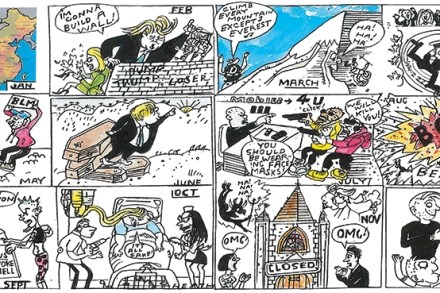
Portrait of the year: Coronavirus, falling statues, banned Easter eggs and compulsory Scotch eggs

January Boris Johnson, the Prime Minister, signed the EU withdrawal agreement, sent from Brussels by train. Sajid Javid, the Chancellor of the Exchequer, promised ‘an infrastructure revolution’ in the Budget. An American drone killed Qassem Soleimani, an Iranian Islamic Revolutionary Guard commander, near Baghdad airport. Iran carelessly shot down a Ukrainian airliner taking off from Tehran, killing 176. Bush fires raged in New South Wales. Cases of acute viral pneumonia were noticed in Wuhan in central China. February Eighty-three British evacuees from Wuhan were quarantined on the Wirral. The Department of Health classified Covid-19 as a ‘serious and imminent threat’. In Hubei 68 million people were made to stay at home.
Ring out, wild bells: 2021 will be a year of renewal

Save for those old enough to have lived through the second world war and its immediate austere aftermath, it would be hard to remember a Christmas which felt less festive. Or a new year that brings such foreboding. In spite of the severe restraints on our lives, which have been in place for months now, it seems likely that we will see some sort of third coronavirus wave with a third lockdown also on the cards. And at the same time, Britain will be embarking on a Brexit adventure that many people still see as reckless and unwanted. Yet if we look a little beyond the immediate future, things begin to appear brighter.

Is zero Covid achievable? A scientific debate about the virus

Throughout the year Carl Heneghan, professor of evidence-based medicine at Oxford, and Simon Clarke, associate professor of cellular microbiology at Reading, have written for The Spectator about the virus and the government’s measures to contain it. They have had very different outlooks, but can they agree about what will happen next? They start by looking back at their early predictions. CLARKE: During the first wave I said: don’t lock down too quickly because there will be a cost. People won’t like it. But if we had acted sooner, perhaps we wouldn’t have been locked down for quite so long and the death toll probably wouldn’t have been so high.

Why mRNA vaccines could revolutionise medicine

Almost 60 years ago, in February 1961, two teams of scientists stumbled on a discovery at the same time. Sydney Brenner in Cambridge and Jim Watson at Harvard independently spotted that genes send short-lived RNA copies of themselves to little machines called ribosomes where they are translated into proteins. ‘Sydney got most of the credit, but I don’t mind,’ Watson sighed last week when I asked him about it. They had solved a puzzle that had held up genetics for almost a decade. The short-lived copies came to be called messenger RNAs — mRNAs – and suddenly they now promise a spectacular revolution in medicine.

Europe’s slow vaccine approval is testing Germany’s patience

The Bundestag can’t be an easy place to be a politician right now. At the start of the pandemic, Germany seemed to be steering a steadier course than other countries, who looked on in awe at the speed with which it launched its testing regime. But as Britain, Canada and the USA begin vaccinations, Germany has been left tapping its feet. It is still waiting for the European Medicines Agency to approve the Pfizer vaccine, which it is set to do on 21 December – a state of affairs that is rapidly turning into a national and international embarrassment. The German public have grown increasingly irritated at the delays. ‘It’s just beyond belief,’ the Bild newspaper wrote in an editorial.

Why we can be confident in the safety of Covid vaccines

At the beginning of the Covid crisis, some expressed the hope that a pandemic might at least bring a divided country back together. Instead, public discourse descended to new levels of bitterness as a fresh schism replaced that caused by Brexit. On one side were those who thought tens of thousands would die because government action was too slow and half-hearted, and on the other, those who thought lockdown to be an over-reaction that inflicted grave damage on our economy and society. Both sides ought now to be able to agree that this week marks a significant turning point in the pandemic. The first shot of an approved Covid vaccine to be administered in a public programme anywhere in the world was given to Margaret Keenan, a 90-year-old woman in a Coventry hospital.

Portrait of the week: Vaccine shots, Brexit stutters and a frosty reception for the royals

Home The Pfizer/BioNTech coronavirus vaccine began, rather slowly, to be given to some old people in hospital and health workers. Margaret Keenan, 90, was the first outside clinical trials to receive it. At the beginning of the week, Sunday 6 December, total deaths (within 28 days of testing positive for the coronavirus) had stood at 61,014, including 2,771 in the past week; the number for the week before was 3,617. Rita Ora, the singer, a week after apologising for entertaining 30 people at a birthday party on the ‘spur of the moment’, remembered to apologise for not having gone into quarantine at the time, after returning from Egypt. England’s cricket tour of South Africa was abandoned after a South Africa player and two hotel staff tested positive for coronavirus.

Watch: 91-year-old’s charming post-vaccine interview

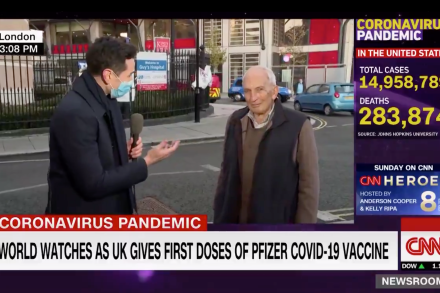
The eyes of the world were on Britain today, as the first patients began to receive the Pfizer vaccine, after it was cleared by Britain’s health regulators as safe to use. Unsurprisingly, foreign TV news channels sent their crews to British hospitals to witness the first patients receiving the jab. Outside Guy’s Hospital in London, CNN managed to catch up with one charming 91-year-old, who had managed to receive the jab after ringing up the hospital to see if they had any spare shots going. As Martin Kenyon explained though, his main difficulty in getting the vaccine was finding a parking spot in London. Mr Kenyon explained that he had taken the vaccine as, ‘Well, there’s no point in dying now, when I’ve lived this long.

Watch: vaccine minister rules out ‘immunity passports’

This morning the new vaccine deployment minister, Nadhim Zahawi, appeared to change his tune when it comes to the use of ‘immunity passports’ for the British public. After telling the BBC last week that UK residents might need some proof of their Covid vaccination status to dine out at a restaurant or attend a sporting event, Zahawi rolled back his comments on Spectator TV. In a Q&A following his keynote speech at The Spectator's Health Summit (held in partnership with MSD), Zahawi told broadcaster Alastair Stewart that so-called 'immunity passports' were not actually on the cards: 'There will not be an immunity passport. I may have misspoken or it was conflated in the interview I gave. I was talking about the brilliant use of the app...

Russians are wary of Putin’s vaccine

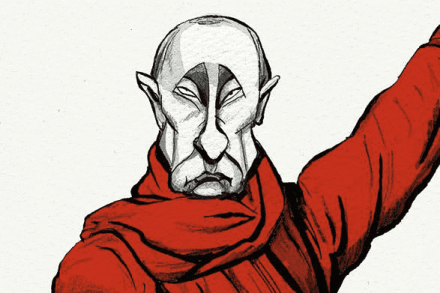
Never one to let a bandwagon pass by, Vladimir Putin launched his own national vaccine programme the moment Britain said it was starting its roll-out. Given how badly Russia has been hit, you would expect it to be a popular move. But Russians themselves seem cautious, not least because they mistrust the Kremlin. On Thursday, Russian health officials announced a new record of more than 28,000 coronavirus cases reported in a single day, bringing the total caseload to almost 2.4 million. Russia has the world’s fourth-worst case numbers, behind only the USA, India and Brazil, with over 41,000 deaths to date. Or at least 41,000 according to official statistics — confidential documents leaked to the press suggest the real figure is at least 75,000.

Portrait of the week: Tiers, Scotch eggs and a devastated high street

Home The Commons voted by 291 votes to 78 for new coronavirus regulations putting 55 million people in England into the restrictive Tier 3 or the little less restrictive Tier 2, apart from the 700,000 or so folk of Cornwall, the Isle of Wight and the Scilly Isles. There were 55 Tory rebels, whom the government had attempted to placate by publishing a 48-page dossier, generally regarded as thin stuff. There would, they were also assured, be a review on 16 December of the areas put into tiers. ‘We do want to be as granular as possible,’ Boris Johnson, the Prime Minister, told the Commons encouragingly. Labour let the regulations go through by abstaining, though 15 Labour MPs voted against. Wales prohibited pubs from selling strong drink and made them close at 6 p.m.

Letters: Labour’s left vs left struggle

Left vs left Sir: Your leading article (‘Comfort spending’, 28 November) makes the classic mistake about modern politics which prevents so many from grasping what is going on. You refer to Sir Keir Starmer as the leader of a battle against Labour’s left by its ‘centre’. Since Neil Kinnock’s pantomime battle with Militant in 1985, political journalists have been beguiled by a fantasy. They think that Labour leaders who attack villainous leftist factions do so in the cause of moderation. But this is in fact a battle by the sophisticated left — of post-1968 cultural revolutionaries — against the crude and embarrassing steam-powered left of Militant or Jeremy Corbyn. Each thinks the other is the wrong kind of socialist.

The problem with ‘immunity passports’

Just a few months ago it was not certain that we would find a vaccine for Covid-19. Now, we have three, with potentially more on the way — and the rollout of the Pfizer jab due to begin next week. It’s an extraordinary achievement for the research community, our best hope of restoring normal life and a bloody relief after a year of disappointments. But the government, at least, should beware of geeks bearing gifts. To get us to herd immunity, they have to persuade somewhere between 60 per cent to 90 per cent of us to get vaccinated. You can see Boris Johnson’s problem. If he makes vaccination completely voluntary, we may never hit the target we need for herd immunity. It’s not just anti-vaxxers.

Did Brexit lead to the UK’s vaccine success?

Today the United Kingdom became the first country in the West to clinically authorise a vaccine protecting against Covid-19, after the medicines regulator, the MHRA, said the Pfizer/BioNTech vaccine was safe to use. The announcement puts Britain ahead of Europe when it comes to rolling out the vaccine, as the EU’s own regulator, the European Medicines Agency (EMA), has not yet approved the vaccine. While Britain will begin administering Pfizer’s vaccine next week, countries like Belgium have announced that they will start their vaccination campaigns in January, subject to EMA approval. When it comes to vaccines, a few weeks of delay can make a big difference, given the economic and health costs of the pandemic.

Two unanswered questions on the Covid-19 vaccine

Britain, we learned this morning, has become the first country in the world to approve the Pfizer/BioNTech vaccine, which is likely to be deployed from Monday onwards. Is Britain being reckless, or are other countries dragging their heels?  The first point to make is that, however tempting though it may be to think so, it is not a case of Britain taking advantage of new-found freedoms enabled by Brexit. It may be in the future that Britain develops a more nimble regulatory system than the EU, and that British patients can benefit for the earlier administration of drugs, but the UK will remain under the European Medicines Agency’s regulatory system until the end of the transition period in a month’s time.

Piers Morgan tries to jump the vaccine queue

This morning the UK became the first country in the West to licence a vaccine, after regulators approved the Pfizer/BioNTech shot. The ruling opens the way for the vaccine to be rolled out nationwide, after the UK purchased 40 million doses of Pfizer’s vaccine. The Health Secretary has said we will have 800,000 doses ready next week. So far, it seemed fairly clear who would be first to receive the vaccine. The government has published a list of ‘priority groups’ who will be first in line, starting with those who live and work in care homes, followed by the over-80s and NHS workers, before progressively moving down the age bands. The idea is to make sure the most vulnerable have access to the vital protection they need while vaccines are still in short supply.

What we know so far about the Oxford vaccine

It’s three for three as far as positive outcomes from Covid vaccine trials are concerned. But the announcement from AstraZeneca and Oxford University, at a first glance, may not seem to be as exciting as those from Pfizer-BioNTech and Moderna. The figures are a bit of a head-scratcher, so let’s look at them in more detail. Monday's results from AstraZeneca and Oxford University state that the combined Phase 3 interim analysis from their COV002 and COV003 studies (based in the UK and Brazil respectively) included 131 Covid-19 cases and that the vaccine was found to be 70.4 per cent effective overall — but that vaccine efficacy in two dosing subgroups was 90 per cent in one and 62 per cent in the other.

How to win over vaccine sceptics

We have a vaccine. In fact, we have three — and more are on the way. While we still need to scrutinise the full data from the Pfizer, Moderna and AstraZeneca trials, the initial reports are stunning: vaccines that in some cases exceed 90 per cent effectiveness, and might be ready within weeks. Previous surveys showed a big appetite for the vaccine, but more recent ones are concerning. According to YouGov, only 67 per cent of British people say they’d be ‘likely’ to get the Pfizer virus, with 21 per cent saying they’d be ‘fairly’ or ‘very’ unlikely to. Other polls also find that scepticism towards the vaccine is increasing.

We need a dose of vaccine realism

One of my geniuses as both a commentator and a character is to confront what for most normal people amounts to unqualified good news and immediately spot the downside. I’m a professional party-pooper. Hence, as promising early results from three major Covid vaccine trials inspire a flurry of jubilant metaphors about tunnels and cavalry, your downer columnist glowers — for the New York Times didn’t tag Shriver ‘the Cassandra of American letters’ for nothing. Beware, warns this killjoy crank, allowing your minders to keep you in confinement ‘just a little bit longer’ and then you’ll be let out to play.

The problems with Boris Johnson’s ‘freedom pass’

In one of his early lockdown press conferences, the Prime Minister suggested that those who tested positive for Covid could be released from lockdown because they’d be immune. The idea of an 'immunity certificate' was then dropped, as it raised obvious questions of unfairness: would you really have a caste of immuno-privileged people exempt from the lockdown rules?  But now the idea seems to be back. The Sunday press reported on an Orwellian-sounding ‘freedom pass’ that would be granted to those who complied with a government-mandated testing regime. A source told the Sunday Telegraph that such a pass would 'allow someone to wander down the streets and if someone else asks why they are not wearing a mask, they can show the card, letter or an app.