Uk politics

Getting the balance right

So what's happened to the Tories' policy-a-day blitz that was meant to fill all of January?  Tory announcements and speeches were happening thick 'n' fast at the beginning of last week, and, obviously, we had Cameron's speech yesterday – but it hasn't been quite as non-stop as we were led to believe.    This is intentional.  As James has already pointed out, the Tories were all too happy to let Labour scrap underneath the limelight last week.  And there's also a realisation that they may have been overdoing it previously.  Some Tories around Westminster are now talking more of one Big Announcement per week.   That sounds about right to me, and deals with some of the qualms I raised before Christmas.

Turnbull savages chancellor Brown

Andrew Turnbull, who was permanent secretary at the Treasury from 1998 to 2002 and Cabinet Secretary from 2003 to 2005, has previous when it comes to criticising Gordon Brown. But his recent piece in the FT — ‘Six steps to salvage the Treasury’ — is one long barely coded attack on the PM. Take this line: “First and perhaps foremost, it [the Treasury] needs a strong ministerial team – a chancellor who wants to be chancellor for the full term rather than coveting the prime minister’s job.” Interestingly, Turnbull comes out in favour of the Tories’ plans to create an Office of Budgetary Responsibility. I know this is derided by some as yet another quango, but I actually think it will be an important reform.

Islam4UK: the clue’s in the name

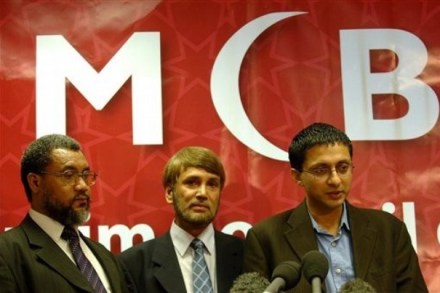
Irony of ironies, proselytising liberal and convinced egalitarian, Anjem Choudary, told the Today programme that the banning of Islam4UK, al-Muhajiroun and their aliases is a ‘failure of democracy’. A further irony is that he is right, sort of. Alan Johnson's decision is understandable but incorrect; the surest way to silence these repugnant extremists and reactionaries is through equality and free debate, even though they hold those principles in contempt. The members of Islam4UK abuse freedom to peddle their reactionary ideals and disregard their duties towards society, but that is no reason to proscribe the group.

The Iraq Inquiry should call Gordon Brown now

Alastair Campbell is before the Iraq Inquiry. As one of Blair’s closest aides, Campbell’s role in the run-up to the Iraq war was key. But I suspect the spinner-in-chief will be doing what he was originally hired to do: namely, protect his master by attracting the incoming fire. In this case, though, he will be helping Gordon Brown, not Tony Blair.   Because it is Brown’s role in the Iraq War, not that of Blair, that is the most obscure part of Britain’s modern history. As chancellor, Brown was the second most powerful man in government. He held the purse strings. If he had opposed the Iraq War, it is hard to see Tony Blair succeeding in persuading Cabinet, the Parliamentary Labour party or the House of Commons.

A sensible Tory rethink on marriage tax breaks

There's something quite refreshing about David Cameron's plan to offer a tax break to married couples.  It says, simply: this is what I believe.  And it does so in spite of polling data and strategic arguments to the contrary.  This is one area where you certainly couldn't accuse the Tory leader of caring too much about what other people think.  But refreshing or not, that doesn't make it good policy.  Of course, there's a tonne of empirical data which demonstrates the benefits of marriage.  That's important and persuasive.  But, as I've written before, there are reasons to doubt the efficacy of a tax break in particular.

Cameron takes a brave line on family policy

David Cameron’s speech today at the launch of Demos’s Character Inquiry was both brave and significant. His message was that it is parenting, not material wealth, that plays the most important role in determining a child’s prospects in life. As Cameron put it, ‘What matters most to a child’s life chances is not the wealth of their upbringing but the warmth of their parenting.’ This message is easily caricatured — ‘Millionaire Cameron says poverty doesn’t matter’ — but it is important and, as recent academic research shows, true. (This is not to say, that poverty doesn’t matter, it clearly does, but that material poverty is not the sole determinant).

Military manoeuvres

Just when you thought it was safe to go back into the water, the leadership speculation starts stirring again. It's not Gordon Brown who's the subject of it this time, though - but rather the defence chief, Air Marshall Sir Jock Stirrup, who, according to today's Times, is due for the chop after the next election. Either his deputy, Nick Houghton, or the Army chief, David Richards, are likely to fill the breach. The story brings to the surface long-simmering tensions at the top of the military establishment about Sir Jock's leadership. The Times says that Gordon Brown did not force out the defence chief because he did not want more rowing with the military after General Richard Dannat's retirement.

Ed Balls says the same stuff, differently

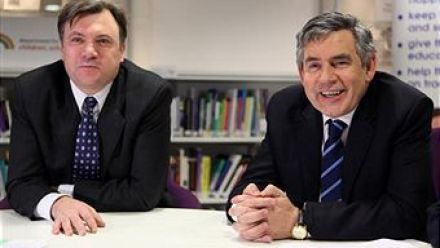
The road to Damascus has nothing on this.  Ed Balls – in interview with the FT – has condemned the class war strategy, called for an end to Labour figures briefing against each other, and suggested that the government should be more "upfront" about spending cuts.  Hallelujah!  What a difference an attempted coup makes!  And so on and so on. But wait a minute.  What does the Schools Secretary actually say?  Worth looking at, that – because Balls hasn't so much changed his arguments as changed the way he makes them.  Take, for instance, what he says about class war: "'I’m totally against a class war strategy,' he says.

It is immaterial who fronts Labour’s campaign

Divide and conquer, that is what preoccupies the Prime Minister. Later today, Gordon Brown will address the Parliamentary Labour Party to reassure them of the strength of his leadership and to invigorate the party by setting it on an election footing. How he achieves the former is anyone’s guess but he will realise the latter by investing Labour’s three election supremos: Mandelson, Harman and Douglas Alexander. In typical Brown style, these lieutenants’ roles are deliberately ill-defined. Who has ultimate authority? Who will be the attack dog? What is the difference between day to day running and managing an overall strategy? And which takes precedence? A pastmaster at internal intrigue, Brown will thrive as his actors compete – divide and conquer.

Hoon may strike again

David Miliband lacks the gumption to play Brutus, but does Geoff Hoon? The Sunday Times has obtained correspondence between Hoon, Brown and Blair illustrating that the then Chancellor overturned Treasury assurances that the MoD would receive additional funds for helicopters in Iraq and Afghanistan. Brown wrote: “I must disallow immediately any flexibility for the Ministry of Defence to move resources between cash and non-cash.” Once again we see the (supposedly) miserly Chancellor holding Blair to ransom at any opportunity, regardless of the consequences. Whilst Brown is a spectre of a Prime Minister, he was anything but as Chancellor.

Cameron has the positioning right – but fiscal questions remain<br />

Here, CoffeeHousers, is my take on this morning's Cameron interview: 1. General demeanor: excellent, articulate, confident. The complete opposite from Brown. It does make you think that he should wipe the floor with Brown in the TV debates. 2. “Last week we saw William Hague and George Osborne going to Afghanistan together. First shadow Chancellor, the man who is going to be in charge of the money, on the frontline seeing what is going on in Afghanistan”. Indeed, but the NHS pledge and deficit cut pledge imply deep cuts to the military. To govern is to choose, and Cameron has made his choice: NHS spending before the military.

What’s Ed Miliband playing at?

There's that prism I mentioned: Ed Miliband writes an article for the Observer, which ostensibly backs Gordon Brown in the first paragraph, and it's written up as the first, tentative step on his own leadership campaign.  Thing is, that's probably also true.  The clue is in how far he steps off his ministerial beat*, to deliver an overall prospectus for the Labour Party: "Let's start, as our manifesto will, with what the country needs in the coming five years. It can't be about business as usual. We need to rebuild our economy in a different way from the past, with more jobs in real engineering not just financial engineering.

A tale of two interviews

So, at the end of a hyperactive week in politics, we've got a pair of interviews with Brown and Cameron.  The PM chats with the News of the World, while Cameron appeared on the Marr sofa earlier. One general similarity between the two interviews stands out: neither is particularly confrontational. Rather than chiding Labour after Alistair Darling's admission yesterday, Cameron adopted a more conciliatory tone, saying things like: "If [the government] ... set out reductions that we think make sense we won’t play politics with it, we’ll say yes."  And, for his part, Brown only nods towards the "big choice" to be made at this year's election, and doesn't mention the Tories once.  Quite rare that, for Gordon.

The NHS is unfair, why should it remain sacrosanct?

I’ve just heard a truly shocking story. A neighbour, left brain damaged by a haemorrhage, arrived at St Richard’s hospital in Chichester on Tuesday afternoon for her check-up. She was discharged at 2 am. No beds or ambulances were available and she was sent out into the night, and of course a blizzard.   One shouldn't extrapolate that this represents standard NHS care; it doesn’t. But care is hindered by a lack of resources and facilities. Despite throwing money at the NHS, vast areas of the country remain ill-equipped, and not merely at Britain’s rural extremities. For example, there is no specialist cardiac unit between London and Portsmouth. Feel your left arm go tense in Petworth and start trusting to God.

Security and Defence Review 101

Defence geeks are waiting to see how the Conservative Party intends to conduct a Security and Defence Review, if they are elected. By the time a new government comes to power, the Ministry of Defence will in all likelihood have produced a Green Paper, setting out initial thoughts on the future of the military, which is meant to lead on to a more substantive Strategic Defence Review.  But if the Tories want a process (and ultimately plans and ideas) that encompasses not only the MoD, but also the Foreign Office, DfiD, the security services and even parts of the Home Office, then a new kind of institutional vehicle will have to be set up. There are, broadly speaking, three options.

Darling’s honesty is good news for the country – but tricky news for Labour

Well, well, well - Darling's Times interview, which James reported earlier, sure is a significant moment, and one which more than deserves a place on the spending cut timeline which I put together last week.  In fact, let's see what it would look like alongside a few of the most recent entries: 9 December 2009: Pre-Budget Report 2009 forecasts Public Sector Net Borrowing of £176 billion, and Public Sector Net Debt of £986 billion, in 2010-11. 10 December 2009: Alistair Darling puts in a bizarre performance on the Today programme, claiming that the PBR implies that departmental budgets would remain “pretty much flat.” 10 December 2009: The IFS works out that the PBR implies departmental budget cuts of around 19 percent over three years.

More trouble lies in wait for the government

Labour lost the first week of the long election campaign. The Hoon and Hewitt plot and the late and tepid endorsements of Brown from key members of the Cabinet have highlighted the divisions within the Labour party. Hoon and Hewitt were right that stories about these decisions will not go away. They will run and run right up to polling day. The weekend papers will also not be good for Labour. To compound Labour’s woes, it looks like the big political story of early next week will be Alastair Campbell’s testimony to the Iraq inquiry, which threatens to dredge up memories of spin and Iraq. It should be remembered, though, that Campbell is a formidable performer and could come out of this appearance far better than expected.

Gordon Brown on fighting and winning…

Ok, I know Labour circulars will always fly the party flag – but the email that's just gone out in Gordon Brown's name has to win some sort of prize for sheer party political effrontery.  With the subject line "When we fight we win," here's how it begins: "If there’s one thing that our recent by-election successes and this week's coverage about the £34 billion credibility gap in the Tories’ spending plans shows us, it’s that when we fight, we win. I know that despite the icy conditions, so many of you are preparing to go out campaigning this weekend. That, for me, says it all about the spirit of our Labour Party – we never give in, we never give up, we fight for progress house by house, street by street, day by day.