Uk politics

Music hall act fails to cut it next to suave Etonian

Miliband’s in a mess. He makes it far too easy for Cameron to portray him as a hypocritical opportunist who sidles up to PMQs every week with lame soundbites and incoherent policies. How come? Perhaps because he sidles up to PMQs every week with lame soundbites and incoherent policies. Today he tried to unsettle the PM with the news that ‘members of his government’ (ie LibDems) ‘have given cast-iron guarantees that they would vote against a rise in tuition fees.’ This isn’t a Cameron problem. It’s a Clegg problem. Right issue, wrong tactics. Cameron had no difficulty adopting a noble but weary expression and praising his coalition partners for taking ‘courageous decisions’ in ‘difficult’ circumstances.

Hardly vintage stuff from Ed and Dave

Neither Ed Miliband nor David Cameron had a good PMQs. Cameron let his irritation at questions about the appointment of his campaign photographer to a civil service post show. It was also a bit rich for him to criticise a Labour MP for asking a question scripted by the whips when Tory MPs ask patsy questions with monotonous regularity, I counted at least four in this session alone. But the regular shouts of ‘cheese, cheese’ from the Labour benches were clearly riling the Prime Minister. But it wasn’t a good session for Ed Miliband either. His delivery was rather halting and he stumbled on his words far more than he usually does. His jokes didn’t quite come off either.

The tuition fees compromise

Away from the mid-terms, we have the little issue of tuition fees. David Willetts will today set out the government's response to the Browne Review, and it's expected to look something like this: a £9,000 cap on fees, but universities will have to show that they are making extra provisions for poorer students if they charge over £6,000. Students would effectively be loaned the money by the state, and would start paying it back once they earn £21,000 after graduation. It's certainly a compromise arrangement, constructed with one eye on the Lib Dems and another on the universities. For Clegg's backbenchers, there's a rejection of the unlimited fees advocated by Browne, and an overall emphasis on "fairness" and on helping the less well-off into university.

Victory, but there’s little triumphalism as Republicans look to court America

Hysteria has lapsed into disaffection: it was a bleak night for President Obama. But, despite the apparent immediacy of a ‘conservative moment’, there is caution in Republican circles this morning: both Clinton and Reagan won from similar positions in 1982 and 1994. The G.O.P's leadership knows that elections are not won from the extremes, as Barack Obama has discovered to his cost, and it is trying to calm the party’s often excitable fringe, which will be no easy task if Rand Paul's 'Tea Party tidal wave' is anything to go by. Ben Brogan recently highlighted the G.O.P’s growing ‘Stop Palin’ campaign, and David Frum adds his voice again.

Prisoner voting rights are undemocratic

It was unlikely that the Coalition could have played for any more time before lifting the ban on prisoner voting.  That was the tactic played by the previous Government, but now it seems the will of Strasbourg will prevail.  But the policy is wildly out of step with public opinion, hard to justify and difficult to administer – it is also another example of how our own Parliament and domestic courts have been undermined.     The public are opposed – usually on principle – to granting additional privileges to serving prisoners, especially when they have done little or nothing to earn it.  They are against voting rights in particular on the grounds that it is one of the rights that lawbreakers give up by virtue of their crime.

A day of Tory grumbles

Today is one of those days when you can’t walk around the Palace of Westminster without bumping into a Tory with a grumble about the coalition’s polices. First of all, there’s massive irritation that the government has been forced into agreeing that prisoners should have the right to vote. It has revived Tory concerns about the ECHR and annoyance that the presence of the Lib Dems in the government means that nothing will be done about it. Then, there’s this Anglo-French defence agreement. Tories are, understandably, deeply suspicious of anything that smacks of giving the French a veto over the deployment of British forces.

A wasted opportunity for EU reform?

David Cameron made his statement on last week’s EU summit yesterday, answering a range of questions on the 2011 EU budget increase and future changes to the EU treaties. The Tory backbenchers appeared to be on their best behaviour, but Cameron did make an interesting admission. Asked by Ed Miliband if he would he be repatriating powers, he pointed to a reassurance that the UK’s opt out from economic sanctions remained intact, which was not really in question in the first place, and spoke of “progress on the EU budget”. It slipped through virtually unnoticed, but this second remark is actually quite worrying.

The inviolable right of prisoners

After 6 years of resistance, the British government has submitted to the European Court of Human Right’s judgement that prisoners have the right to vote. It will use a case in the Court of Appeal to make the announcement and then prepare itself for compensation suits. Understandably, the government is furious that it has been forced to make a concession on law and order, an area where they are weak enough already. Even Dominic Grieve, a firm supporter of the ECHR, is understood to be exasperated. Straining to limit the political damage, Ken Clark hopes to limit the franchise to those prisoners sentenced to less than four years; judges may also be able to decide who to exclude.

In defence of Control Orders

David Cameron currently thinks the coalition is heading for a ‘f***ing car crash’ on Control Orders. While the Home Secretary Teresa May is now convinced of their necessity, many Liberal Democrats and some Conservatives disagree. Everyone would prefer potential terrorists be prosecuted, but sensitive counter-terrorism evidence cannot always be used in a criminal court. In addition, the European Convention on Human Rights decrees that terror threats cannot be deported to states where they could be tortured. Hoping to circumvent these problems, the previous government attempted detention without trial. When this was struck out in the courts, Control Orders were the best viable option left.

A harmful double standard

Professor David Nutt, the former Chief Drugs Adviser to the Government, has sparked controversy again today by pronouncing that alcohol is more harmful than heroin, crack, powder cocaine and methamphetamine. His findings are based on a paper published today, which builds on a 2007 journal that explored the same issues. So, is Professor Nutt right? If he is, what should the consequences be for public policy and, in particular, our systems of drug classification and alcohol taxation?   To find out, it is worth returning to Professor Nutt’s 2007 academic paper.  The relative harm of drugs is measured according to nine meters, taking into account the various aspects of physical harm, dependence and wider social harms.

All is not quiet of the welfare front

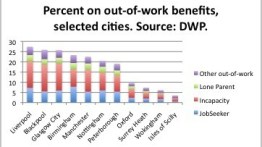
Welfare is fast becoming this parliament’s Ypres Salient - strategically critical, it is constantly contested. £20bn on social housing, £100bn on out of work benefits and £billions on universal benefits: welfare reform is where spending cuts are most conspicuous. A rhetorical confrontation is building and various tactical dispositions are being made. The Staggers’ George Eaton has an analysis that assumes that Labour’s current wedge-strategy (which I critiqued here) is not working because it is avowedly sectional, privileging those who might be caricatured as ‘undeserving’. Eaton argues that Labour must ‘launch a defence of the hard pressed majority’; those who work but still stand to lose, particularly families.

Confronting terror at home

As Julian Glover notes, Jack Straw let the cat out of the bag. ‘Never, ever, downplay the possible consequences,’ he says. The coverage of the recent bomb plot has largely ignored that it was foiled. That, by any definition, is a success, a vindication of our security services. Independent inspector Lord Carlile is right that improvements can be made to the bomb detection apparatus in airports and targeting security at the source of a threat – i.e. packages from the Yemen rather than package holidays. The previous government would have used this plot to introduce another wave of invasive legislation – never, ever, downplay the possible consequences to justify I.D. cards, deeper control orders and further suspension of Habeas Corpus.

The Lib Dems, breaking doors in anger

This one, from the Mail on Sunday, needs adding to the scrapbook: "Colchester MP Bob Russell’s fury over the Coalition’s housing benefit cuts boiled over at a stormy private meeting with the Deputy Prime Minister. To the astonishment of fellow Lib Dem MPs, it ended with Mr Russell storming out and slamming the Commons’ committee room door behind him. Witnesses said last night: ‘He took the door off its hinges.' In a bizarre twist, Mr Russell’s ally and fellow Lib Dem MP Mike Hancock - himself a fierce critic of Mr Clegg - tried to spare his colleague’s blushes by creeping back the following morning to repair the door before Commons authorities noticed it was even damaged.

The Tories rally after the Spending Review

It's just one poll, but today's YouGov effort for the Sunday Times seems to underline many of the themes of recent weeks. It has the Tories on 42 percent, 5 points ahead of Labour on 37 percent, and with the Lib Dems on 13 percent. So the Spending Review – accompanied, as it has been, by rows over housing and child benefits – has not yet had a precipitous effect on the Tories' poll rating. If anything, YouGov have had the blue vote rallying since 20 October. As always we should be wary of drawing too many conclusions from the shifting landscape of opinion polls and surveys, but some of YouGov's subsidiary findings could help explain the Tories' position. First up, 72 percent of respondents back the coalition's plan to impose a cap on housing benefit.

The ginger rodent

I wonder what they'll come up with for Uncle Vince? Nick Clegg is a closet Tory (nice homophobic overtone there), and Danny Alexander reminds anti-persecution supremo Harriet Harman of a ginger rodent. Alexander deigned to respond, saying:  'I am proud to be ginger and rodents do valuable work cleaning up the mess others lead behind. Red Squirrel deserves to survive, unlike Labour.'   Aside from being witless, the problem with Labour's assault  on senior Lib Dem politicians is that each one makes a future Lib-Lab pact ever more unlikely. After all, there aren't so many Lib Dems to insult.

Cameron’s euro battle is just beginning

David Cameron sold himself a hospital pass in Europe this week. His failure to secure a budget freeze has revealed that Britain's clout has been wildly exaggerated. The likely 2.9 percent budget increase is mildly inconvenient for Cameron politically, but it is immaterial in the grand scheme of the next round of budget discussions and the mounting wrangle about the Lisbon treaty. He will have to compromise, as he did this week. He made some ground, finding allies to resist an untrammelled treaty change - the Irish, the Dutch, the Danes, the Czechs and the Poles. The biggest prize will be Sarkozy, whose antipathy towards Merkel is arch - the ongoing diplomatic and military discussions between Britain and France must be about more than sharing aircraftless carriers.

Housing benefit reform is a Good Thing

Dressed with his effortless prose, Matthew Parris has a point (£) that proves why he is the leading commentator of the last two decades. Housing benefit reform is his subject and he urges his readers reject the legends that have accrued around the issue - not Boris, not Polly Toynbee, not shrill councils, not rapacious landlords and definitely not the government. No one, he says, has the numbers but there are several certainties: ‘The outcomes may not prove nearly as brutal as this week’s predictions. What (as I asked above) can we know? We know that comparisons with Paris are ludicrous. All of our big cities are speckled with very large-scale “social” housing of a type that is suited only to the income groups for which it was constructed.