Uk politics

The Miliband deception

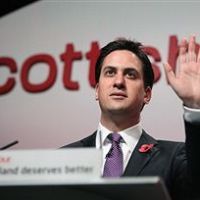
Ed Miliband's speech in Scotland this afternoon was a strange beast. So much of it was typical of the new Labour leader: for instance, the incessant stream of words like "optimism," "new" and "change". Some of it was rather surprising, such as the lengthy and warm tribute he paid to Gordon Brown at the start. One passage on the flaws of the Big Society (from a Labour perspective, natch) set out a philosophically intriguing dividing line. And his challenge over housing benefit was quite swashbuckling, in a Westminster-ish kind of way. But there's one line I'd like to focus on, because I'm sure it will come up again and again. Namely, this one: "Remember, our government paid down the debt before the crisis hit." Really?

Voters think the new generations look old and tired

There’s an intriguing detail in the latest YouGov poll. The number of people seeing Labour as old and tired is back up to 44 percent, which is where it was before Ed Miliband became leader.   The concern for Labour must be that the youthful, vigorous optimism that Ed Miliband is trying to promote hasn’t cut through to the public yet. Admittedly it is early days. But first impressions do matter in politics. Indeed, I must admit to being slightly surprised that the Tories are still generally ahead in the polls. I thought that the spending review would push Labour into the lead.   Something that, contrary to the media perception, might be helping the Tories is the ongoing rows over housing benefit and child benefit.

More perspective on housing benefit

A useful reminder of the opinion polls on housing benefit from ConservativeHome's Harry Phibbs: "...in coming out with such hyperbole Labour show themselves to be out of touch with the voters. An ICM poll in June asked: "Do you support or oppose imposing a maximum weekly limit of £400 on Housing Benefit." Support was 68% with 23% opposed. Even among Labour voters there was strong support - by 57% to 35%. A YouGov poll in August asked: "Here are some policies the coalition government have announced in their first hundred days. For each one please say if you oppose or support it?" Among them was: "Putting a limit on housing benefit." 72% expressed support. 17% said they were opposed.

Victory or defeat?

What has David Cameron achieved in Brussels so far? In truth, it's fairly hard to tell. In a meeting with his European Council counterparts last night, our prime minister didn't get the "freeze or a cut [in the EU budget]" that he mentioned last weekend. But ten other countries, including France and Germany, have now allegedly hardened their resolve not to go beyond the 2.9 percent increase that they agreed back in August. A Downing Street spokesman explains that these countries will resist the usual compromise between their 2.9 percent and the European Parliament's demand for 6 percent, when the two sides meet over the next 21 days.

Some perspective on housing benefit

Depending on who you read, the planned £400 a week cap on housing benefit is either comparable to Nazi concentration camps, death squads in Brazil, or ethnic cleansing in the Balkans Critics have ranged from the Mayor of London to the ultra Left. So it is worth taking a moment to get some perspective. Firstly, the general caps on housing benefit don't even impact on social tenants because they pay lower, subsidised rents, (though the £26,000 cap on the total amount of benefits per household might hit them). But for housing benefit claimants in the private sector outside London, less than 1% are affected by the cap. And even in London 9 out of 10 of private renters claiming housing benefit will be totally unaffected.

Sarah Palin and the presidency

It's not the confirmation that her fans are after, but it's pretty close: in an interview airing on US television this evening, Sarah Palin will say that she would run for the presidency, "if there's nobody else to do it." Which brings us neatly to this piece by John Heilemann in New York magazine, highlighted by Gideon Rachman over at the FT. In it Heilemann sets out how, despite the odds, Palin could actually triumph in 2012. It's a scenario which involves a generous sprinkling of ifs and buts, including Michael Bloomberg running as an independent candidate – but it's strangely persuasive nonetheless. Worth a read.

Question: how much do we contribute towards the EU budget?

Answer: it depends on how you look at it. I've put together the chart below (click for a larger version), which sets how much money we've given the the EU since 1973. There are three lines for each year: i) our gross contribution, ii) our total contribution (which is the gross contribution minus the money we get back from the rebate), and iii) the net contribution (gross contribution minus both the rebate and the money that the Treasury gets to pay for various EU projects across the UK). In terms of how much the EU costs the taxpayer, then, I'd say the second line is the best one to follow:   As for the future, there are no comparable figures yet (as the Treasury works in financial years, whereas the EU works in calendar years).

Labour’s hypocrisy on the EU budget

Labour’s Shadow Europe Minister, Wayne David, has been busy castigating David Cameron for his apparent failure to secure an EU Budget freeze. He says, ‘It is imperative that we do have a freeze on the EU budget’. Quite so, why then did Labour MEPs vote against an amendement to freeze it?

Boris v Dave, this time it’s serious

Make no mistake about it, Boris Johnson’s rhetorical assault on the coalition’s housing benefit plan is a direct challenge to David Cameron’s authority. The two best-known Conservatives in the country are now involved in a battle that only one of them can win.   Boris told BBC London this morning: "What we will not see and we will not accept any kind of Kosovo-style social cleansing of London. "On my watch, you are not going to see thousands of families evicted from the place where they have been living and have put down roots." What is infuriating the Tory machine is not only Boris’s criticisms, but the language that he is used—which makes Labour’s talk of social cleansing sound positively moderate.

Another fine mess | 28 October 2010

You know that child benefit cut for higher-rate taxpayers? Yeah, well, it may not be quite as straightforward as the government have hitherto indicated. In an important post on his Wall Street Journal blog, Iain Martin sets out a problem that is exercising nerves and minds in the Treasury: simply put, there's no existing method for establishing whether mothers (who receive child benefit) are living in a household which pays tax at the higher rate.

The Big Society in action

The Big Society, in so far as it can be defined at all, envisages an empowered people taking responsibility for their local communities. The little platoons’ efforts could determine the atmosphere of a place, by helping to deliver public services, founding employment schemes, running activities that unite the rich and the dispossessed, and exercising more influence over planning authorities. It is, in effect, an assault on adamantine local government, overbearing central government and predominant corporatism.

Cameron takes on Europe

European leaders, we are told, have been charmed by David Cameron since he formed the coalition government – today, we must hope that he can use that charm to good effect. The Prime Minister heads to the EU Summit in Brussels later, following an evening of earnest phone conversations with his French and German counterparts. His plea was simple: reject a planned 6 percent rise in the EU budget  for next year. But the outcome is hazy. While our government wants the budget to be frozen in 2011, the likelihood is that it will alight somewhere between the 2.9 percent sought by the European Council and the 6 percent agreed by the European Parliament.

Fighting back against Google

The Tory MP for Harlow, Rob Halfon, has secured an historic backbench business debate tomorrow on privacy and the internet. In my opinion, this subject is of vital importance to our public life. I attended the Backbench Business Committee with Rob as a witness to secure the debate, and invasions of privacy online are of growing concern to many of us.

The new fairness battleground

The f word, fairness, got another outing today at PMQs as David Cameron attempted to defend the coalition’s proposed housing benefit changes from attack by Ed Miliband. Cameron’s argument was that it isn’t fair for people to be subsiding people on housing benefit to live in houses that they couldn’t afford to live in themselves. On this, I strongly suspect that most people in the country agree with him. If Labour wants to turn housing benefit into a big issue, the wedge will work to the Conservatives’ advantage. However, what should be worrying the coalition is that the changes to housing benefit will have to be implemented by local authorities, many of which strongly disagree with the policy.

The pros and cons of tweaking the housing benefit cuts

It says a lot about the Lib Dems that a meeting between their party leader and deputy leader can throw up so many policy differences. When Nick Clegg and Simon Hughes chatted behind closed doors yesterday, the latter sought concessions over the coalition's housing benefit cuts – the cuts that Clegg then had to defend in the House. This morning, it was reported that he might just get some of them, even though Downing St are denying the story. Regardless of the outcome, the situation is reminiscent of the child benefit cut for higher-rate taxpayers. A policy was announced, only for the coalition to start pulling back from it in the face of both internal and external opposition.

PMQs live blog | 27 October 2010

VERDICT: The housing benefit cuts inspired Ed Miliband's chosen attack – and he deployed it quite effectively, with none of the unclarity that we saw last week. For the most part, though, Cameron stood firm – leaning on his favourite rhetorical stick, What Would Labour Do? – and his final flurry against Ed Miliband was enough, I think, to win him this encounter on points. But don't expect this housing benefit issue to dissipate quickly. Bob Russell's question was evidence enough of how tricky this could be for the coalition. 1232: And that's it. My quick verdict shortly. 1231: Bob Russell, a Lib Dem, says that housing benefit cuts are "not a laughing matter," and urges the PM to reconsider the coalition's position.

Miliband’s stage directions

Labour have sprung a leak, and it's furnishing the Times with some high-grade copy. Yesterday, the paper got their hands on an internal party memo about economic policy. Today, it's one on how Ed Miliband should deal with PMQs (£). With this week's bout only an hour-and-a-half away, here are some of the key snippets: 1. The Big Prize. "The big prize is usually to provoke the PM into appearing evasive by repeatedly failing to answer a simple question, often one that requires a simple Yes or No." 2. Cheer lines. "It's important to have a cheer line that goes down well in the chamber and can be clipped easily by the broadcasters. Mocking humour us especially useful here, especially if it strikes a chord with Tory backbenchers to silence them." 3.

When public safety is threatened, strikes should be banned

The Fire Brigade’s Union (FBU) have called for strike action in London during the busiest firefighting night of the year: Bonfire Night.  Attempts to renegotiate work patterns (already changed in several fire brigades but unchanged in London for thirty years) have been hysterically termed ‘sacking’ all London firefighters by the union.  Rather like the threatened British Airways strike during Christmas 2009, this is a clear attempt by a trade union to use its monopoly power to force an employer into accepting its terms by inflicting maximum possible damage on the general public.   This is clearly worse than a normal strike, however.  If, say, all Asda employees went on strike, we could shop at Tesco or another supermarket.