Uk politics

Lessons from wars gone by

As the situation deteriorates in Libya and the international community begins to look at various options, including military ones, policymakers would do well to remember a number of key lessons from the last 15 years of warfare. Like all history, they don't provide a guide to the future, but can be a warning nonetheless. The Bosnian experience of the mid '90s contains four key lessons. The first is that international handwringing costs lives. Many lives. (The same lesson emerges from the post-Gulf War I slaughter of the Kurds and Shia by Saddam Hussein). Wait, and the situation usually gets worse not better. The second lesson is that however great the humanitarian need may be, any military mission must not be framed as a humanitarian one.

Tackling the last great unreformed public service

The Home Office has an ambitious police reform agenda and is overseeing challenging budget reductions, but they are also forging ahead with plans to introduce real workforce modernisation.  The serious and credible reviewer, Tom Winsor, will publish his independent report next Tuesday.   Winsor’s review will cover pay, conditions and other aspects of employment that will set the framework for a new settlement when the current 3-year pay deal expires. Expect police overtime and shift patterns to be another major focus of the review.   David Cameron himself, who once boldly described the police as “the last great unreformed public service” is firmly committed to this agenda.

Government to appeal on prisoner votes

PoliticsHome reports that the government is to ask the ECHR to reconsider its verdict in the prisoner voting rights case. The website says: ‘In a response to a parliamentary question from Labour MP Gordon Marsden, Cabinet Office Under-Secretary Mark Harper said: "We believe that the court should look again at the principles in "Hirst" which outlaws a blanket ban on prisoners voting, particularly given the recent debate in the House of Commons."’ This is unsurprising. Last month, the government asked its lawyers to advise on the ramifications of noncompliance. The lawyers were unequivocal: the repercussions of such defiance was diplomatically impossible and extremely expensive.

Blame Twitter for the increased oil prices

The BBC are reporting that unleaded petrol has now reached 130p per litre and are blaming Libya. I¹m not convinced. Libya only accounts for about 2.3 percent of global oil production and even now the Arabian Gulf Oil Co¹s production in east Libya is around a third of normal levels. The real cause of the current price increase seems to be Twitter and Facebook. The social networking sites are allowing protestors to organise uprisings with a sophistication and speed which have taken analysts completely by surprise. Increased oil prices are the market¹s response to all this uncertainty and the possibility of this revolutionary fervour spreading. It's not unreasonable: after all, four of the top ten oil producing countries in the world are in the Middle East.

Dave ‘n’ Ed’s Flying Circus

It was Monty Python without the jokes. The focus of PMQs today veered surreally between crisis in north Africa and early swimming pool closures in Leeds. The session opened in Security Council mode with Ed Miliband politely asking the PM to brief us on the humanitarian disaster evolving in Libya’s border-zone. Cameron went into his statesman-of-the-year routine and announced that HMS York had docked in Benghazi with medical supplies.   At such moments the imperial ghosts of the Commons seem momentarily reawakened. Ed Miliband sounds like some Victorian stooge asking the Foreign Secretary to reassure the nation that an uprising in a far-flung oriental possession is being energetically suppressed. Having dealt with Libya, Ed Miliband moved to Bromley.

Promoting Cameron from a party leader to a national leader

Danny Finkelstein’s paean of praise (£) to Andrew Cooper, the PM’s new director of political strategy, contains several interesting lines.  Finkelstein says that his former flat mate’s biggest challenge is, ‘Devising a strategy for changes in the NHS so that a critical political battle isn’t lost disastrously’. This is yet another indication of how nervous Osborne and co are about Lansley’s reforms and reopening the NHS as a political issue. The second is him reporting that Cooper will tell ‘Cameron to be a national leader, rather than a party politician. Especially in the Commons.

May’s change of emphasis

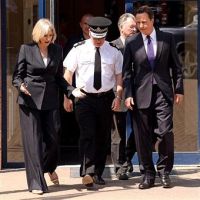
Theresa May has a new soundbite: police pay or police jobs. May has been asked to find cuts of 20 percent in the police budget. May insists that the frontline must and will be protected and that therefore these ‘extraordinary circumstances’ mean that the government will have to rewrite the terms and conditions of police employment. The former rail regulator, Tim Windsor, is already conducting a review into police pay and working conditions. In addition to his recommendations, May is scrutinising overtime payments, housing and travel allowances and so forth. Estimates vary but these perks are thought to cost the taxpayer more than £500million a year. She is also overseeing a deluge of bureaucratic reforms, which she hopes will save 800,000 man hours a year.

The failing business case for HS2

Under a week ago, when James Forsyth wrote about how the government was successfully mobilising third party groups to support high-speed rail, it looked like Philip Hammond was going to get the neat debate he wanted. The script was simple: the new high speed line was urgently needed and in the national interest, a small number of people ardently opposed it because it would spoil their views. Since then that message has come unstuck. I think it is understandable that some people are very upset at the aesthetic disruption that could come with HS2.  But that isn't the only objection. Plenty of people who have no particular attachment to Wendover, Aylesbury or Great Missenden are opposed.

Of course Pickles is ambitious. He needs to be

No one, most of all the normally genial Eric Pickles, said that reforming local government would be easy or quick. The New Local Government Network reports that the government’s plan to encourage councils to share back office functions is ‘hugely ambitious’. It says that considerable savings can be made, but it doubts that councils will meet the 40 percent target for backroom efficiencies. Savings of 20 percent are more likely, the NLGN argues. On the face of it, the NLGN is correct. Eric Pickles’s demand that councils share their functions and facilities is ambitious. At the moment, councils are struggling to meet the upfront costs of uniting geographically diverse buildings and services.

British foreign policy needs to promote democracy

After a week of hesitation and well-publicised problems evacuating British citizens from Libya, the government has led the international community's response to the crisis. The decision to move HMS Cumberland into position was astute, as was the authorisation to rescue the people stranded in the dessert. At the UN, British diplomats have been drafting most of the key resolutions and now David Cameron has out-hawked everyone by saying he'd be willing to contemplate a no-fly zone. US lawmakers have asked the Obama administration why they have not been as swift as the UK. As a Bosnian-born friend of mine said last night: "If only David Cameron and William Hague were around in 1992, so many of my friends would have been alive today!

Clarke in the Sun’s harsh light

The Sun has launched another sortie against Ken Clarke’s restorative justice programme. The paper reports: ‘SHOPLIFTERS could escape prison by just paying for what they pinch and saying "sorry". Jail sentences and tough fines will be SCRAPPED as the default punishment for nicking from stores under controversial plans soon to be unveiled by Justice Secretary Kenneth Clarke. Instead he wants thieves to make face-to-face apologies to victims and pay compensation.’ The Ministry of Justice has responded by saying that it ‘strongly believe[s] offenders should make more financial and other amends to victims and are in the process of consulting on plans for this.

Osborne goes on the offensive

Attack, attack, attack. That's the temper of George Osborne's article for the Guardian this morning, which sets about Labour's economic credibility with a ferocious sort of glee. Perhaps the best passage is where he asks how many times Labour can spend their ubiquitous "bank tax," but this is more pertinent to the recent debate: "Where does all this leave Ed Miliband's newfound enthusiasm for the "squeezed middle"? Let's pass over his failure in every interview to define it – his last effort included around 90% of taxpayers. Where we can all agree is that these are difficult times for family incomes. There are two root causes. One is global: rises in food and commodity prices.

The Tories take the train to war

Philip Hammond should be wary of the ladies of Cranford. The advent of the railways was met with considerable disquiet in rural England, depicted by Elizabeth Gaskell in both Cranford and North and South. High-speed rail has inspired another wave of determined conservatism in the shires. It’s a proper grassroots movement. For months now, Tory-controlled Buckinghamshire has warned the government that its councils and associations would oppose the development. Cabinet Ministers whose seats are local have supported their constituents, but the resentment is unchecked and it will damage the Conservatives to an extent.

Boris: give us a referendum on Europe

Boris kicks off his Telegraph column today by observing that Colonel Gaddafi and Gordon Brown "look vaguely similar". And yet the really provocative copy, at least so far as the government is concerned, is reserved for the final paragraph: "It is bonkers [by pushing for AV] to be pursuing the last manoeuvre of a cornered Gordon Brown. By all means let us have a referendum – the one we were promised, on the Lisbon EU Treaty. Have you noticed the EU policy on North Africa? Have you heard much from Baroness Ashton? Shouldn't we have a vote on all that?" It's hardly a secret that Boris wanted a referendum on Lisbon: he said as much in an interview before the 2009 Tory conference, and irritated the party leadership in the process.

The need to address National Pay Bargaining

National Pay Bargaining is one of the major impediments to rebalancing the national economy and improving the quality of public services. But as Julian Astle, the head of the Liberal think tank Centre Forum, notes the coalition is doing little about it. It knows that the public sector unions will go to the wall for national pay bargaining and so are holding off. Gordon Brown flirted with doing something about national pay bargaining, announcing a review of it in the 2003 Budget. But he then backed away from the issue. One area where the coalition is chipping away at national pay bargaining is schools. Academies and free schools have the right to set their own pay and conditions. But, interestingly, academies tend not to use these freedoms.

Miliband’s latest break with the past

As an independent creature, the Resolution Foundation's new Commission on Living Standards isn't doing Ed Miliband's work for him. But, boy, must the Labour leader be glad that they exist. At their launch event this morning, the "squeezed middle" – aka low-to-middle earners – suddenly took shape. There were graphs, such as those in James Plunkett's post for us earlier, setting out the very real problems facing a segment of British society. And there were even definitions explaining what that segment is: 11 million adults, by the Resolution Foundation's count, too rich to benefit from measures for the least well-off, and too poor to be entirely comfortable. This was a decent platform for Miliband's speech, and he used it to make a fairly important leap forward.

Three charts that complicate a simple focus on growth

GDP growth figures have become the barometer of choice for commentators trying to tell the political weather – a good measure of how the public will eventually fall in the faceoff between Osborne and Balls. The story goes that a return to sustained growth will mean a return to rising living standards.  That means a vindication of the government’s position, and a victory for the Chancellor. As a simple story, that makes sense if the pressures now facing Britain’s households are straightforwardly growth-related – if, in other words, we’re in a post-recession hangover that will vanish when growth returns. But there’s now mounting evidence of a deeper problem for living standards in the UK economy. Take the chart below.