James Plunkett

When a growing economy still feels bad

From our UK edition

David Cameron was right; the good news has kept on coming. This morning’s first estimate from the ONS puts GDP growth in the third quarter at 1.0 per cent. Cue much justified squabbling over what the 'real' number is. A significant portion of this growth will be a one-off, post-Jubilympics bounce-back, suggesting slower underlying growth. As Jonathan pointed out yesterday, ONS first estimates have a margin of error of 0.7 percentage points, meaning that even with these factors built in, the real figure could lie between 0.3 and 1.7 per cent. Gaps of this magnitude are no small matter. But behind these arguments about the number itself lies a different and in many ways much more politically important question: what will a return to growth actually feel like?

Four tests for Osborne’s Budget


From our UK edition

With the Coalition taking pre-Budget briefing to new levels you’d be excused for thinking there’s little we don’t know about tomorrow’s statement. But here are four questions we can’t yet answer, and that will be crucial to assessing whether this is a Budget for low-to-middle earners as the Chancellor claims:
 1) Will the new increase in the personal allowance be restricted to basic rate taxpayers? When the Coalition raised the allowance by £1,000 back in April 2011 they cancelled out the benefits to those at the top by lowering the 40p tax threshold. The second time around — the £630 increase that kicks in this April — they didn’t.

Cameron is right to focus on quality apprenticeships

From our UK edition

If there are ‘no votes in skills’, as the old dictum goes, there seem to be some in apprenticeships. Hence David Cameron's call this morning for apprenticeships to become a ‘gold standard’ qualification ranking alongside degrees from the best universities. His goal is to rectify Britain's shockingly poor performance on mid-level skills compared to world leaders such as Germany. So how hard would it be for us to catch the Germans? The numbers speak for themselves. Of every 1,000 employed people in England 11 are apprentices; compared to 40 in Germany. Here, fewer than one in ten employers are training an apprentice; in Germany it’s roughly a third.

Are we facing an American nightmare?

From our UK edition

With the Chancellor’s autumn statement due next Tuesday, we're all talking about growth. The ECB and Bank of England now say the UK economy is set to grow at less than half the rate the OBR forecast back in March. That makes it all but certain that George Osborne will announce dramatic downward revisions to UK forecasts when he stands up in parliament next week. But before all the fighting about Plan As and Bs reaches fever pitch, it’s worth asking what the next decade looked like under the previous, more optimistic growth projections. The answer isn’t pretty and it helps highlight one major question that’s rarely asked in our debate about GDP: what kind of growth are we after? The chart below neatly sums up the problem.

Tories dodge a bullet on childcare

From our UK edition

In the past year the government has proven good at cauterising self-inflicted wounds. This morning's announcement from Iain Duncan Smith on childcare stems another potential bleeder. His department have found an extra £300 million to prevent further cuts to childcare support. It’s a welcome reversal of an ill-advised plan and a narrowly averted political foul-up. The extra money is needed because of IDS's big welfare reform project, the Universal Credit. One of the big advantages of the UC is that it will smooth out all those ugly ‘cliff-edges’ in the benefit system, particularly rules that say you don’t get help if you work fewer than 16 hours a week.

A reform the Tories should shout about

From our UK edition

As of today, you can’t fire someone just for turning 65. The government has delivered its promise to scrap the Default Retirement Age (DRA), introduced by Labour in 2006 as a caveat to otherwise laudable equality legislation. This ends the practice of forced retirement regardless of someone’s ability to work. Killing it is one of the best things the coalition has done and the Tories should be making more of as they gather in Manchester. Of course, there will be some transition difficulties from scrapping (DRA), but they’re likely to be minor. Claims that older workers sticking around in their jobs will squeeze out the young are too simplistic – our jobs market isn’t ‘one in, one out’.

Eating into household savings

From our UK edition

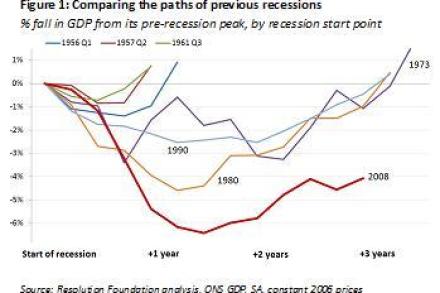
Next Tuesday, the ONS will release initial estimates of second quarter UK GDP growth. It may be a slight exaggeration to call it a ‘make or break’ moment for the Chancellor but ‘make or brake’ might not be a bad description. After six months of no growth, another three months of flat GDP would strengthen calls to slow his current strategy. Plenty of forecasters are predicting gloom. The graph below, which readers may have seen in some form before, compares this recession with its predecessors. This was the sharpest, deepest downturn in living memory; a similarly strong recovery is needed. So, what will the chancellor hope to see next Tuesday?

Inflation hits work incentives

From our UK edition

New inflation stats are out tomorrow and they’re expected to show further rises in CPI and RPI.  Aside from their brief peak in 2008, headline rates of inflation are now at their highest levels for 19 years.  That’s prompting more discussion about the way rising prices are playing out for Britain’s households, from a nice graphic in today’s Times (£) to a new report due out tomorrow from the IFS.  But one implication of today’s higher inflation environment is receiving less attention – the impact of rising prices on work incentives. Inflation and work incentives aren’t often mentioned in the same breath.

The growing need for a policy response to the ‘new inflation’

From our UK edition

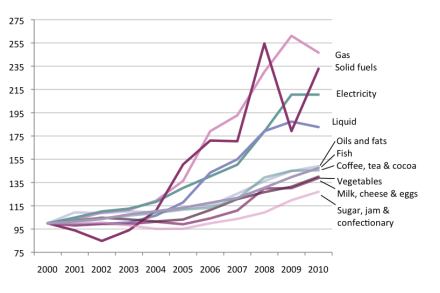
There’s been much debate on these pages about the political implications of higher inflation. Ironically, this morning’s news of record food prices could relieve the pressure on the Bank of England Governor. His argument for caution when it comes to a rate rise is based on the claim that UK inflation is now being driven by events beyond the MPC’s control. Today’s figures reinforce that case, showing that global commodity prices remain a key driver of the rising cost of living in Britain’s households. The same argument doesn’t really work for the Chancellor, whose remit isn’t just to keep headline inflation down, but also to help households cope with the kind of inflation we’re now seeing – whatever its cause.

Osborne the Reformer is an unfinished work

From our UK edition

One interesting aspect of today’s Budget is the government’s change of tack on personal allowances. Back in June 2010, when the Chancellor committed to raise allowances from £6,475 to £7,475, he chose to cancel out the gains for higher rate taxpayers by lowering the level at which the 40p tax rate kicks in. The idea was to focus the gains of the policy on basic rate taxpayers, making things a little more efficient. The 40p threshold will therefore be lowered from April this year from £43,875 to £42,475 with the result that 700,000 people will become higher rate taxpayers. Needless to say, that’s proved unpopular, and so this time around the higher rate threshold won’t be reduced.

Three charts that complicate a simple focus on growth

From our UK edition

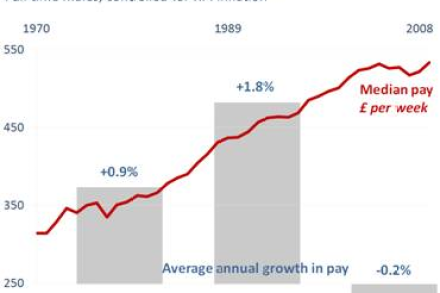
GDP growth figures have become the barometer of choice for commentators trying to tell the political weather – a good measure of how the public will eventually fall in the faceoff between Osborne and Balls. The story goes that a return to sustained growth will mean a return to rising living standards.  That means a vindication of the government’s position, and a victory for the Chancellor. As a simple story, that makes sense if the pressures now facing Britain’s households are straightforwardly growth-related – if, in other words, we’re in a post-recession hangover that will vanish when growth returns. But there’s now mounting evidence of a deeper problem for living standards in the UK economy. Take the chart below.