Teaching

To transform schools, sack bad teachers and hire great ones. It’ll transform education – and the economy

The Labour years can, in retrospect, be seen as a massive experiment into the link between cash and education. Gordon Brown almost doubled spending per pupil over the past decade, the biggest money injection in the history of state schooling. But as he did so, England hurtled down the international league tables. It now languishes in 18th place, according to the Organisation for Economic Co-operation and Development (OECD). The plan didn’t work. Only now is the full cost of that failure becoming clear. In an age when ‘work’ is increasingly something done with the head rather than the hands, education standards determine the wealth of nations. There is now enough data to draw a direct relationship between the two and put a price on it. Smarter nations are richer nations.

Dear Mary: Are my party chairs safe for fatties?

Q. With just a month to go of training as a primary school teacher, I am relieved and excited to have been offered a job. Now it has been a few weeks since I last spoke to one of my good friends in our PGCE cohort. I have many lively stories to tell of weird and wonderful escapades with wild children. However, I feel I should not call her, since I cannot be sure that she has been offered a post. — J.C.R.R., London SE11 A. Your tact is misplaced and you should call with your news. To be weirdly silent about it suggests your presumption that your fellow student is unlikely to be employed. Do you think Renée Zellweger doesn’t dare ring up Julia Roberts to tell her about her latest part, in case Julia hasn’t got one and would be jealous?

Don’t jump, Felipe!

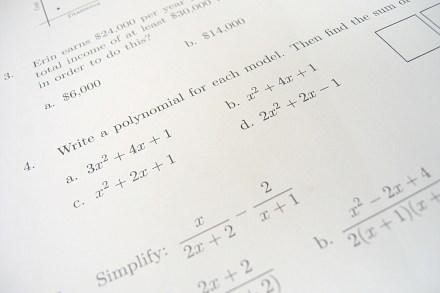
Peering over my son’s shoulder as he forced himself through a pile of practice IGCSE maths papers in readiness for this week’s exams, I was shocked both by the absence of pounds sterling and by the ardently international imaginary first names dreamed up by the question-setters. That ‘I’ stands for ‘international’ — and goodness, you’re not allowed to forget it. ‘Nyali paid $62 for a bicycle.’ ‘Alejandro goes to Europe for a holiday. He changes 500 pesos into euros at an exchange rate of…’ ‘Abdul invested $240…’ ‘At 05 06 Mr Ho bought 850 fish at a market for $2.62 each…’ ‘On 1 January 2000 Ashraf was x years old.

What Michael Gove should know about going to school in Singapore

I like to tease my friend Wei about being a tiger mother. She once told me of an incident where her daughter Shu was making an artwork for a friend as a birthday present. Shu doodled for a few minutes, then showed her mother a sketch of a funny face. ‘I told her to knuckle down, spend more time, and come back with a far better drawing,’ said Wei. ‘It just wasn’t good enough.’ I said that was a bit harsh on her eight-year-old, especially since it was not schoolwork but part of Shu’s leisure time. Wei snorted. ‘It was a gift for her best mate, yet she hadn’t put any thought into it,’ she said. ‘She needs to know that you must make an effort for the things you really care about.

Michael Gove: Unions need to do a better job

Cometh the Gove, cometh the angry trade union representative. It was inevitable that the Education Secretary would have at least one exchange with someone from one of the two largest teaching unions when he took questions from the floor at today's Spectator education conference. Gove spoke powerfully without notes on his vision for education, and then in conversation with Andrew Neil, attacked those he believed had low expectations for certain pupils. He said: 'There are wonderful people in teaching and I want to empower them. This is, I think, a tremendous opportunity for teachers. But there are some in the teaching profession, I'm afraid, who won't take yes for an answer. They say we'd like more freedom - and we'd give them more freedom with academies and free schools.

Michael Gove’s planned national curriculum is designed to renew teaching as a vocation

Michael Gove’s planned national curriculum, heavily influenced by American reformer E.D. Hirsch, came under strong attack over the weekend. Critics claim that it will de-professionalise teachers. NUT activists and their allies insist that teachers will have to abandon the ideas that were prevalent when they were trained, and teach in a different way, which risks alienating and demoralising them. There are good reasons for being concerned about the de-professionalisation of teachers, but Hirsch’s curriculum for the UK is not one of them. On the contrary, his curriculum, found in books such as What Your Year 3 Child Needs to Know, is designed to encourage the renewal of teaching as a vocation.

What is this word?

‘What are you writing?’ I asked my nine-year-old daughter as she sat at the kitchen table doing her homework. ‘A recount,’ she said. ‘What’s a recount?’ She looked at me with utter disdain. ‘Duh! A recount.’ I calmly explained that you could recount an event in a piece of writing, but that didn’t make what you’d written a ‘recount’. The only sense in which you can use ‘recount’ as a noun is when referring to the act of recounting something. ‘What’s this then?’ she said, waving a piece of paper in my face. Sure enough, the exercise she’d been given by her teacher was to write a ‘recount’ of something that had happened to her the previous week.

Another weird sacking

Another teacher has been sacked for what looks like a wholly fatuous and unjust reason; these stories come in at the rate of about two a week. Christopher Hammond, head of German at a private girls’ school in Reading, was booted out for having taken photographs of his pupils on a school trip. Or, at least, on the technicality of taking them on his own camera rather than using a ‘memory card or school-owned device’. None of the photos were remotely indecent, nor was there any suggestion he might be a bit of a wrong ‘un on the quiet. Leaving Mr Hammond’s case aside, I wonder if these weird sackings are the consequence of employers not being able to get rid of people on perfectly good grounds, eg that they are utterly bloody useless at their jobs.

Michael Gove’s schools ultimatum pushes up standards

Michael Gove’s reformation of the education system from top to bottom has so far been unstoppable. Often though, the Education Secretary's detractors bellow there is a lack of proof that his reforms are doing any good. Today's news (£) that hundreds of primary schools have benefited from Gove's tougher approach to internal management adds credence to the view that his freeing up of our education system is working. This year, the number of schools below the government’s baseline target dropped by more than half: ‘League tables of this year’s primary school test results showed that 521 were beneath his minimum threshold. Of these, 37 have since been replaced by academies with new sponsors or governance, and seven have closed.

Michael Gove tells heads to dock the pay of ‘militant’ staff

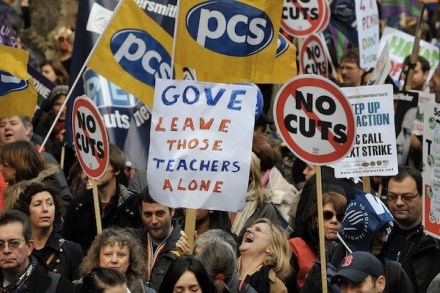
Michael Gove has written to schools across the country telling them that they can deduct a day's pay from staff who try to disrupt school time by carrying out 'work to rule' industrial action. This form of action involves teachers fulfilling their job description to the very letter, with the NUT and NASUWT issuing list of activities their members should refuse to undertake. These include refusing to submit lesson plans, refusing to agree to timetable changes, refusing to undertake clerical tasks or covering for colleagues' absences. Gove's letter, seen by Coffee House, says: 'I respect the right of teachers to take industrial action, but this action short of a strike lacks a clear purpose or even a set of coherent aims.

Do teaching unions not trust head teachers?

Michael Gove had a very good autumn statement: not only did he get £1bn for new free schools and academies, but he also got performance-related pay for teachers. Gone will be the days of automatic rises and pay based on length of time served, replaced by rises based on merit as in many other professions. As James notes in his column this week, accepting the recommendations of the School Teachers' Review Body is a 'full-bore assault on union power'. So, unsurprisingly, the unions are terribly upset by the change. Chris Keates, general secretary of the NASUWT, released this response: 'The war on teachers waged by the Coalition government continues. The value of a national pay framework has been recognised by other pay review bodies but the STRB appears to be seriously out of step.

Gove kicks back at school bullies

A Labour conference delegate was heckled from the floor when she mentioned her school. Joanne, an immigrant who came to this country seeking political asylum and is about to read law, came face to face with the vested interests that blight education reform: the hall did not like the fact that she went to an Academy school. A delegate started shouting about comprehensive schooling, much to the horror of those around her. Michael Gove has come down on the girl's side, he has just told me: ‘Heckling a schoolgirl because she goes to an academy is disgraceful. But it also shows the real face of Labour – a party where aspiration and achievement gets booed. Stephen Twigg needs to condemn this and the culprit must be expelled from the party.

Pay study embarrasses teaching unions

The teaching unions like to dismiss talk of introducing regional pay to the public sector as a plan that will hit deprived areas hardest. Their fierce opposition to the plans touted by Michael Gove and other ministers threatens to crystallise into strike action should the government make any serious moves towards the changes. But research from Bristol University published today changes the terms of the debate rather, as it suggests that pupils are paying the price for a national pay rate for teachers. The study, which compared pay to performance in around 3,000 schools, found that in areas where salaries in the private sector are significantly higher than in schools, pupils can drop one GCSE grade in one subject.

Obstruction overruled

The Spectator's Schools Revolution conference is being held on Tuesday next week. One of the speakers, Mark Lehain, writes below about his experience setting up a free school. Other speakers include Michael Gove, Michelle Rhee and Barbara Bergstrom, all of whom will take questions from the floor. There are still tickets available: to book, click here. When I’m asked why I’m setting up a free school, or why I think they’re necessary, I tell a story about a Trades Union Congress meeting on the subject that I went to in December 2010, a few months into our campaign to open a new school in Bedford.

Repeat after me…

The fuss stirred up by the mere suggestion that poetry might be part of the school curriculum was extremely suspicious. Just as George Osborne quietly announced his u-turn on the charities tax during the less soporific sections of Leveson, the proposal that children should have to learn poetry off by heart smacked of a smoke screen.   What evil is lurking in the small print of Gove's national curriculum? Will school dinners get even smaller? Have all our schools been sold to Google?   But when it comes to poetry, there seem to be two main objections to Gove's plan.

Gove gets covering fire

Good teaching matters; that’s something we don't need to be taught. But how much does it matter? What are its measurable benefits? Today’s education select committee report collects some striking, if pre-existing, research into just those very questions, and it is worth reading for that reason. There is, for example, the IPPR’s suggestion that ‘having an “excellent” teacher compared with a “bad” one can mean an increase of more than one GCSE grade per pupil per subject.’ Or there’s the American study which found that the best teachers can ‘generate about $250,000 or more of additional earnings for their students over their lives in a single classroom of about 28 students.

The teachers’ unions take on Ofsted, Osborne and Gove

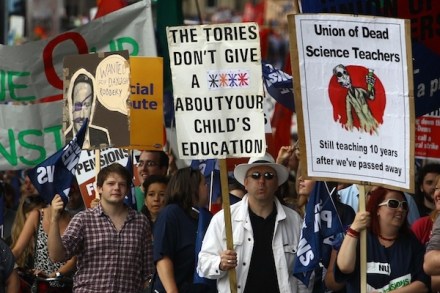
I counted five issues which the NUT conference suggested that teachers might strike over. But in a conference full of the usual bluster, the most noteworthy threat was not to cooperate with Ofsted inspections. Ever since the new chief inspector Sir Michael Wilshaw — who was hugely successful as the head of Mossbourne academy — announced that a merely satisfactory grade would no longer be regarded as good enough, the teaching unions have taken agin him. But not cooperating with Oftsed would be unlawful. Anyone who tried to block an inspection would be liable to prosecution and a fine. Another issue exercising the unions is George Osborne’s proposals for regional pay for the public sector.

First, Liquidate the Teaching Unions

There are few sights more pitiful, more vexing or more predictable than the sight of teaching unions on the whinge. This time it is the EIS and the other unions representing teachers in Scotland. They are unhappy that the new Curriculum for Excellence - of which, for what little it may be worth I have, albeit anecdotally, heard some encouraging things - is being rushed into service too quickly. It has only been in development since 2004. Just as bad, apparently, the new National exams designed to replace the unfit Standard Grade are coming along too soon. Teachers are confused and unhappy and overworked and all the rest of it. The new exam, incidentally, won't be sat until 2014.

When failure actually counts as success

Michael Gove's latest prognosis for schools was delivered at a lunch in Westminster yesterday, but it's important enough to repeat the morning after. The Independent has a full report here, but the key quotation is this: ’Education is like trying to run up a down escalator. There are some uncomfortable decisions that will have to be taken. There will be years when, because we are going to make exams tougher, the number of people passing will fall. There are headteachers who have been peddling the wrong sort of approach to teaching for too long, who are going to lose their jobs.’ Just read that bit again: ‘the number of people passing will fall’. It's a deeply encouraging admission by Gove, and one that he ought to repeat frequently.

Gove takes on bad teachers

Michael Gove’s giving a robust defence of his plans to make it quicker and easier for schools to sack bad teachers. ‘You wouldn’t tolerate an underperforming surgeon in an operating theatre, or an underperforming midwife at your child’s birth,’ he says in the Mail. ‘Why is it that we tolerate underperforming teachers in the classroom?’ And he was similarly forceful in an interview on the Today programme, the full transcript of which we’ve got here. Gove is emphatic about how important this is. ‘The evidence is quite clear,’ he says. ‘If you’re with a bad teacher, you can go back a year; if you’re with a good teacher you can leap ahead a year.