Proust

A mirror to the world

[audioplayer src="http://feeds.soundcloud.com/stream/260046943-the-spectator-podcast-obamas-eu-intervention-the-pms.mp3" title="Lloyd Evans and Dr Daniel Swift discuss how Shakespeare died" startat=1008] Listen [/audioplayer]Who’s there? Shakespeare’s most famous play opens with this slightly hokey line, and the question remains for his countless audiences, biographers and scholars. Who was this man? What makes his works so apparently endless? Like the plays, his life is studded with riddles. Even the basic facts are slippery and over-determined. We do not, for example, know the date of Shakespeare’s birth. His baptism was recorded at Stratford on 26 April 1564, and since it was customary to baptise newborns quickly, it has been accepted that his birthday was 23 April.
Gay tittle-tattle

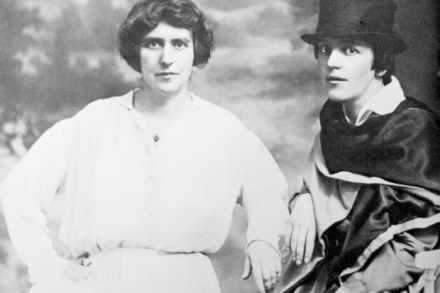
The Comintern was the name given to the international communist network in the Soviet era, advancing the cause wherever it could. The ‘Homintern’, a wry play on that, was first coined at Oxford by Maurice Bowra and gladly passed on by Cyril Connolly, Auden and others, inferring an international homosexual network of mutual interest and support. Gregory Woods, in his very first sentence, defines it thus: ‘The Homintern is the international presence of lesbians and gay men in modern life.’ A few pages later he says: ‘There was no such thing as the “Homintern”.’ So which is it to be? And what does Woods mean by ‘modern life’?

Diary – 31 December 2015

Disappointingly, the recent film about Steve Jobs, co-founder of Apple, does not include the thing about him which most struck me in Walter Isaacson’s biography: Jobs habitually parked in disabled parking bays. Naturally, this is something that I (in company with many drivers, I suspect) long to do whenever disabled spaces are the only available parking, especially when two or three of them are standing empty. But I don’t — even for a five-minute dash to Tesco. The fear of exposure stops me, as well perhaps as a smidgen of unselfishness.

Swords of honour

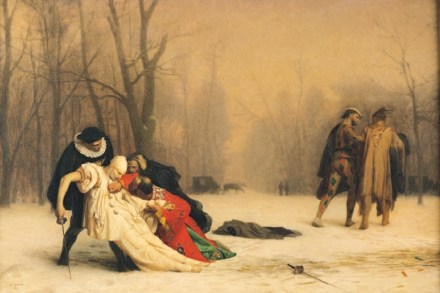
Earlier this century I was a guest at a fine dinner, held in a citadel of aristocratic Catholicism, for youngish members of German student duelling societies. My hosts were splendidly courteous, some of them held deadly straight rapiers or lethal curved blades, there were brightly coloured and golden braided costumes that made King Rudolf of Ruritania’s coronation robes seem dowdy, and we sung a rousing anthem about Prince Eugene of Savoy smiting the fearful Turk at the battle of Zenta in 1697. It was a high-testosterone evening. A few of my young hosts had duelling scars, discreetly placed so as to be imperceptible when they were in office suits, for some of them worked in Canary Wharf or the City as bankers, lawyers and accountants.

Soldier, poet, lover, spy: just the man to translate Proust

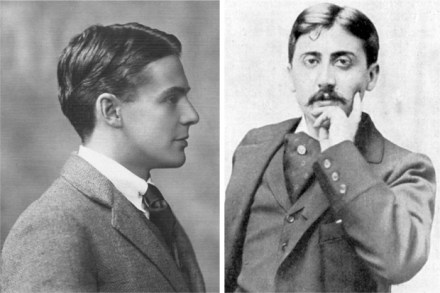
Charles Kenneth Scott Moncrieff’s Englishing of Proust — widely and immediately agreed to be one of the greatest literary translations of all time — very nearly didn’t happen. Scott Moncrieff only suggested the project to his publisher after they rejected a collection of satirical squibs in verse (sample: ‘Sir Philip Sassoon is the Member for Hythe;/ He is opulent, generous, swarthy and lithe.’). Like any good hack, he had another suggestion up his sleeve: there was this character Proust just starting to be published — making a bit of noise in France. Constable didn’t immediately see the value: ‘They replied that they did not see much use in publishing a translation of Prevost [sic].

TV snobs hate the telly because it’s watched by those born on the wrong side of the tracks

Growing up in the 1970s I watched as much TV as humanly possible. When we had important visitors to the house my mum would merely turn down the volume, and by the time we went to bed you could have fried an egg on the screen. Now that I am a middle-aged, middle-class professional the only thing that has changed is I watch even more of it. I have a TV in my bedroom, in the kitchen, lounge, and access to it on my phone, iPad and laptop. But all my adult life, since I began mixing with educated, privileged people, I have been plagued by TV snobs. You know the type: if you admit to watching Coronation Street, or Eastenders, you are treated as though you walked straight off Jeremy Kyle.

Brains with green fingers

‘Life is bristling with thorns,’ Voltaire observed in 1769, ‘and I know no other remedy than to cultivate one’s garden.’ This is the remedy espoused by Candide at the end of Voltaire’s satirical novel, published ten years earlier, and the literal and metaphorical cultivating of gardens is the subject of Damon Young’s sprightly and stimulating little book. Young examines the relationship between gardening and philosophy in the life and work of 11 writers, from the 18th to the 20th century, topping and tailing these individual essays with a consideration of the Ancient Greeks.

How much can you tell about E.E. Cummings from this photo?

Do you think you can tell things about writers from the way they look in a painting or photograph? A more demanding test: from their books can you predict how authors look? It sounds unlikely, yet, upon seeing a photograph of an author, we do find ourselves exclaiming: ‘That’s not how I thought he’d look!’ In Portrait of the Writer there are 250 photographs with a potted biography opposite each. ‘In the best instances,’ says Goffredo Fofi in the foreword, ‘we can see in the photograph that the writer (although not just the writer) has discovered something about himself or herself that he or she was unaware of or had not reflected upon sufficiently.’ Can we, though? Take E.E.