Painting

The great French painter who had no time for France

In 1855, Paul Gauguin’s widowed mother Aline returned to her husband’s family in Orleans after seven years in Peru. She brought back her daughter Marie, eight-year-old son Paul and her collection of pre-Columbian artefacts. They had no commercial value but those strange objects, sprouting the heads of birds and animals, had a power that the westernised world had lost touch with. They sank deep into the imagination of her wild, headstrong boy, who often described himself as ‘a savage from Peru’. After the sensory overload of South America, France and school were grey, cold and miserable. With education over, Gauguin insisted on going to sea and served in the navy in the Franco-Prussian war.

Why has Leonora Carrington still not had a big exhibition?

‘It had nothing to endow it with the title of studio at all,’ was Edward James’s first impression of Leonora Carrington’s Mexico City workspace in 1946. ‘The place was combined kitchen, nursery, bedroom, kennel and junk store. The disorder was apocalyptic: the appurtenances of the poorest. My hopes and expectations began to swell.’ Carrington blended Egpytian, Mayan, Mesopotamian and Celtic legends learned at her nanny’s knee Over six decades in the creative chaos of this house on Calle Chihuahua, Carrington would paint some of her best-known works and write her quirky serio-comic novella The Hearing Trumpet, which is narrated by a 92-year-old woman.

The importance of copying

The lunatics were once in charge of the asylum. The first six directors of the National Gallery were all artists: before art history became an academic discipline, artists were the leading authorities on art. Founded more as a teaching resource than a visitor attraction, until the mid-1940s the gallery was reserved for artists two days a week, when other visitors had to pay for entry. This stopped them getting in the way of artists copying from the masters, an essential part of an art education in the days before cheap colour reproduction. There’s something of the altarpiece in this image of an artist’s progenitors flanking a touchstone for his art It’s rare to see artists copying in the galleries now that they are so jam-packed with tourists.

Porcelain-painting during the French revolution

People don’t accumulate stuff any more. When the late Victorian houses on our street change hands their interiors are stripped of all decorative features and the walls painted white, unrelieved by pictures: if their Victorian owners returned as ghosts, they would go snow-blind. The Victorians’ passion for accumulating stuff was close to an addiction, and no one accumulated it like the Rothschilds. But the Rothschilds didn’t stop at objects; they also collected exotic animals, especially birds. All the Rothschild chateaux and mansions boasted aviaries – and Baron Ferdinand de Rothschild’s Waddesdon Manor was no exception.

This British surrealist is a revelation

When the 15-year-old Maggi Hambling arrived at Benton End in Hadleigh, Suffolk – home of the East Anglian School of Painting and Drawing – with two paintings to show the school’s founders, Cedric Morris and Arthur Lett-Haines, she was ushered into the dining room where Morris was having dinner. He made some criticisms but was very encouraging, then Lett-Haines came in and made the opposite criticisms but was encouraging too. As teachers, both believed in bringing out a student’s native talent – but as artists and characters, says Hambling: ‘They were polar opposites.

How a market town in Hampshire shaped Peggy Guggenheim

On 24 April 1937 Marguerite Guggenheim – known as Peggy – of Yew Tree Cottage, Hurst was booked by a certain PC Dore for driving an unlicensed vehicle through nearby Petersfield. What was the founder of the famous Venice museum doing in a market town in Hampshire? It’s a long story, vividly told in an exhibition marking the 25th anniversary of the opening of Petersfield Museum on the site of the former police station and courthouse where she paid her £1 fine. ‘Peggy,’ said a friend, ‘is absolutely revolting about sex. Delicacy is unknown to her’ In the 1930s the Jewish-American heiress, who had lost her father Benjamin on the Titanic, was rattling around Europe with a fast crowd of writers and artists.

The beauty of pollution

On the back of the British £20 note, J.M.W. Turner appears against the backdrop of his most iconic image. Voted the country’s favourite painting in 2005, ‘The Fighting Temeraire’ (1838) was Turner’s favourite too. It remained in his possession until his death; the 70-year-old artist swore in a letter of 1845 that ‘no consideration of money or favour can induce me to lend my Darling again’. But I suspect he would have approved of his darling’s current loan, along with that letter, to the Laing Art Gallery in Newcastle as part of the National Gallery’s bicentenary programme of loans of national treasures to regional museums.

The most original sea painter since Turner? Lowry

In 1958 an elderly gentleman staying at the Castle Hotel in Berwick-upon-Tweed gave the receptionist a doodle he had made on the hotel’s notepaper. She kept it in a box and 43 years later, on the advice of Antiques Roadshow, sold it at auction for £8,000. ‘I don’t think anyone since Turner has looked at the sea with such an original eye’ A contemporary photograph shows that gentleman in his trademark trilby, dark suit and tie – no casual wear for L.S. Lowry – standing on the pier with Berwick in the background. Lowry (1887-1976) is not best known for his paintings of the sea, but there are 21 – including the receptionist’s sketch – in this interesting little exhibition in the Northumbrian town which he regular visited, and they cast him in an unaccustomed light.

The ordeal of sitting for my father Lucian Freud

The frontispiece of this book is Lucian Freud’s portrait of his daughter Rose naked on a bed. Rose says that when her father asked her to sit, which she had long hoped he would do, she naturally assumed he would want her naked, but asked him not to paint her hairy legs. He, in turn, asked her to remove her mascara, but she refused. When she saw the canvas she was shocked at how much it focused on her vulva, but she did not object. She sat for him at night – he had other sitters during the day – and he sometimes gave her purple hearts to keep awake. When the portrait was finished, she took on the task of cleaning Freud’s studio, which ‘made me feel special, downtrodden, and loved for all the wrong reasons’. Rose was born in 1958, 18 months after her brother, Ali.

Is there still life in British still life?

‘The tyrannical rule of nature morte is, at last, over,’ announced Paul Nash in the Listener in 1931. ‘Apples have had their day.’ Since Cézanne fulfilled his famous boast that he would astonish Paris with an apple, artists had been trying the same trick in London, with limited success. Astonishment, unfortunately, only works once. Nash had had it up to here with them apples: tired of post-impressionism, tired of still life. An electric toothbrush occupied the same place in Hamilton’s heart as Mont Sainte-Victoire in Cézanne’s Continental ghosts haunt the tabletops of Pallant House Gallery’s informative new survey of modern and contemporary British still life.

Suppress your groans: this women-only show is fascinating

In a Victorian art dealer’s shop a woman waits with her young son while the supercilious owner examines her work; behind her two top-hatted gents interrupt their inspection of a drawing of a dancer in a tutu to give her the once-over. The woman’s shabby umbrella, propped against the counter, awaits reopening in the rain outside. She knows what the dealer will say, and so do we. Every picture tells a story, and Emily Mary Osborn’s ‘Nameless and Friendless’ (1857) summarises the plot of Tate Britain’s latest exhibition, Now You See Us. Unlike her picture’s protagonist, Osborn was herself a successful artist in a field dominated by men – not the fate of many of the artists in the Tate’s new survey of four centuries of British art by women.

Beguiling: Yinka Shonibare, at the Serpentine Galleries, reviewed

More than seven centuries ago, the medieval cartographer Richard of Haldingham created Hereford Cathedral’s Mappa Mundi; I say ‘created’ because when he drew his map it was largely a work of the imagination. Its terra incognita is populated with bizarre creatures born of the fever dreams of early travel writers: his Africa is inhabited by Monocules, one-eyed, one-legged men who use their single foot as a parasol, and his Asia is roamed by the Bonnacon, a bull-like creature with inward-curling horns whose only defence is his projectile faeces.

The brilliance of Beryl Cook

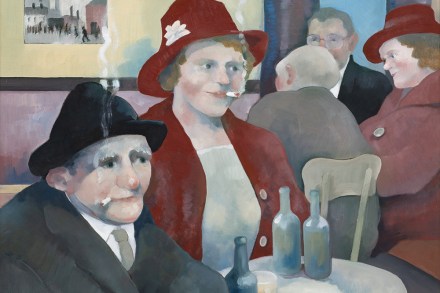
Nobody claims Beryl Cook was an artistic genius, least of all the artist herself. ‘I think my work lies somewhere between Donald McGill [the saucy postcard artist that George Orwell wrote so lyrically about] and Stanley Spencer,’ she once told me. ‘But I’m sorry to say I’m probably nearer McGill.’ She was, as ever, being modest. I actually think she’s nearer Spencer – and Hogarth, come to that. Cook’s paintings make us laugh but that doesn’t stop them from being art. (Few would say Shakespeare’s comedies are as profound as his tragedies, but they’re brilliant creations, nevertheless.) Though Victoria Wood dubbed her work ‘Rubens with jokes’, there aren’t actually any jokes in her pictures; they’re all direct observations, not double entendres.

The latest Venice Biennale is ideologically and aesthetically bankrupt 

Last week’s opening of the 60th edition of the Venice Biennale marks a watershed for the art world. In much of the festival’s gigantic central exhibition, curated by the Brazilian museum director Adriano Pedrosa, as well as in many of the dozens of independently organised national pavilions and countless collateral events, it more obviously than ever before didn’t so much matter what was on show, but why. The politics of visibility and representation has been eating away at the arts for at least a decade, most recently under the banner of ‘decolonisation’. The now nearly complete abdication of aesthetic criteria in favour of a decolonial organising principle is here finally exposed as a wholly inadequate rationale for presenting contemporary art.

Impressionism is 150 years old – this is the anniversary show to see

The time that elapsed between the fall of the Paris Commune and the opening of the first proper impressionist exhibition amounted to less than three years. Over the course of that period, the city had witnessed the collapse of the Second Empire, suffered a siege at the hands of the Prussian army and seen vicious house-to-house fighting between the troops of the Versailles government and thescrappy citizen-army of Paris proper. All Parisians would recall the rivers of blood running down the city’s ritziest shopping streets, zoo animals being butchered for restaurant fodder, and the mass slaughter of rebel prisoners across the public squares of the city’s eastern faubourgs.

Rich, beautiful and vital: John Craxton, at Pallant House Gallery, reviewed

The sensuality of the light in John Craxton’s painting ‘Two Figures and Setting Sun’ (1952-67) has to be seen to be believed. Viewing this large work in Pallant House, you feel its full force. Craxton was concerned with a scene’s essence, rather than simply its appearance and here he achieves not merely an effect but affect. In spite of most of the light being painted in yellows and oranges rather than white, the contrast and refraction of the rays produce a blinding sensation much like staring into the sun on a hot day.   It was as a chorister at Chichester Cathedral that Craxton’s daily encounter with two 12th-century Romanesque bas-reliefs taught him the timelessness of great art; that, even though it was from the distant past, something fresh and modern endured.

Why did this brilliant Irish artist fall off the radar? 

Sir John Lavery has always had a place in Irish affections. His depiction of his wife, Hazel, as the mythical figure of Cathleen ni Houlihan, which appeared on the old ten shilling and subsequently on the watermark of the Irish pound notes, meant, as the joke went, that every Irishman kept her close to his heart. He was indeed Irish – born in Belfast – but was at home in Scotland, and was the best known of the spirited group of painters called the Glasgow Boys. Yet he lived most of his life in London, was friends with Winston Churchill (they took a painting trip together) and also with Michael Collins, the Irish Nationalist, with whom Hazel was, ahem, close. If ever there were a man who embodied the interconnectedness of Britain and Ireland, it was Lavery.

The force of nature that drove Claude Monet

There have been some really good biographies of artists over recent years and what distinguishes the best of them is their sense of context and a lucid prose free from the jargon of the art historian. In the end, of course, any work of art has to be able to stand by itself, but for Jackie Wullschläger her appreciation of Monet’s paintings has been immeasurably deepened by her sense of the man behind them. ‘My approach,’ she writes, ‘stems from the belief that painters transform the raw material of experience into art’, and that material, both the familiar external events and, more illuminatingly, the inner man, is what she gives us here.

How Philip Guston became a hero to a new generation of figurative painters

Why do painters represent things? There was a time when the answers seemed obvious. Art glorified power, earthly and divine, and provided moral exemplars of how to behave – in the case of sacred paintings – or how not to in the case of profane ones. When modernism threw all that into doubt, the picture frame remained. The question for modern artists was, what to put in it? Fifteen years of non-representational painting prompted Guston to question its usefulness For the first decade of his career, Philip Guston had an old-fashioned answer: the murals he painted in the style of Italian Renaissance frescoes in the US and Mexico during the 1930s promoted ideals of social justice.

Proof that Rubens really was a champion of the female sex: Rubens & Women, at the Dulwich Picture Gallery reviewed

‘She is a princess endowed with all the virtues of sex; long experience has taught her how to govern these people… I think that if Her Highness could govern in her own way, everything would turn out very happily.’ The ‘princess’ in question was Isabel Clara Eugenia, Infanta of Spain and regent of the Spanish Netherlands; ‘these people’ were the pesky, ungovernable Flemings and the author of the glowing testimonial was Peter Paul Rubens who, since the death of Isabel’s husband the Archduke Albert in 1621, had become her trusted diplomatic adviser. It was quite a step up for a mere court painter, especially one with a skeleton in the family closet.