Painting

Artist, actor, social justice warrior, serial killer: the many faces of Walter Sickert

‘It’s too dark and life is too short,’ was Walter Sickert’s explanation of his decision to leave London in 1898. Separated from his first wife Ellen Cobden and in financial trouble, he did a flit across the Channel to Dieppe. A magnet for artists in the summer season, the town had long been a popular subject for tourist views. ‘I see my line…’ he wrote soon after his arrival. ‘Picturesque work. This place Dieppe, is my only up to now, goldmine.’ The place had already had a transformative effect on his painting.

The beauty of gasholders

On 25 October 1960, a Boeing pilot aiming for Heathrow accidentally landed at an RAF base, only realising his error when the runway turned out to be alarmingly short. Disaster was averted, but the near-miss caused some embarrassment, and the minister of aviation had to answer questions in the House. What had confused the pilot, it emerged, was the advice from air traffic control to start his descent ‘in line with the gasholder’. He had picked the wrong one. Ever since, the gasholders near Heathrow and RAF Northolt have had painted on them, in 50ft-high letters, ‘LH’ and ‘NO’. There is a surprising amount of strange lore about these industrial relics, which once kept the nation’s homes and factories lighted and warm.

You’d never guess from her art how passionate Gwen John was

‘Dearest Gwen,’ writes Celia Paul, born 1959, to Gwen John, died 1939, ‘I know this letter to you is an artifice. I know you are dead and that I’m alive... But I do feel mysteriously connected to you.’ And well she might, because the parallels between the lives of the two painters are legion. To take the most obvious: both were students at the Slade, both had relationships with much older artists and both came to be seen, for a time at least, through the prism of their association with men. Gwen John was the older sister of the once more famous Augustus and model and lover of the French sculptor Auguste Rodin; Celia Paul, the lover, model and mother of a son of the painter Lucian Freud.

Valuable reassessment of British art: Barbican’s Postwar Modern reviewed

Notoriously, the past is another country: what’s more, it’s a terrain for which the guidebooks need constantly to be rewritten. That’s one attraction of the new exhibition Postwar Modern at the Barbican. It’s a survey of what might seem all-too-familiar territory: British art in the two decades that followed VE day. Yet it succeeds in revealing numerous half-forgotten or undervalued movements and people, the good, the bad and – most intriguingly – candidates for reassessment. The decades that followed the second world war were marked by dreary austerity, perhaps explaining the tendency for the art to be coloured oatmeal, beige, grey and brown. But this was also a time of dawning hope, increasing prosperity and growing optimism.

The shadowy charisma of the Mater Dei sisters

Catriona has a commission to paint the 17th-century façade of the chapel of St Joseph’s. She’d made a start when she decided that a foreground figure would lend greater interest and perspective to the composition. Following an email exchange, one of the nuns agreed to pose on the stony path leading up to the chapel for a photograph, from which Catriona would complete the work. At the appointed time she clanked the bell beside the pointed nunnery door. I was her out-of-breath photographer’s assistant. After two long minutes, the door opened and the youngest and prettiest of the seven sisters stepped from the cloister into the windy world.

Renaissance radical: Carlo Crivelli – Shadows on the Sky at Ikon Gallery reviewed

‘Camp,’ wrote Susan Sontag, ‘is the paintings of Carlo Crivelli, with their real jewels and trompe-l’oeil insects and cracks in the masonry.’ She didn’t even mention the renaissance painter’s curious cucumber fetish. Nor the unwittingly comedic homoeroticism of his portrait of Saint Roch, one stocking rolled down coquettishly to reveal a decorous inner-thigh wound. Nor the extraordinarily ugly baby Jesus clutching an apple as big as his head while his mother, understandably, averts her eyes. ‘Camp is playful, anti-serious,’ argued Sontag. Sontag wasn’t alone in not taking Crivelli (c.1430–95) seriously.

Astonishing and gripping: Van Gogh’s Self Portraits at the Courtauld reviewed

In September 1889, Vincent van Gogh sent his brother Theo a new self-portrait from the mental hospital at Saint-Rémy-de-Provence. ‘You must look at it for some time,’ he instructed, then ‘you’ll see, I hope, that my physiognomy has grown much calmer, although the gaze may be vaguer than before, so it appears to me.’ Vincent was severely ill and was in the hospital to recover from his affliction, the nature of which remains controversial. Yet he carried on creating marvellous pictures, including several of himself. One of the questions raised by Van Gogh. Self-Portraits, the wonderful exhibition at the Courtauld Gallery, is simple but fundamental: why? We take it as a given that artists depict themselves; but some never do, and others only rarely.

The art of the high street

I can no longer remember when it was that high streets did not all look the same. The architectural writer James Maude Richards bemoaned the disappearance of local character from our shops as early as 1938, but even so he could include a plumassier, submarine engineer and shop of model transport in his winsome introduction to the high street. With the exception of some of the specialists, subs included, these were shops that could still be found in many towns beyond London. Eric Ravilious did the illustrations for the book (which, alongside three of the original prints, is on show at the Arc gallery in Winchester from 18 February to 15 May).

The fascination of house fronts: Where We Live at Millennium Gallery reviewed

Paintings of houses go back a long way in British art: the earliest landscape in Tate Britain is a late 17th-century view of an estate in Belsize Park by the inventor of the country-house portrait, Jan Siberechts. The genre quickly became déclassé. By the 18th century Thomas Gainsborough was painting peasant cottages; by the 20th, Algernon Newton had turned his attention to middle-class villas on London’s canals. Not made for the owners of the houses they depicted, these paintings were destined to decorate the walls of strangers: the householders might not even know the pictures had been ‘taken’. A commissioned house portrait has legitimacy; a non-commissioned one feels like an invasion of privacy.

Feral showstoppers and some of the greatest paintings of the 20th century: Francis Bacon at the RA reviewed

The superb new exhibition at the Royal Academy, Francis Bacon: Man and Beast, is not a retrospective. Nonetheless it is one of the most revealing presentations of this great painter’s work I have ever seen. It follows one of the most important of the chains of thought and feeling that ran through his art — animality: the beastliness in humanity, and the humanity of beasts. He was a great master of the feral. ‘Man with Dog’ (1953) depicts a creature with which it would be hazardous to tangle: a blurred, slathering smear with just a hint of Cerberus, the ancient guardian of Hades. Just below its paws is the gutter, with a drain opening downwards into the earth.

Why do British galleries shun the humane, generous art of Ruskin Spear?

Where do you see paintings by Ruskin Spear (1911–90)? In the salerooms mostly, because his work in public collections is rarely on display. Until the National Portrait Gallery closed for redevelopment it was, however, possible to study Spear’s splendid portrait of ‘Citizen James’ (Sid James) peering from a black and white TV screen, and his oil sketch of Harold Wilson wreathed in pipe smoke, the epitome of political cunning. Both were strikingly more convincing than their companion array of anodyne commissioned images. Like his beloved Sickert, Spear painted commissioned portraits but also took to making enigmatic ‘unofficial’ portraits based on press photographs — or, in the case of Sid James, a snap off the telly.

Ethereal and allusive, all nuance and no schmaltz: Helen Frankenthaler, at Dulwich Gallery, reviewed

In 1950 the 21-year-old painter Helen Frankenthaler, fresh out of college, went to an exhibition at New York’s Betty Parson’s Gallery that changed her whole perspective on art. ‘It was as if I suddenly went to a foreign country,’ she later recalled. ‘I wanted to live in this land; I had to live there, and master the language.’ The language was in fact American and the discoverer of the new land was Jackson Pollock. After seeing his drip paintings Frankenthaler ditched her easel and, too impatient to bother with primer, applied oil paint straight on to canvas on the floor. The oil sank into the canvas, isolating the pigment on the surface; when thinned with turps, the paint acquired the transparency of watercolour.

This radical Nativity is also one of the great whodunnits of art history

On 25 October 1510 Isabella d’Este, the Marchioness of Mantua, wrote a letter to her agent in Venice inquiring after a certain highly collectable item. ‘We believe that in the effects and the estate of Zorzo da Castelfranco, the painter, there exists a painting of a night scene, very beautiful and unusual.’ She thus set off one of the great whodunnits of art history: a mystery hidden inside an enigma that caused a furious 20th-century quarrel between one of the greatest connoisseurs of Renaissance art and the most powerful dealer of the age — and which has never been definitively solved.

Ignore the wall text and focus on the magnificent paintings: Tate Britain’s Hogarth and Europe reviewed

There are, perhaps, two types of exhibition visitor. Those who read the texts on the walls and those who don’t. Personally, I instinctively tend towards the latter group, which is no doubt often my loss. In the case of Hogarth and Europe at Tate Britain, however, ignoring all the verbiage would be a huge advantage. This concentrates with anxious obsessiveness on the topics of empire and slavery (with a little condemnation of sexism on the side) and has infuriated several of my colleagues: ‘wokeish drivel’ (Sunday Times), ‘non-aperçus — which range from the crass to the asinine’ (New Statesman), ‘some quite drastic misreadings’ (Observer). Well, I’m not going to dissent from any of those judgments.

His final paintings are like Jackson Pollocks: RA’s Late Constable reviewed

On 13 July 1815, John Constable wrote to his fiancée, Maria Bicknell, about this and that. Interspersed with a discussion of the fine weather and the lack of village gossip, he added a disclaimer on the subject posterity would most like to hear about: his art. ‘You know that I do not like to talk of what I am about in painting (I am such a conjuror).’ Perhaps by that he meant he did not like to give away how he did his tricks. As Late Constable, the magnificent exhibition currently at the Royal Academy, makes clear, he was a true magician with paintbrush and palette. Before your eye he performs astonishing transformations. Take, for example, the little oil sketch ‘Rainstorm over the Sea’, c.1824–8. It’s a picture of a sudden squall.

Albrecht Dürer was a 16th-century Andy Warhol

On 6 January 1506, Albrecht Dürer wrote from Venice to his friend Willibald Pirckheimer, who was at home in Nuremberg. The artist had already been in the city for a little while, and like many people who visit Venice he had spent a good deal of time shopping. Pirckheimer had asked him to buy some jewellery for him, ‘a few pearls and precious stones’, and the artist had been looking out for something suitable. There were, however, difficulties. For one thing, he says: ‘I can find nothing good enough or worth the money; everything is snapped up by the Germans.’ For another, Dürer complained, there were a lot of swindlers around. These ‘always expect four times the value for anything, for they are the falsest knaves’.

The best podcasts to help you become a better painter

There’s a great documentary film on Netflix at the moment about the late artist Bob Ross, he of the happy little trees and friendly perm, and the battles fought over his estate. It coincides with the revival on BBC4 of his Joy of Painting TV programmes, which originally aired in the US between 1983 and 1994, but have lately struck a chord with pandemic--stressed audiences here. They are, basically, free therapy, with a suburban far-out vibe and colour-laden fan brush. I was sceptical about how genuine Ross’s demeanour was until I saw the film, which left me in no doubt that he was exactly as he appeared. When someone is as enthusiastic and well-meaning as he was, you can’t help but stifle any sniggers and jump on board.

The frisky side of a classical master: National Gallery’s Poussin and the Dance reviewed

In the winter of 1861, visitors to the Louvre might have seen a young artist painstakingly copying one of the museum’s 39 paintings by Poussin. The subject was ‘The Abduction of the Sabine Women’ and the artist was the 27-year-old Edgar Degas, then at work on his own classical battle of the sexes, ‘Young Spartans’. Although lumped with the impressionists, Degas was a classicist at heart. ‘The masters must be copied over and over again,’ he believed, ‘and it is only after proving yourself a good copyist that you should reasonably be permitted to draw a radish from nature.’ A dedicated copyist himself, Poussin would have approved.

The genius of Frans Hals

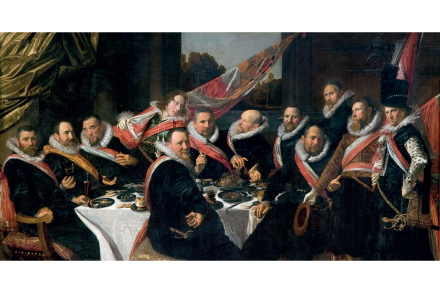
Since art auctions were invented, they have served to hype artists’ prices. It can happen during an artist’s lifetime — Jeff Koons’s ‘Balloon Dog’ — or half a millennium after their death — Leonardo’s ‘Salvator Mundi’. And it can sometimes restore a lost reputation, as happened with Frans Hals. When the picture now famous as ‘The Laughing Cavalier’ came up for auction in Paris in 1865, Hals was all but forgotten. A successful portraitist in his lifetime, he never made much money — with a wife and at least ten children, he remained a renter throughout his career — and after his death his reputation, overshadowed by Rembrandt’s, was tarnished by claims that he was a piss artist.

Fortifying snapshot of the gardener’s year: Saatchi Gallery’s RHS Botanical Art show reviewed

Elizabeth Blackadder, who died last month at the age of 89, was probably the most distinctive botanical artist of our time. Her paintings of lilies and irises, of cats poking their heads imperiously between poppies and freesias, are more alive than any such chocolate-box description could convey. The first woman to be elected to both the Royal and the Royal Scottish academies, Blackadder showed that botanical painting did not need to be twee and parochial. It could be as vibrant and interesting as narrative. The 15 artists and 19 photographers participating in this year’s Royal Horticultural Society exhibition at the Saatchi Gallery follow in Blackadder’s tradition.