National theatre

Profit and loss | 9 June 2016

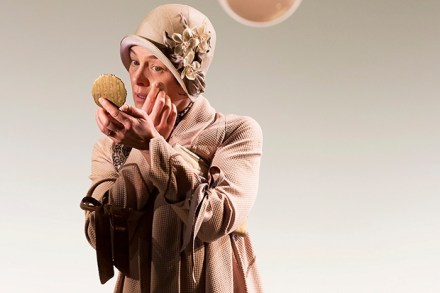
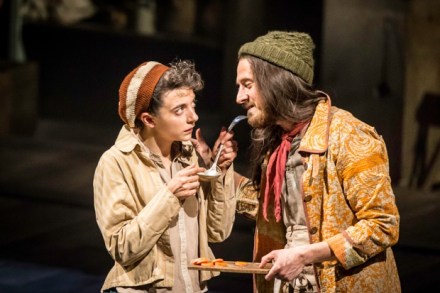
Bertolt Brecht took The Threepenny Opera  from an 18th-century script by John Gay and relocated it to Victorian London. This National Theatre version wants to straddle the contemporary and the antique. Mack the Knife, an Afghan war veteran who murders strangers, contracts a bigamous marriage with Polly Peachum, the daughter of a cross-dressing mastermind who runs begging gangs across east London. This laborious set-up takes an hour to establish and the drama gets started only when Polly’s mum vows to rub out Mack at a knocking-shop. A wise dramatist would have placed this threat in the opening scene. But Brecht isn’t a wise dramatist; he’s a preachy one and his purpose is to show that all human sin derives from the profit motive.
All the world’s a stage | 21 April 2016

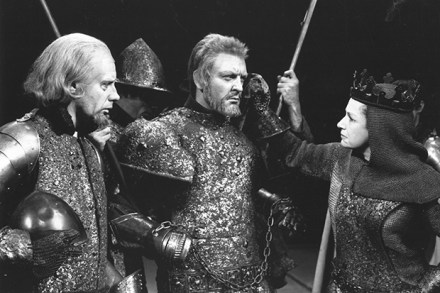
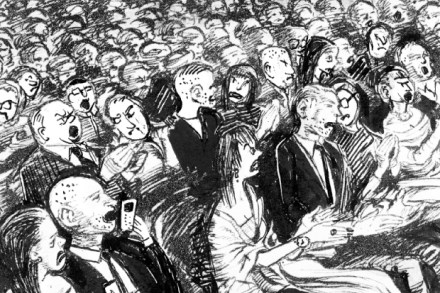
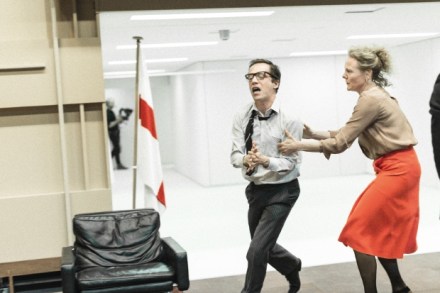
In this much-heralded Shakespeare anniversary year, one might expect a certain respect for the works to prevail. In Holland it’s different. Under the tutelage of a Belgian, Ivo van Hove, a huge slice of Shakespeare’s history theatre has been filleted for the stage into something that might sit nicely on HBO alongside Game of Thrones. It opens at the Barbican on 22 April, a day before the official Shakespeare-death day four centuries ago. And it’s all in contemporary Dutch verse — four hours of it... Kings of War starts with a photo, on a video-screen, of little Prince George. His infant form is followed in rapid succession by that of every English monarch back to Henry V. There, the display halts.

Deluded continent

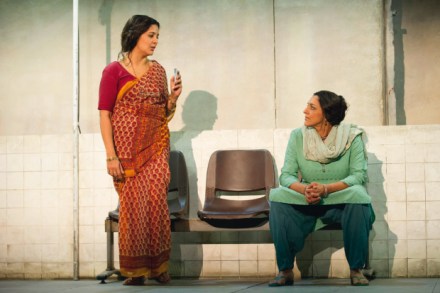
Les Blancs had a troubled birth. In 1965 several unfinished drafts of the play were entrusted by its dying author, Lorraine Hansberry, to her ex-husband, Robert Nemiroff, who mounted a debut production in New York in 1970. Nemiroff has created a fresh version with the help of a ‘dramaturg’ (or ‘colleague’, in English) named Drew Lichtenberg who believes not only that this ramshackle script is a masterpiece but also that Hansberry belongs in the first rank of dramatists alongside Ibsen, Sophocles and Aeschylus. This does not bode well. But the result is surprisingly good. Or good-ish.

Tragedy trumped by porn

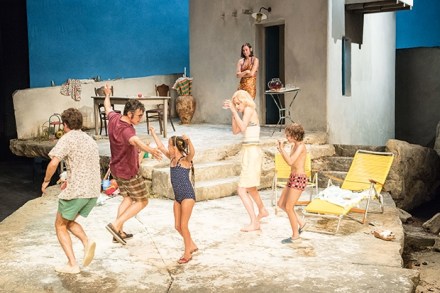
Big fuss about Cleansed at the Dorfman. Talk of nauseous punters rushing for the gangways may have perversely delighted the show’s creators but I’m firmly with the exiteers. This is barely a play and more a thin, vicious pantomime with an Isis-video aesthetic. The minuscule plot follows Grace (Michelle Terry) as she visits a prison hospital to receive news of a tortured relative. She’s immediately roped in as a victim and we’re treated to a sequence of gougings, knifings, electrocutions, rectal penetrations and tongue extractions which are bizarrely interspersed with scenes of lustful romance. Alex Eales’s design stands out.

Alice in cyberspace

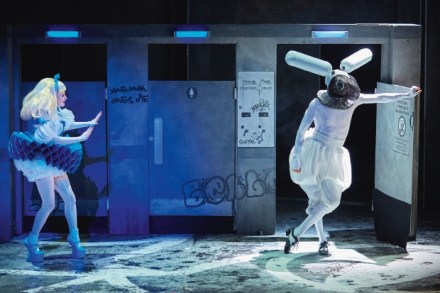
Damon Albarn and Rufus Norris present a musical version of Alice in Wonderland. A challenging enterprise even if they’d stuck to the original but they’ve fast-forwarded everything to the present day. The titular heroine, a trusting and solemn Victorian schoolgirl, has been recast as Aly, a wheedling teenage grump who loathes her mum, her dad, her comp, her teachers and her playmates. ‘I hate being me,’ she announces. And as we learn more about her we’re increasingly struck by the sagacity of this verdict. To escape her distress she downloads a game from www.wonder.land and creates a cyber-self, Alice, who goes on adventures. Hmm. A computer game.

Tricycle’s Ben Hur is magnificent in its superficiality – a masterpiece of nothing

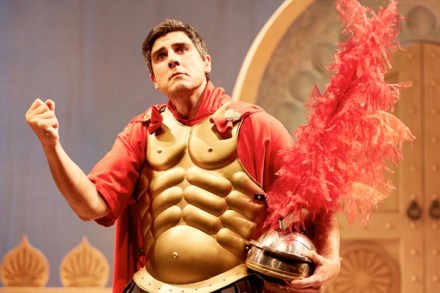
It’s the target that makes the satire as well as the satirist. Is the subject powerful, active, relevant and menacing? Patrick Barlow’s new spoof, Ben Hur, must answer ‘No’ on all four counts. The show takes aim at two principal irritants: vain actors and the Hollywood epics of the 1950s, whose titanic scale was offered as bait to audiences besotted with their cosy new TV sets. Old Hollywood is a spent ogre these days and the foibles of the acting trade are hardly a threat to civilised life, so the show can’t embrace our immediate concerns. But the execution is compellingly assured.

Why is there no one at the National Theatre preventing these duds getting staged?

Wallace Shawn is a lovely old sausage. A stalwart of American theatre, he’s taken cameo roles in classic movies like Clueless and Manhattan. He’s also a playwright whose new script has received its world première at the National Theatre. Lucky chap. He spent three or four years writing Evening at the Talk House and it reveals a peculiar methodology. A play normally features a central character grappling with a personal dilemma, which leads to suffering, change and self-discovery. Shawn doesn’t bother with any of that, he just lays on a gang of theatre types who spend two hours spouting cascades of circuitous chitchat. The show opens with a speech by a rich and successful American TV producer who tells us how rich and successful he is.

All white on the night

Shakespeare’s ‘Wars of the Roses’ will have no ethnic minority actors in the cast when the shows (two Henry VI plays and Richard III) open at the Rose Theatre, Kingston upon Thames, later this month. A sprinkling of so-called BME (black and minority ethnic) actors in Shakespeare has been the norm for ages now. So the decision by the director to go with an all-white cast has caused much hurt and concern from the actor’s union Equity, the Guardian, and from various groups promoting racial diversity in the arts. From all the fuss, you’d think the plays are being directed by a hooded white supremacist.

Walking with cadence

I often regret that I’m writing in the past tense here, but never more than about milonga. It is such a smash show in every way that by rights it would be having a six-month run where everyone can see it, rather than five measly days at the elite Sadler’s Wells dance theatre where people aren’t put off by a choreographer’s tripartite name that takes several goes to pronounce. Tango has a way of curdling in show presentation — just to say ‘thrusting loins and stiletto toes’ is already a Strictly-type parody. Sidi Larbi Cherkaoui is something of an expert cook, however.

His dark materials | 4 June 2015

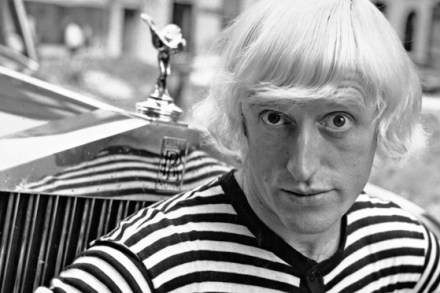
Have you heard the one about girlfriend-killer Oscar Pistorius not having a leg to stand on? Or what about the Germanwings knock-knock joke? If you find gags like these funny, you could come and stand with me on the terraces at Brentford FC. When we played Leeds United earlier in the season, we chanted at them, ‘He’s one of your own, he’s one of your own, Jimmy Savile, he’s one of your own.’ The general public has never wasted much time making up jokes about tragic public events. Making light of high-profile tragedies is a perfectly understandable human reaction, even if it might be frowned upon by some. And what about those who seek to turn topical events into serious art? Is that any more noble than making a cheap joke?

Pinter without the bus routes

David Mamet is Pinter without the Pinteresque indulgences, the absurdities and obscurities, the pauses, the Number 38 bus routes. American Buffalo, from the 1970s, is one of Mamet’s early triumphs. Don is a junkshop owner who believes a customer cheated him over a rare nickel so he gets his young pal Bob to steal it back. An older friend, Teach, persuades Don to ditch Bob and let him commit the burglary. That’s it. That’s all that happens in this narrow, gripping thriller, which takes the brutal male culture of the Wild West and imports it to the Chicago slums where three lonely outcasts fight desperately for scraps of cash and friendship. On paper it all sounds grey, miserable and petty. On stage it’s magnificent, multicoloured, vast and tragic.

Losing the plot | 30 April 2015

Enter Rufus Norris. The new National Theatre boss is perfectly on-message with this debut effort by Caryl Churchill. Her 1976 play about inequality screams, ‘Vote Ed’ at triple-klaxon volume. Not that anyone in the audience was won over. They’d made up their minds long ago. Which is just as well because the play is hopelessly ineffective on every level. Churchill must be the most over-rated writer the English theatre has produced. She has virtually no dramatic skills. She can knock out humourless preachy rhetoric by the yard but as for the rest of it she hasn’t a clue. She can’t write a plot. She can’t create a human individual or differentiate one character from another with quirks of thought, word or deed.

Ayckbourn again

Experts are concerned that Alan Ayckbourn’s plays may soon face extinction. Fewer than 80 of these precious beasts still exist in their natural habitat, so theatre-goers will be cheered to know that the National Theatre has created a genetically identical replica and released it into the wild. Rules for Living, fashioned by Sam Holcroft from the Acykbourn blueprint, is a bourgeois natter-fest in which bickering couples meet for a fractious Christmas summit. The characters are a bit nice and a bit nasty. Stephen Mangan plays a failed cricket star married to a soak in a frock. They have an only child who suffers from this year’s must-have mental disorder.

Alan Bennett shows how hypocrisy is a National issue

Alan Bennett announced on Radio 4 last week that 'hypocrisy' is the defining characteristic of the English. 'In England, what we do best is lip service,' he sighed, before going on to admit that even he is a hypocrite. While many have taken issue with his claim, Mr S was reminded of Bennett's words on a recent trip to the National Theatre. The playwright – a Primrose Hill millionaire who claims to hate rich privilege - has just penned a fluffy essay about soon-to-retire National boss Sir Nicholas Hytner (who just happens to have used public money to stage Bennett’s latest play People). The essay appears in programmes at the National and gushes that Hytner is: 'never the star of his own productions.

Tom Stoppard’s The Hard Problem review: too clever by half

Big event. A new play from Sir Tom. And he tackles one of philosophy’s oldest and crunchiest issues, which varsity thinkers call ‘the hard problem’. How is it that a wrinkled three-pound blancmange sitting at the top of the spinal cord can generate abstract thoughts of almost limitless complexity? In real life Sir Tom is said to have such a flair for philosophical chitchat that he can fire off searching observations about Descartes, mind-body dualism, the nature of immateriality, being and non-being, the ‘cogito’ and so on, until those around him have slithered into a coma. Which is not rude of them.

Without childhood traumas, how did Alan Bennett ever become a writer?

‘So — take heart,’ said Alan Bennett, sending us out from his play, Cocktail Sticks, on a cheery note. The treatment for cancer had been gruelling, but that was 15 years ago, so... This Radio 4 production was adapted (and produced) by Gordon House from the stage version at the National Theatre but was perfectly made for radio, a monologue interrupted by dramatic scenes that take us back into Bennett’s childhood. Why, he wonders, is there nothing from that past for him to write about — no trauma, no deprivation, no disappointment? Surely, his parents could have done more to help him become a writer?

National Theatre’s 3 Winters: a hideous Balkans ballyhoo

A masterpiece at the National. A masterpiece of persuasion and bewitchment. Croatian word-athlete Tena Stivicic has miraculously convinced director Howard Davies that she can write epic historical theatre. And Davies has transmitted his gullibility to Nicholas Hytner, who must have OK’d this blizzard of verbiage rather than converting it into biofuel and sparing us a hideous Balkans ballyhoo. Certainly the play is conceived on a grand scale. Location: a Zagreb mansion. Timeline: 1945 to 2011. Characters: several generations of clever proles plus one dangling aristo. It opens on a note of sourness and corruption. A blonde Marxist stunnah seduces a top commissar who buys her off with the freehold to a townhouse occupied by some rich bloodsuckers. The snooty vermin are kicked out.

Treasure Island is a boys’ book. There’s no need for a feminist twist

When Robert Louis Stevenson wrote Treasure Island he declared triumphantly that if it wasn’t a winner with boys, then he didn’t know what boys were like. And it was indeed the perfect boys’ book; pirates, a map, treasure, a boy hero, black-hearted villains and gore. Perfect. It was, therefore, with mixed feelings that I sat through the National Theatre's feminist take on Treasure Island last night. On the bright side, the set was phenomenal, a cavernous structure like a whale’s ribcage enclosing the action, with the ribs descending like some sort of swamp creature. In fact, Lizzie Clachan’s design - she had great fun with the rising central platform -  stole the show.

David Hare’s notebook: The National Theatre belongs to taxpayers, not corporate sponsors

The nicest day of the year was spent at Charleston in May. The Sussex farmhouse shared by Duncan Grant and Vanessa Bell looked splendid in the streaming sunshine. As a dramatist, I’ve idly disparaged bald and white-haired audiences. But as soon as I started speaking at the literary festival, I realised that everyone in panama hats and cardigans was way to the left of me. The first question was about my local childhood, and I said that growing up so close to the Channel meant that stories of people like Bernard Shaw and Virginia Woolf sitting on English lawns and hearing the sound of battle in the first world war from across the water had always moved me.

The National’s latest attempt to cheer us up: three hours of poverty porn

Bombay is now called Mumbai by everyone bar its residents, whose historic name (from the Portuguese for ‘beautiful cove’) has been discarded for them by their betters. Near the airport a huge advertising board bearing the slogan ‘Beautiful Forever’ overlooks an alp of discarded junk where homeless paupers crouching in tin shacks toil and slave around the clock to earn a meagre bowl of grey, rat-licked gruel. Welcome to the National’s latest attempt to cheer us all up. The verminous scrapheap teems with cocky adolescents, witty thieves, evil moneylenders and struggling mums.