National theatre

Funny, short and cheap to stage, Hansard is an excellent bet for a transfer

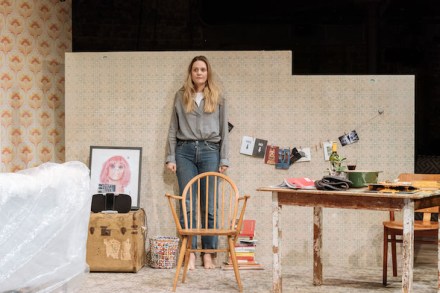
Hansard is the debut play by actor Simon Woods, who enjoys a deep knowledge of his subject. The characters are a middle-aged couple, the Heskeths, who occupy ‘a country house in Oxfordshire. Georgian. Good bones. Not large’. The year is 1988 and Robin is a busy Tory MP whose wife Diana has realised that she loathes the Conservative party and all its doings. ‘They talk a good game,’ she says, ‘but they’re unbelievably dangerous.’ As a lifelong leftie, she has even started begging strangers to vote against her husband, whose policies ‘inflict damage on the most vulnerable in society’. She also suspects him of philandering and has taken to appearing unannounced at his London flat. Robin shares his wife’s talent for invective.

A decorative pageant that would appeal to civic grandees: The Secret River reviewed

The Secret River opens in a fertile corner of New South Wales in the early 1800s. William, a cockney pauper transported to Australia for theft, receives a pardon from the governor and decides to plant a crop on 100 acres of Aboriginal land. His doting wife, Sal, begs him to take her and their young sons back to her beloved London. They make a deal. William must succeed as a farmer within five years or pay for their passage home. He clashes with a tribe of spear-waving Aboriginals who make it clear that they want him off their ancestral turf. Neither side speaks the other’s language. ‘This is mine now. You lot can have the rest,’ says William, pointing vaguely at Australia.

Hare-brained | 18 July 2019

The National Theatre’s boss, Rufus Norris, has confessed that he ‘took his eye off the ball’ when it came to female writers and he plans to strike an equal balance between the sexes in future. Good news for male scribblers who’ll know that they’ve been selected on merit but rather demoralising for females who’ll suspect that they’re just making up the numbers. Sir David Hare, who has written or adapted 25 shows for the National, could easily solve the NT’s sexual identity crisis by announcing that he’s a woman. His latest is a modern version of Ibsen’s barmy but enjoyable fable Peer Gynt, which mixes folklore, fantasy, social comment and tragicomedy.

Poetic and profound

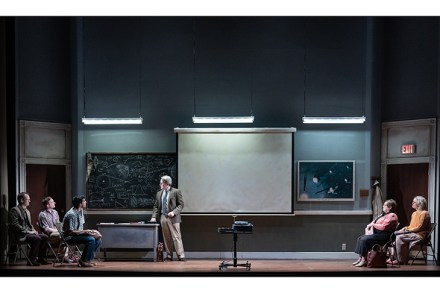
Kenneth Lonergan, who wrote the movie Manchester by the Sea, shapes his work from loss, disillusionment, small-mindedness, hesitation and superficiality, all the forgettable detritus of life. The Starry Messenger is about Mark, a disappointed astronomer aged 52, who gives public lectures at a city planetarium. He loves his subject even though it let him down and every week he tackles the daft questions of his pupils with superhuman patience. The same two pests always raise their hands. One is a burly misanthrope who disbelieves all experts, the other is a high-flying oddball who craves attention. Mark starts a slow-burn affair with Angela, a single mum who needs a role model for her nine-year old son: an expert on the stars and inter-planetary travel is just the ticket.

Hilarity with heart

Small Island, based on Andrea Levy’s novel about Jamaican migrants in Britain, feels like the world’s longest book review. We meet Hortense, a priggish school teacher, and her cool, handsome boyfriend who survive on a pittance in the Caribbean. Then we skip back to Hortense’s childhood in a house dominated by a bullying preacher who forbids conversations at mealtime. Then we cross the Atlantic to Lincolnshire and meet a chirpy blonde, Queenie, whose auntie runs a sweetie shop. Does Queenie want a job selling sweeties? Yes, says Queenie to her auntie. All this takes ages, and it feels like a deadly earnest sociology lecture. Then a stiff young bank clerk enters the shop and asks Queenie if she’d like to go for a walk. And the show takes off.

Toxic waste

Bruce Norris is a firefighter among dramatists. He runs towards danger while others sprint in the other direction. His Pulitzer-winning hit Clybourne Park studied ethnic bigotry among American yuppies and it culminated in a gruesomely funny scene in which smug liberals exchange racist jokes in public. The play was morally complex, dramatically satisfying and an absolute hoot to watch. His new show, Downstate, co-commissioned by the NT and Steppenwolf Theatre in Chicago, takes on a far crunchier topic than racism. Child sex abuse. We’re in a residential home occupied by a quartet of tagged offenders monitored by a sharp-tongued probation officer. We meet the molesters. Fred was once a music teacher who thought it was OK to seduce the boys perched on his piano stool.

You’ve been scammed

The NT’s new play is an update of Pamela, a sexploitation novel by Samuel Richardson. It opens with Stephen Dillane and Cate Blanchett stranded in a concrete garage dressed as French maids. On one side, a black Audi saloon. Mid-stage, colourful blinking lights. At the edges, four other actors lurking. The main characters have no names so let’s call them Stephen and Cate. Who are they? Adulterous workmates, or a divorcing couple, or a male boss and his abused underling? The script reveals nothing about their characters, their backgrounds, their location or their intentions, and the audience’s natural reaction to this indifference is further indifference.

‘I wished Jimmy Porter would just shut up’

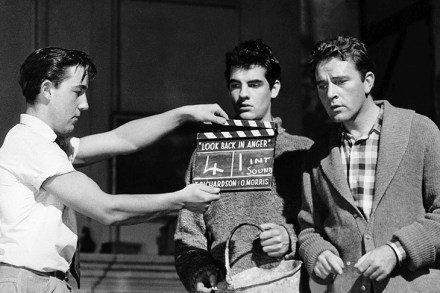
Gary Raymond must have been wondering if it was the end of a promising career — curtains. He was starring in The Rat Patrol, a wartime adventure series. Co-star Justin Tarr had managed to roll the jeep Raymond and fellow actor Christopher George were travelling in. Raymond escaped with a badly broken ankle (he tells me it still gives him jip). George had more serious injuries, including an injured back and a heart contusion. Raymond lived to act another day, but when The Rat Patrol ended after two series, it really was the end of his Hollywood years. But what a few years he’d had, in El Cid alongside Charlton Heston and Sophia Loren, The Greatest Story Ever Told (playing Peter) and in Jason and the Argonauts. I’m interviewing him in the canteen at the National Theatre.

All in the mind | 3 January 2019

The Tell-Tale Heart is based on a teeny-weeny short story by Edgar Allan Poe. The full text appears in the programme notes. Here’s the gist. A madman kills his landlord and is haunted by a ghostly heartbeat that prompts him to confess his crime. Anthony Neilson’s adaptation turns both characters into women and gives away the ending in the opening scene. An English writer lodging with a young Irish landlady is accused of murdering her by a detective. At a stroke, all uncertainty is effaced. The only remaining mystery is why Neilson can’t understand his chosen genre. He tries to interest us in the causes of the murder, and we watch the developing relationship between landlady and lodger.

Love hurts

There is very little art about modern poverty, because who wants to know? It is barely acknowledged, unless there is redemption, or salvation, as in A Christmas Carol. Those most suited to make it — those who are actually poor — are usually too busy doing something else, such as surviving. So, it is remarkable to learn that Alexander Zeldin’s play LOVE, a success at the National Theatre in 2016, is now a film and will air this weekend on BBC2. The closest thing to it recently was Benefits Street, which was exploitative and, therefore, an instant hit. Zeldin is 33. He read French at Oxford University and is artist-in-residence at the National Theatre. His work is plain and understated. He listens, rather than writes, and there are no diatribes, just calm despair.

This is a man’s world

Sir David Hare’s weird new play sets out to chronicle the history of the Labour movement from 1996 to the present day. But it makes no mention of Corbyn, Momentum, the anti-Semitism row or rumours of a breakaway party. The drama is located in the dead-safe Miliband era and it opens with talk of a leadership election. The two best candidates, Pauline and Jack, are old lovers from university. Pauline is a doctor who entered politics when budget cuts threatened the hospital where her mother was being treated for cancer. Jack is a colourless Blairite greaser, a sort of Andy Burnham without the mascara, who is still besotted with Pauline despite being newly married to Jessica.

Less is Moor

It’s intelligent, enjoyable, beautiful to look at and funny in unexpected places, yet Othello at the Globe didn’t quite meet my sky-high expectations. The star should be the Moor but André Holland, from Alabama, can’t rival the magnetism of Mark Rylance (Iago). Holland’s diction is a strain for British ears. We’re used to hearing consonants bashed out — rata-tat-tat — like a rifle range, but his looser southern accent made some of his lines indistinct. Stately Jessica Warbeck lacks Desdemona’s impulsive streak and she plays her as a mature and self-possessed recipient of several Businesswoman of the Year awards.

God save us from the King

Gandalf, also known as Ian McKellen, has awarded himself another lap of honour by bringing King Lear back to London. Jonathan Munby directs. His eccentric decision to hire actors who don’t resemble their characters will baffle anyone who hasn’t studied the play in advance. The casting may be ‘colour-blind’, but the audience isn’t. Anita-Joy Uwajeh (Cordelia) evidently has no white ancestry and therefore cannot be Lear’s natural daughter. A newcomer might deduce that the king’s cruelty towards her stems from her second-class status as an adoptive child. And anyone trying to unravel that mystery will be equally baffled by Sinead Cusack’s Kent.

Bank account

Stefano Massini’s play opens with a man in a frock-coat reaching New York after six weeks at sea. The year is 1844 and young Henry Lehman has just emigrated from Bavaria to make his fortune. He started modestly with a general store in Montgomery, Alabama, serving local farmers. When wildfires destroyed the cotton crop on which the community relied, Lehman’s business ought to have failed but he saw his opportunity. Whatever possessions the farmers had lost they would have to purchase again. From him. He was joined by his brothers, Manny and Mayer, and they invented the profession of brokerage, ‘middle-men’ they called themselves, buying raw cotton from farmers and selling it on to the clothing factories.

Lost in transplantation

Polly Stenham starts her overhaul of Strindberg’s Miss Julie with the title. She gives the ‘Miss’ a miss and calls it Julie. The wonder of Strindberg is that his characters speak to us with such force, knowingness and candour that they seem to belong to our own era. Modernising the setting destroys the wonder. This is a textbook lesson in how to kill by transplantation. We’re in a London mansion owned by an absent billionaire whose chauffeur, Jean, is casually seduced by a trustafarian coke fiend, Julie, on the night of her 33rd birthday. Julie’s motives are lust, boredom, a need for attention and a perfunctory desire to sabotage Jean’s forthcoming marriage to Kristina the cleaner, a bombshell from Brazil.

The Friel-bad factor

The National has made its largest stage available to one of the nation’s smallest talents. If Brian Friel had been born in Dorset rather than in Co. Tyrone he’d have enjoyed an unremarkable career writing episodes of The Archers with the odd stint on Emmer-dale. He’s a champion witterer whose plays lack suspense, pace, depth or spectacle. His characters are constantly and infuriatingly nice to each other. Occasionally they rise to mild irascibility, or a spot of vituperative teasing, but that’s about it. When he needs a crisis he turns to external sources, to destiny or to happenstance, and his plays often end with dreadful sufferings being visited on russet-faced, cheeky-chappy Irish folk by crool, crool fate. Translations at the Olivier is set in Co.

Artistic Munchausen’s

Ella Hickson’s last play at the Almeida was a sketch show about oil. Her new effort uses the same episodic format ornamented with ‘meta-textual experimentation’ (i.e. plotless confusion). The central character is a brilliant young female writer who finds that all male theatre directors are boorish cynical greedy philistine racist sex pests. In Sketch One she meets a smarmy monster twice her age who tries to seduce her with the offer of a script commission. Sketch Two is a commentary on Sketch One, which turns out to have been a play within a play. Sketch Three shows the writer cohabiting with a loser who ‘sells football boots’. The loser has just bought a new sofa (with her money) and he baptises it with an enforced bout of loveless copulation.

Theatrical dining

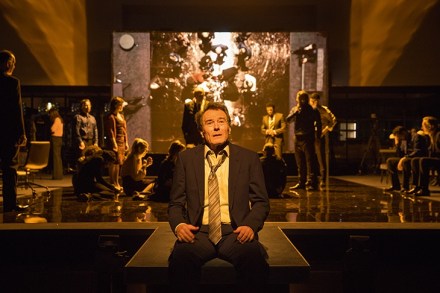
There is a restaurant on the stage at the National Theatre in London. It is called Foodwork, and it is part of the set of Network, an adaptation of Paddy Chayefsky’s 1976 masterpiece about a news anchorman called Howard Beale who goes mad and is given a new show — The Howard Beale Show — to preach the gospel of despair. If you think this sounds dull, imagine Huw Edwards threatening suicide after an item about ducks. Beale is played by Bryan Cranston — Peter Finch in the film — and the restaurant will close when the run ends. Ephemera, then; chase the art, chase the cake. I do not know why they built a restaurant here; some critics have complained that the set, which is Foodwork and a television studio, is too noisy: an oddity, a mistake.

Net effect | 23 November 2017

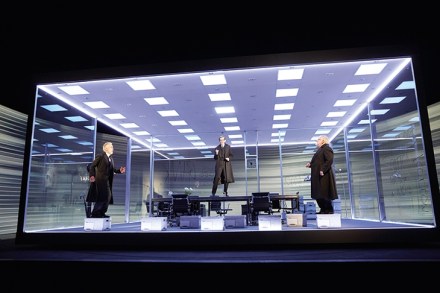
The inexplicable popularity of Ivo Van Hove continues. The director’s latest visit to the fairies involves an updated version of Network, a creaky and over-rated news satire from 1976. Van Hove appears to be unconstrained by thrift or self-discipline and he fills the Lyttelton stage with expensive clobber. It’s like a hangar full of half-tested prototypes. Centre, a TV studio featuring three cameras and an anchor man’s desk the size of a lifeboat. Behind it, a controller’s gallery with lots of TV monitors shielded by wobbly glass. Stage-rear, a vast flat-screen telly that relays the action as it happens but with an irritating quarter-second delay.

Bring up the bodies | 9 November 2017

The moment you invite friends to some new ‘cutting-edge’ disability theatre or film, most swallow paroxysms of social anxiety. What if it’s dull? Am I allowed to yawn? What if I hate it? How interminably politically correct will it be? Do I want to think about ‘disability’ on a fun night out? While most objections can be overcome by a convincing performance, it is interesting to ask whether disability makes a difference to art, or does art transcend disability? If the current crop of plays and films, not to mention disability production companies, is anything to go by, the answer is yes to both, and we should want more of them.