Nasa

Will the New Glenn explosion put America behind China in the Moon race?

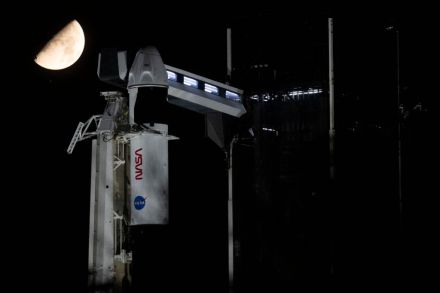
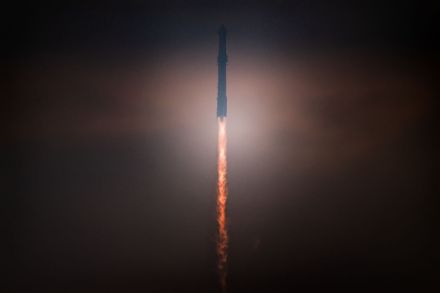
Last Thursday's explosion of the New Glenn rocket, on its launch pad during a test, could hardly be worse news for America’s return to the Moon. Just two days earlier, NASA had unveiled its plans for a Moon Base, which relied heavily on Jeff Bezos’s rocket and his Blue Origin series of lunar landers. As investigators, safety and clean-up crews inspect the wreckage, NASA will be contemplating a major rethink. The options aren’t good. Explosions on the pad are among the worst things that can happen because of how long repairs can take. If a rocket is to explode, engineers pray that it takes place in the air.

new glenn

The moon matters to China

From our UK edition

China’s Chang’e-6 moon mission was launched on 3 May. It reached lunar orbit a few days later and began waiting for sunrise over its landing site on the moon’s far side. Chang’e-6 is named after the Chinese goddess of the moon and it will land on Sunday in a crater called Apollo – an ancient double-ringed walled plain caused by an asteroid smashing into the young moon. Apollo has been heavily damaged by subsequent impacts and in many places covered with lava flows and sprinkled with particles from newer impacts. It is as Buzz Aldrin said, a magnificent desolation. It is a region of great geological significance, since it contains rocks from the moon’s lower crust and the deeper mantle – a treasure trove of planetary history.

Space travel, ancient Greek style

Apollo, Artemis and Orion have not been named at random. The first two are brother and sister, and all three are known in myth as hunters – which is what the astronauts are. Ancient Greeks would have been very envious of them. The satirist Lucian (c. AD 125-180) had great fun with space travel. In his True History, he describes how he sets off with his companions to sail the Atlantic when suddenly a typhoon whirls them up to the Moon, but after many adventures he is able to return and describe what he saw. There are no women, but men act as wives. They produce children in the calf of the leg. The children are born dead but brought to life by breathing in the wind. Men then become husbands. Their noses run with honey and when they exercise, they sweat milk.

How Artemis II returned to Earth

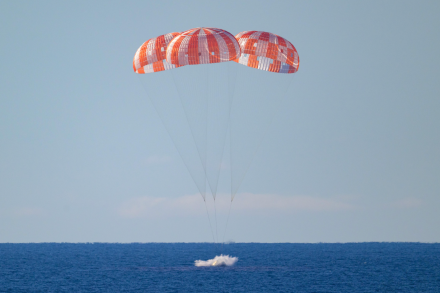
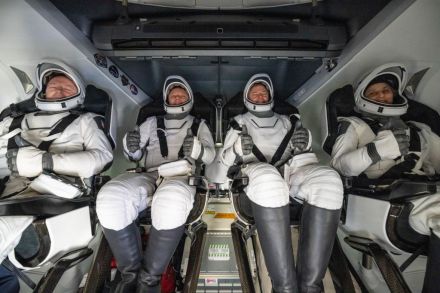
The key event in the return of the Artemis II crew was the moment of real drama during what mission controllers call Entry Interface. The capsule is 400,000 feet above the Earth and still traveling at 25,000 miles an hour. They were among the fastest humans even though they did not break the incoming speed of the Apollo 10 mission. It is only fourteen minutes until splashdown in the Pacific, there is no turning back, no second chance, re-entry will happen no matter what. A few hours earlier the crew donned their orange so-called crew survival suits and lowered their visors. In essence these are personal spacecraft providing everything they need to survive for up to six days. Their water-cooled inner suit was keeping them cool even though the cabin temperature was normal.

Artemis II

Farewell, Voyager 1

From our UK edition

Some time soon we will have to say farewell to our most distant emissary – the Voyager 1 spacecraft. After almost 50 years in space, it’s 15 billion miles away and showing signs of wear and could soon stop transmitting. Late last year, Voyager 1 began to decline, sending back spools of gibberish to its handlers on this planet. A few days ago, Nasa engineers finally traced the problem back to a single chip but it’s clear that Voyager 1 will shortly have to cut contact and make its way out across the universe on its own. It’s strange to think that it will be exploring on out into deep space long after its makers – humans – have become extinct.

Portrait of the week: Trump threatens Iran, Kanye is banned and Artemis II heads to the Moon 

From our UK edition

Home The government withdrew an offer to create 1,000 more training posts for doctors in England after the British Medical Association refused to call off a six-day strike by resident doctors. In a speech at a White House Easter lunch, President Donald Trump of America mocked Sir Keir Starmer, the Prime Minister, for having to consult his team about sending ‘two, old broken-down aircraft carriers’ to the Middle East. Seven people protesting at Lakenheath RAF base were arrested on suspicion of supporting the proscribed group Palestine Action. Chris Rokos, the billionaire hedge fund owner, is to donate £190 million to the University of Cambridge to found a school of government.

Why Artemis II matters

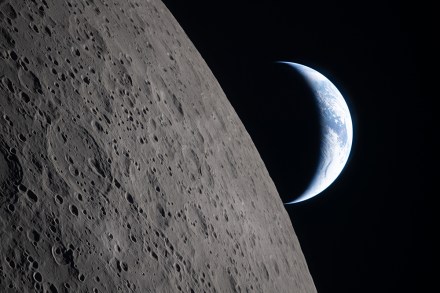
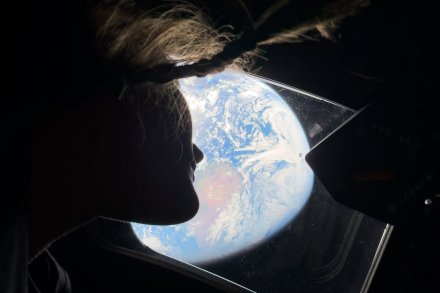
Weren’t those images beamed back from the Artemis II mission something to catch the breath in the throat? If something in you wasn’t stirred by the sight of Earth, glimpsed through the window of the space capsule past the silhouetted face of the astronaut Christina Koch, I don’t think you can be fully alive. And what about the thought that for the first time in history, human eyes will look directly on the dark side of the moon; or that the inhabitants of that spacecraft will travel farther from our home than any humans have ever done? That for a few tens of minutes before earthrise, they will be wholly out of contact with home as they travel through the vast dark? Stir the soul it might; but why, some will reasonably ask, should we be doing it at all?

Will Artemis II fulfill our Space Age dreams?

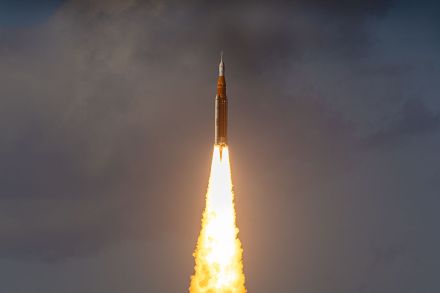
As the Artemis II mission thundered into the sky last night, a full moon rose above Cape Canaveral. It was no coincidence: the timing of the lift-off was ordained by lighting requirements and the mechanics of the Moon's orbit. The mission set off not in the direction of the Moon, but towards where the Moon will be in five days’ time when the spacecraft swings around it in what is called a "free-return trajectory." The crew of four are the first in almost 54 years to go to the Moon. In a way, things have not changed so much since then.

Will Bezos beat Musk to the Moon?

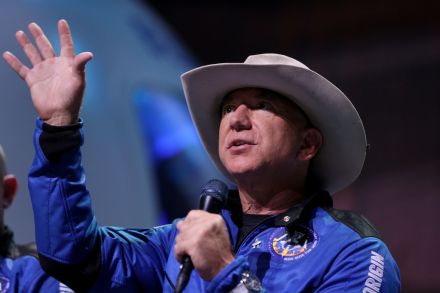
Even Elon Musk has to face a dose of reality every once in a while. Technology and politics have forced him to turn his gaze away from Mars, for the moment at least, to put Americans back on the surface of the Moon before China gets there. But it might already be too late. If America has any chance of beating China, it now seems inevitable that the next American human landing on the Moon will not be by Musk’s Starship but using a craft being developed by his rival Jeff Bezos. Announcing the pivot, Musk wrote on X: “For those unaware, SpaceX has already shifted focus to building a self-growing city on the Moon, as we can potentially achieve that in less than 10 years, whereas Mars would take 20+ years.

Bezos

Will US businesses profit from a return to the Russian market?

Rome Will peace in Ukraine also prove to be a great deal for US business? Vladimir Putin would certainly like Donald Trump to think so. Within days of Trump’s election victory last November, the Kremlin ordered major Russian corporations to prepare detailed proposals for economic cooperation with Washington. Coordinating these efforts were Maxim Oreshkin, deputy head of Putin’s presidential administration, and Kirill Dmitriev, the US-educated Harvard, Stanford and Goldman Sachs alumnus who heads Russia’s sovereign investment fund.

Why Trump must build a nuclear reactor on the Moon

Sean Duffy, the secretary of transportation whom President Trump appointed last month as temporary leader of NASA, has issued a directive to fast-track efforts to put a nuclear reactor on the moon. “To properly advance this critical technology to be able to support a future lunar economy, high power energy generation on Mars, and to strengthen our national security in space,” he says.A small nuclear reactor on the moon is a good idea, but the directive is about more than that: it is about renewing America’s leadership in space exploration that, with its magnificent achievements receding into the past, looks vulnerable. Bill Nelson, NASA’s last leader, didn't mince his words when it came to the new rivals, China. “It is a fact: we’re in a space race.

The Moon

How politics tainted the delayed homecoming of stranded astronauts

The return of two NASA astronauts – Suni Williams and Butch Wilmore – back to Earth after equipment malfunctions saw their intended week-long sojourn to space turn into a nine-month stay on the International Space Station, should be cause for national celebration. Alas, politics has tainted the stratosphere, with each side of the aisle playing a part in the blame game for the astounding delay in getting our stranded astronauts back home.  Williams and Wilmore will have endured more than just a few missed family events and some extra time spent conducting experiments (they carried out more than 150) aboard the ISS.

Why space is the perfect subject for podcasts

From our UK edition

The podcasts I’m recommending to everyone at the moment are Nasa’s Curious Universe and the Royal Astronomical Society’s The Supermassive Podcast. Both have me convinced there’s no topic better suited to the oral medium than space. Not even history. Unless you happen to be an astronaut, you’ll find much of what is described so alien, that your imagination will go into overdrive. What does a Brown dwarf look like? What is the ‘tadpole’ orbit of a quasi-moon? The icy surface of Europa has red furrows which make it look like ‘a giant dragged its fingernails’ across it. How did those furrows get there? You will probably find the images summoned in your head offset the urge to reach for Google.

The death of the American museum

It starts with the promise of skipping school — always an illicit thrill at nine years old. My son and I, seasoned truants, hop the early train to downtown Chicago for what I’ve convinced him is a real education. The day’s agenda: two of the city’s iconic museums — grand, intimidating and, up until recently, somewhat sacred. These sprawling neoclassical behemoths, both originally constructed for the 1893 World’s Columbian Exposition, dot the waterfront like ancient ruins. They once felt like temples to knowledge, where wonder and learning collided, where static displays ignited curiosity. But as we step inside, I can’t shake the feeling that maybe, just maybe, their magic has faded. Can museums as we know them survive my lifetime?

museum

Acceptable for a hangover day: Fly Me to the Moon reviewed

From our UK edition

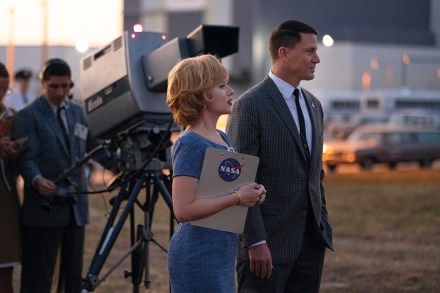
Fly Me to the Moon is a romantic comedy starring Scarlett Johansson and Channing Tatum set during the 1960s space race but, unlike Apollo 11, this isn’t going anywhere we haven’t been before. The extent to which the film does take flight is largely thanks to Johansson’s charisma, even though I couldn’t help shake the feeling they’d fired up a Maserati for a job that basically required a pootle to the shops and back. Tatum, meanwhile, doesn’t have to do much but stand around and look beefy – but he does excel at beefiness. (The shoulders on this fella!) Tatum is 82 per cent shoulders,18 per cent neck. (This is aguess; don’t hold me to it) The film opens in 1969 with Johansson as Kelly Jones, a Madison Avenue marketing genius.

The space race gets serious

We are shifting from the early era of space exploration to a more serious phase extending ever further from Earth’s orbit, focused on key opportunities such as mining and manufacturing as well as military purposes. This newly expanded playing field will determine not only who rules in space, but who ends up dominating Earth. The protagonists include some familiar faces — the US, Russia and the European Union — but much competition will come from emerging powers, notably India and China, both of which look upon the “final frontier” as critical to their economic and military futures. Yet the rise of non-state space entrepreneurs, notably SpaceX, has introduced a fresh and potentially decisive factor to the new space race.

space

Fools rush in: Mania, by Lionel Shriver, reviewed

From our UK edition

Pearson Converse teaches literature at Verlaine University, Pennsylvania. She exists in an alternative universe to our own in which the Mental Parity Movement holds sway.  There is intellectual levelling, and no ‘cognitive discrimination’. This is high satire, exaggerated, crude, inviting ridicule of the social system portrayed, close to the great satirists of the 18th century in tone if not in style.   Yet Lionel Shriver’s Mania is more than just a satire. It is a study of Pearson’s family life and her ‘unbalanced’ relationship with her best friend from childhood, Emory. Pearson has three children: an intellectually gifted girl and boy by a high-IQ sperm donor, and an averagely intelligent girl conceived with her tree-surgeon partner, Wade.

Scientists’ strange offering to the final frontier

Dr. Jonathan Jiang dreams of beaming an easy-to-read message into space before civilization collapses. He’s run the simulations to test humanity’s self-destruction rate. According to his computers, there’s a 0.1 percent chance that humanity destroys itself in the not-so-distant future. He’s even more pessimistic than Stephen Hawking, who bowed out of public life saying, “I don’t think we will survive another 1,000 years without escaping beyond our fragile planet.” Jiang, who works for NASA’s Jet Propulsion Laboratory, co-authored the 2022 paper “A Beacon in the Galaxy,” which argues for the importance of streamlining the communications we send into space hoping they might be intercepted by an interplanetary species.

space

What would life on Mars actually look like?

From our UK edition

Just as extreme altitudes have notable effects on the human body and mind, so too does extreme wealth seem to have a particular effect on psychology. Or at least that’s how it appears when you look at the shared ambition of two of the world’s most prominent billionaires, Elon Musk and Jeff Bezos. Both men are fixated on the idea that humanity’s future lies beyond Earth and are funnelling fortunes into the vision that we will soon have significant human settlements off-planet, whether on the moon, Mars or elsewhere. It’s an argument grounded not just in exploration and discovery, but in survival. If humanity’s future on Earth looks to be in doubt, is living off-world not the ultimate insurance policy for our species?

What exactly is the new space race all about?

The recent spate of articles about attempts by different countries to land vehicles on the Moon make it clear that a new space race is on. Just last month, Russia launched its first mission there in forty-seven years. And although the automated Luna-25 spacecraft spun out of control and crashed at the last minute, India’s heavily-instrumented Chandrayaan-3 landed successfully just four days later. NASA itself aims to return humans to the lunar surface in 2025 with its Artemis program. Remarkably, more than eighty countries, including Israel and the United Arab Emirates, have thus far established some kind of presence in space.

space