Modernism

Dawn party

From our US edition

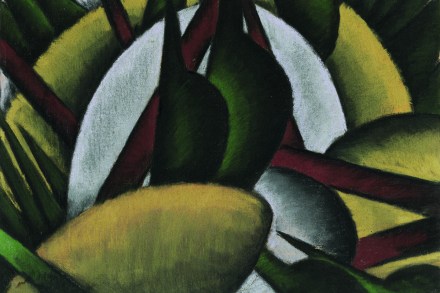
What a difference a century makes. That’s the upshot of At the Dawn of a New Age: Early Twentieth-Century American Modernism, an exhibition at The Whitney Museum of American Art culled from its own holdings. In-house ventures can sometimes come off as so much house-cleaning, an opportunity to air out the storage racks and take stock of inventory. Which is, in fact, exactly what Whitney curator Barbara Haskell has done. But by adding select loans from other institutions and private collections, she’s put together a show that has its own Gestalt. Though the fervor of artistic innovation has a limited shelf life, the work on display here continues to radiate a klutzy, almost childlike audacity. There’s a naivete at the heart of At the Dawn of a New Age, and it is winning.
dawn

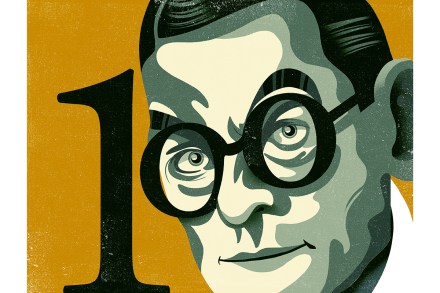
T.S. Eliot’s The Waste Land at 100

From our US edition

In the United States a century ago, a single poet dominated the literary sphere. He was not only the recipient of the first ever Pulitzer Prize for Poetry — which he would win twice more during the course of an internationally distinguished career — but would be nominated for the Nobel Prize for Literature on four separate occasions. He was beloved by presidents, described by one admirer as “more artful than Hardy and more coy than Frost” and found himself one of the bestselling writers in America. His reputation seemed assured forever.

waste land

From modernism to totalitarianism

From our US edition

The modernist movement in the arts got underway around the start of the last century, encouraged by Ezra Pound’s exuberant exhortation to “Make it new!” Somewhat less attention was paid to making it good, as if what was new was inevitably good — better, indeed, than everything that had come before it. Barrels of printers’ ink were expended on the subject in the so-called “little magazines” of the period on both sides of the Atlantic, not all of it wasted; much of the relevant critical commentary was very intelligent and interesting indeed. Modernism as a concept and an aesthetic was less successful in music, painting, the plastic arts and architecture than in literature — though again, some of the work it inspired was very good.

modernism

The well of happiness – and despair: Queer St Ives reviewed

In the winter of 1952 the 21-year-old sculptor John Milne travelled to St Ives in Cornwall to take up a temporary job as an assistant to Barbara Hepworth. The arrangement was that he would become her pupil in exchange for helping her in the studio, but he was subsequently paid a small salary and ended up staying in her employ for two years. By this time, Milne had decided to settle in the town, which had become a thriving modernist artists’ colony, and in 1956 he acquired Trewyn House, a three-storey Victorian property next door to Hepworth’s studio.

Playing the long game

From our US edition

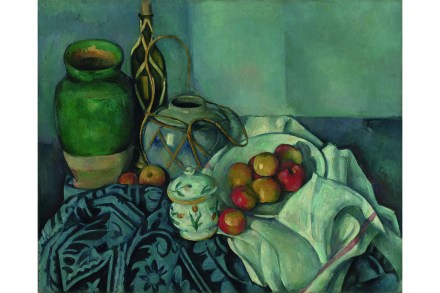
Back in the fall of 1995, on the centennial of Paul Cezanne’s breakout late-career exhibition at Ambroise Vollard’s avant-garde art gallery, a retrospective opened at the Grand Palais in Paris, titled simply “Cézanne.” That show traveled to the Tate in London in 1996 and then to the Philadelphia Museum of Art. Now, more than a quarter century later, another retrospective with a similarly spartan title has opened in the Windy City: a joint venture between the Art Institute of Chicago and Tate Modern.

cezanne

Virginia Woolf’s very own Bloomsday

From our US edition

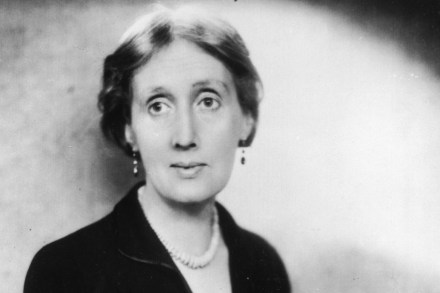
“Mrs. Dalloway said she would buy the flowers herself.” Nine words into her 1925 classic, Virginia Woolf has taken us to another world. London — Westminster to be precise — in mid-June 1913, a world in which it is unusual for a woman to buy the flowers for her own party. Clarissa Dalloway only steps out into the early morning air (“fresh as if issued to children on a beach”) because her maid, Lucy, “had her work cut out for her.” The Wednesday in the “middle of June” on which the action of Mrs. Dalloway takes place is debated. The year is 1923, which would make the 13th of June the most likely candidate. But as academics are wont to do, there has been some disagreement.

mrs. dalloway

Don’t read Ulysses; listen to it

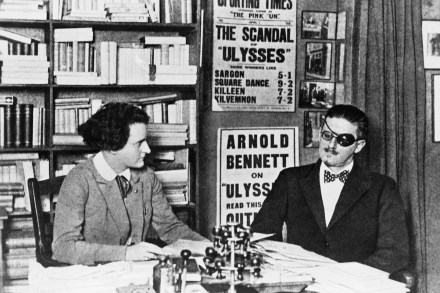
Dublin. 16 June 1904. A little after 8 a.m. Two men – both annoying, one stung with grief and ambition – are having an argument. One is pierced by thoughts of his late mother. ‘Pain, that was not yet the pain of love, fretted his heart.’ She has come to him in a dream smelling of wax and rosewood. ‘Dedalus,’ the other calls up to him. ‘Come down, like a good mosey. Breakfast is ready.’ Ireland. 16 June 1982. 6:30 a.m. Radios all over the country emit the words ‘Stately, plump Buck Mulligan’, and don’t stop broadcasting until they have read out every word of Ulysses, down to its last, heart-stopping syllable. There was no abridgement and no explanation: just the text, entire.

A play for bureaucrats: David Hare’s Straight Line Crazy reviewed

It’s good of Nicholas Hytner to let Londoners see David Hare’s new play before it travels to Broadway where it belongs. Few Brits will know the subject, Robert Moses, an urban planner of the 1920s who built the roads and bridges that gave New Yorkers access to seaside resorts in Long Island. This is a play for bureaucrats. Nit-picking and box-ticking are the main points of interest. Squiggles on forms. Correct signatures at the bottom of proof-read documents. Hare is copying George Bernard Shaw and his script is a celebration of rhetoric above all other qualities. Dialogue-junkies will enjoy the screeds of quickfire chatter that keep the play motoring along. And like Shaw, Hare omits many of the elements that make a drama feel lifelike.

The genius of Iannis Xenakis

This year is the centenary of the birth of Iannis Xenakis, the Greek composer-architect who called himself an ancient Greek stuck in the contemporary world. His instrumental music at times suggests an alien species trying to communicate with us through our musical instruments, his electronic music a distressed animal on the receiving end of amateur dentistry. For his part, Xenakis said that music ‘must aim… towards a total exaltation in which the individual mingles, losing his consciousness in a truth immediate, rare, enormous and perfect’. Of all the post-war European firebrands, Xenakis remains the most influential today.

Ralph Vaughan Williams: modernist master

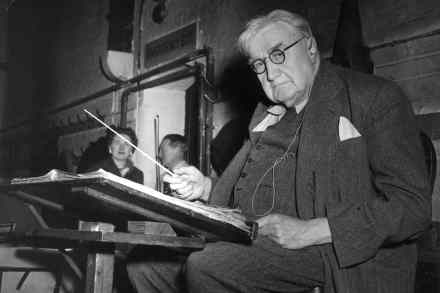
To look at a picture of Ralph Vaughan Williams is like contemplating an image of a mountain. Not the elegant, keen-eyed Edwardian intellectual whom we sometimes glimpse on CD sleeves or in concert programmes; I’m thinking of the portraits from the last decade of his long life. By the 1950s ‘RVW’ had been the father of British music for so long that he already seemed like part of the landscape, and he looked it too. The craggy jowls, the weathered thatch of grey hair; that questioning gaze — and beneath it all, those great, tumbling scree slopes of rumpled tweed. In his 150th anniversary year he’s still there, towering in the middle distance of national memory.

Abstract and concrete: the beauty of brutalism

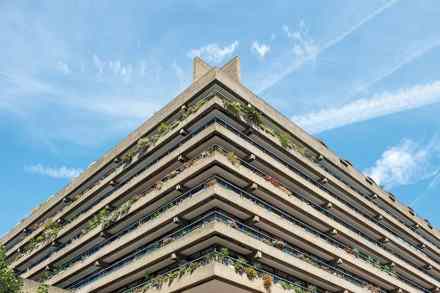
Nothing divides the British like modernist architecture. Traditionalists are suspicious of its utopian ambitions and dismiss it as ugly; proponents romanticise it, yearn for the civic principles that built it and gloss over its failings; the young see period charm in flat roofs and straight lines, while the old associate them with deprivation; the wealthy mostly avoid it — and many people have no choice but to live in it. Nearly 100 years after Le Corbusier set out his five points of modern architecture the British are still arguing about its merits, partly because we still live with so much of it: housing, offices and civic and industrial buildings. Two new books may change our perspective — or at least convince us that neither side is entirely right.

Disappointingly conventional and linear: BBC radio’s modernism season reviewed

This week marks the beginning of modernism season on BBC Radio 3 and 4, which means it’s time for some pundit or other to own up to abandoning Ulysses at page seven, or to finding T.S. Eliot a bore, or to infinitely preferring the landscapes of J.M.W. Turner to the repetitive squares of Kazimir Malevich. That pundit, however, won’t be me. Modernism is rather like the birth of the Roman Empire. It could be seen as a brilliant sloughing off of everything that had decayed in favour of sensible revolution, or as the predictably reactive consequence of years of wrangling over a loss of identity.

When did postmodernism begin?

There’s a scene in Martin Amis’s 1990s revenge comedy The Information in which a book reviewer, who’s crushed by his failures and rendered literally impotent by his best friend’s success, is sitting in a low-lit suburban room beside a girl (not his wife) named Belladonna: ‘She was definitely younger than him. He was a modernist. She was the thing that came next.’ Stuart Jeffries argues in his new book that the thing that came next was in fact a thing that started a couple of decades before Amis wrote The Information. In Jeffries’s telling, postmodernity can be dated to 13 August 1971, when Richard Nixon held a closed-door meeting that led to America’s abandonment of the Bretton Woods policy of gold-backed currencies.

One hundred years of Ulysses

From our US edition

A few years ago, the private school where I teach asked me to offer an evening class on James Joyce’s Ulysses to adults. The idea was to remind alumni, parents and other community members what it feels like to be in one of our enriching classrooms. For over a decade, my Ulysses senior elective had been a major feature of our course catalogue; now, a few adults were about to pop the hood on this infamous tank of a book. As course registrations began to trickle in, I recognized the surnames of current and former students. Then an administrator joined the course, and I had a flutter of nerves at the realization that one of my bosses was actually going to read Ulysses and encounter the disreputable content that lurks within. My cover was blown.

Ulysses

Prints of Wales and elsewhere

From our US edition

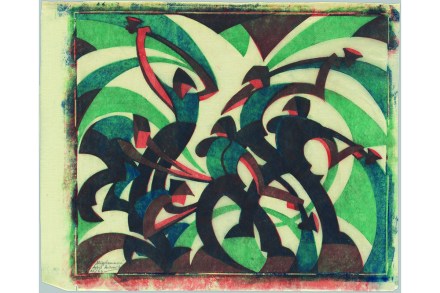
The print is a curious category in the world of art. Prints are not singular, of course — not typically at least. They are not ubiquitous, either — at least, again, not typically. They exist somewhere between art objects and art products. Printmakers often use the tools of sculpture to create works on paper. Three-dimensional carved objects become two-dimensional printed products. Think about it and you realize prints are far more curious than they let on. While art history typically does not know what to do with its curiosities, artists can sometimes make much out of the opportunities of hybrid creation.

prints

The Sunday Feature is one of the most consistently interesting things on Radio 3

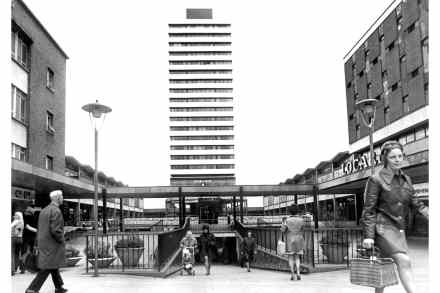
The story is likely apocryphal — and so disgraceful I almost hesitate to tell it — but it goes like this. On the night of 14 November 1940, as more than 500 Luftwaffe rained bombs on the people of Coventry, the newly appointed city architect Donald Gibson was watching the fires. Gibson had been appointed to the newly created position of ‘city architect’ three years earlier by the radical Labour council that had come to power in a local election. His job was to modernise what was then Britain’s best-preserved medieval city, and build the ideals of social justice and equality into the city’s brick and mortar.

Deserves to be much better known: Sophie Taeuber-Arp at Tate Modern reviewed

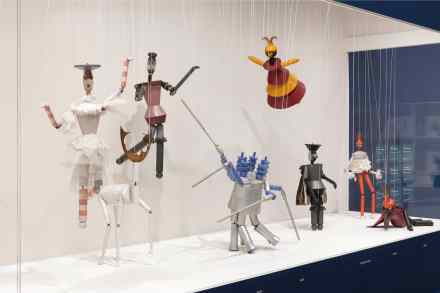
Great Swiss artists, like famous Belgians, might seem to be an amusingly underpopulated category. Actually, as with celebrated Flemings and Walloons, when you start counting you discover there are more of them than you thought. Paul Klee, for example, and Alberto Giacometti. A third, whose work is reassessed in a large exhibition at Tate Modern, was Sophie Taeuber-Arp. Clearly, unlike the other two, hers is far from being a household name even in fairly artistic homes. There are several reasons for this, one perhaps being the unwieldiness of that cognomen itself. She was born Sophie Henriette Gertrud Taeuber in 1889 at Davos, and as was then the custom, hyphenated her surname with her husband’s when she married Hans (or Jean) Arp in 1922.

Welcome to the Impasse Ronsin – the artists’ colony to beat them all

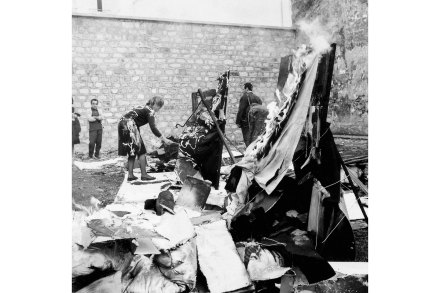
Of all creatives, visual artists are perhaps the least likely to work in isolation; the atomised life of garret-installed solitude is not for them. Artists have always bounced off one another, whether in colonies, studios, collectives or co-operatives. The YBAs would not have been a thing, let alone a now-unfashionable acronym, had a significant group of them not chosen to hang out together. There are outliers, of course, but for the most part artists seem to like rubbing along together, perhaps in the belief that the fumes of oil from one studio can inspire brushwork in the one next door. The Impasse Ronsin, a tiny cul de sac in the 15th arrondissement of Paris, was the artists’ colony to beat them all. It had everything: fame, obscurity, money, poverty, radicalism, outrage.

The magnificent fiasco of Mies van der Rohe’s Farnsworth House

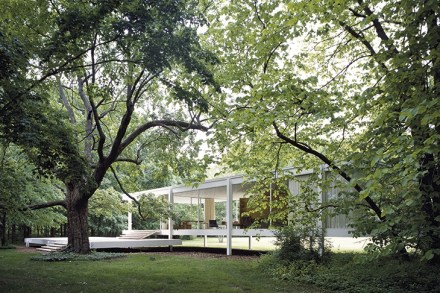
John Ruskin believed the most beautiful things are also the most useless, citing lilies and peacocks. Had he known about the Farnsworth House in Plano, Illinois, a rural community 50 miles west of Chicago, he might have suggested it too. Except this modernist building of 1951 is an evolved expression of the emerging industrial culture Ruskin so despised. But it is several other things too, notably an example of fraught transactions between architect and client. The Farnsworth test case became a trial whose transcript ran to 3,800 pages. Of all relationships, except that between a firing squad and its target, the architect-client example is the one most predictably headed for calamity.

Why did David Bomberg disappear?

David Bomberg was only 23 when his first solo exhibition opened in July 1914 at the Chenil Gallery in Chelsea. ‘I am searching for an Intenser expression,’ the brash young painter wrote in the introduction to the catalogue. ‘I hate… the Fat Man of the Renaissance.’ As if to advertise his radical intentions, the first work in the exhibition, the strikingly geometric ‘The Mud Bath’, was hung outside the gallery, facing the street. Bomberg was endowed with a self-belief bordering on conceit. Born in 1890, the fifth of 11 children of Polish-Jewish immigrants, he spent his childhood in the overcrowded slums of Birmingham and east London.