Military

Inaction is easy; action is harder but needed now

It’s easier to oppose than propose war. The conflict between Israel and Hamas inspired #NotInMyName on Twitter, and opposition to the invasion of Iraq in 2003 was spearheaded by the ‘Stop The War’ Coalition. It is easy for ‘anti-interventionists’ to cite negative consequences of action already documented, for example in post-invasion Iraq, than for ‘interventionists’ to make their case. Insults like ‘warmonger’ or ‘blood on your hands’ slip off the tongue more readily than complicated arguments to the effect that inaction can cause even more blood-letting and chaos, and that those who advocate it bear some responsibility for the ensuing carnage. The present crisis facing the Yazidis, Kurds and indeed

The three golden rules of intervention

Barack Obama has authorised the use of targeted airstrikes in Iraq against forces of the Islamic State, which are hell-bent on massacring Yazidi and Christian minorities, and threatening American assets and citizens. David Cameron has welcomed Barack Obama’s decision. There are already voices calling for wider deeper intervention; special forces and conventional ground troops have been mentioned by former US generals and diplomats. Interventions have a habit of escalating, a point that Douglas Murray made in The Spectator this time last year when Barack Obama and David Cameron were preparing to intervene in Syria. Douglas urged Obama and Cameron (and any other statesmen considering intervention) to prepare throroughly: ‘The repercussions

What Britain will lose if Scotland goes

[audioplayer src=”http://traffic.libsyn.com/spectator/TheViewFrom22_3_July_2014_v4.mp3″ title=”James Forsyth, Fraser Nelson and Eddie Bone discuss whether the UK could survive without Scotland” startat=41] Listen [/audioplayer]On 19 September, people over all Britain could wake up in a diminished country, one that doesn’t bestride the world stage but hobbles instead. If Scotland votes to leave the United Kingdom, it would be Britain’s greatest ever defeat: the nation would have voted to abolish itself. The rump that would be left behind after a Scottish yes vote would become a global laughing stock. Whenever the Prime Minister of what remained of the United Kingdom raised his voice in the international arena, he would be met by a chorus of

Would the word ‘NATO’ make Vladimir Putin think twice?

Russia, Ukraine, the European Union and the United States will meet in Geneva later today in order to find a solution to the confrontation in eastern Ukraine. There is not much hope of success. The Obama administration has been lowering expectations, so too the Foreign Office. Kiev’s heavy-handedness in eastern Ukraine has embarrassed the western allies; not least because the military deployment yesterday exposed Ukraine’s inherent weakness: government forces were either incapable or reluctant to enforce Kiev’s writ in the east of the country. There were further violent clashes overnight. Kiev says that 3 ‘Russian separatists’ were killed and 13 wounded when trying to seize a military installation on the

Crimea, Russia and the power of ‘provokatsiya’

What to make of the appearance at two airports in Crimea of armed men wearing uniforms without insignia? The airports are strategically placed – Belbek near Sevastopol, and the main airport outside Simferopol, the regional capital. Obviously, an airport is a vital piece of local infrastructure that provides an entry point for reinforcement and supply; their possible seizure by unidentified troops is a very serious business. Authorities in Crimea insist that the armed personnel belong to the Russian Black Sea fleet, and that this is a ‘military invasion and occupation’. Meanwhile, a spokesman for the Russian Black Sea fleet has issued this communiqué: ‘No subdivision of the Black Sea Fleet has been advanced into

Griff Rhys Jones: Burma, My Father and the Forgotten Army

Burma, My Father and the Forgotten Army, with Griff Rhys Jones, is on BBC2 at 9pm on Sunday, 7th July. I have spent a week with old, old men, interviewing veterans who served with the West African regiments in Burma in the 1940s. It’s for a television programme about my father’s war. The young men who were shipped off to the Far East are nonagenarians now and, black or white, universally charming and calm: unhurried, unflappable and brimming with patient good humour. At first, I thought that that’s what must happen as you approach your own centenary. But then I realised it might be the other way round. Perhaps this

America won’t be Europe’s policeman any more – but that’s good for Britain

The US Army’s cuts are good for Britain. They will force our European allies to think about their own defence and re-evaluate their policies. This will highlight the benefits of NATO’s guarantees and put the focus in the EU on what matters. For over twenty years European members of NATO have had a free ride. They’ve enjoyed the protection of a shield on land and a fleet at sea wherever needed, and have prospered as a result. Insurance without premiums has been one hell of a gift. It has also led to what Sir Humphrey would call ‘courageous’ assumptions. Just think what hasn’t happened. The Baltic States haven’t been invaded,

French baiting from the PM?

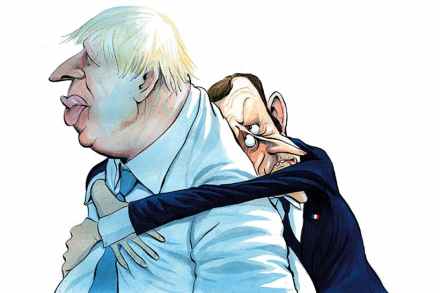
The French media might prostrate themselves before their own leaders; but they are a little more adventurous with ours. Le Figaro reports that the original plan for today’s Anglo-French Summit at RAF Brize Norton, followed by a pub lunch, was to have been a far grander affair. Hollande was to be invited to Cameron’s constituency and then on to nearby Blenheim Palace. But French officials reportedly pointed out that the Duke of Marlborough’s home was so named in honour of his ancestor’s crushing defeat of the Franco-Bavarian army at Blenheim in 1704. The French suffered 30,000 casualties and the battle was a turning point in the War of the Spanish

What can the international community do to restore law and order in the Philippines?

Britain is to deploy one warship, the Type 45 destroyer HMS Daring, which is currently on station near Singapore, and RAF support aircraft, including one Boeing C17 transporter, to the Philippines. The US has deployed a carrier group. It will take HMS Daring 5 days or so to reach its destination. It will provide engineering equipment, first aid, water sanitising kits and the means to turn sea water into drinking water. Most reports from the disaster area warn of the threat of waterborne disaster, so HMS Daring’s supplies will be very welcome. The destroyer is also equipped with one Lynx helicopter, which will extend its operational reach inland. The RAF

The one good thing we’re leaving in Afghanistan

 Kabul A strange new institution is rising from the dust in the mountains west of Kabul. The foreigners here call it the Sandhurst in the Sand. Those who work at the new British-led military school, which welcomed its first cadets last week, prefer the more cumbersome ‘ANA-OA’, short for Afghan National Army Officers Academy (though the Australians who guard the place call it ‘Duntroon in the Desert’ after their own Sandhurst equivalent). Whichever name sticks, the ‘Afghan Sandhurst’ will be perhaps the only significant British contribution to Afghanistan’s security after the Nato mission finishes at the end of next year. Some see it as a way of making up for

The Syrian paradox

Readers may be interested to know that I have a piece in this morning’s Wall Street Journal on the House of Commons vote last week on Syria. David Davis MP has a piece in the same edition making some broadly similar points. For me the conundrum of Syria now comes down to one particular problem. That is one which the House of Commons stumbled over last week and which the US Congress is likely to stumble over in the week ahead. The West has now given ample warning to President Assad of its intention to strike at some point. President Obama has famously drawn a red-line over the use of

Another reason to biff the hawkers of Marrakech

Apologies for the prolonged absence. This was due to a holiday in which I stayed away from all forms of communication for two and a half weeks. I cannot recommend this policy too highly. During my break, incidentally, I discovered another reason to physically assault the hawkers who festoon the central square in Marrakech, the Djema el Fna. There were plenty of reasons before – the leering, the groping, the monomaniacal persistence, the useless tat they are flogging, the lying, the cheating etc. But now you can add the fact that they all say ‘lovely jubbly’ as soon as they realise you are English. Sadly I never quite mastered the

Winston Churchill was a very human leader, says Churchill and Empire author Lawrence James

More books have been written about Winston Churchill than perhaps any other figure in British history. Do we really need another volume added to the existing library? In Churchill and Empire, the historian Lawrence James makes a strong case for justifying another book for Churchillian bibliophiles. The narrative begins by looking back at Churchill’s career as a young army officer in the late nineteenth century, where he served in conflicts in India, South Africa and Sudan. It ends with Churchill’s slightly deluded view of Britain’s place in global politics as the Second World War is ending: when the British Empire is disintegrating and America is the most dominant superpower on

What did President Eisenhower say about the ‘military industrial complex’?

The ‘routine’ deployment of HMS Illustrious and two bustling frigates to Gibraltar, en route to the Gulf of Aden, has excited the morning papers. And the evacuation of the American consulate in Lahore gets lots of attention, following the closure of consulates and embassies across the Middle East last weekend. Neither story is the most interesting defence news item today. The Telegraph’s Con Coughlin reports that a huge defence contract could see the establishment of a permanent British military presence in the Gulf. He writes: ‘If a deal can be agreed – and detailed negotiations have been under way for more than a year – then the six states (Saudi Arabia, Oman, the UAE, Qatar,

Gibraltar – 200 years of history in the Spectator

The most dramatic part of Lothar-Günther Buchheim’s unmatched submarine novel, Das Boot, takes place beneath the Straits of Gibraltar, when Buchheim’s U-boat is ordered from the Atlantic to the Mediterranean. ‘How can we get through?’ Asks one of the luckless crew, certain that Gibraltar’s massive defences will be the death of them. At least 9 U-boats were destroyed making that perilous run during the Second World War. The story of Gibraltar is not merely a tale of garrisons and gunships. The Spectator’s unique archive provides some insight into the life of the colony over the last 200 years, especially at times when the Rock became embroiled in Spanish intrigue or when it was threatened by

Spectator Syria intervention debate

A terrific debate last night at the Spectator: ‘Assad is a war criminal – the West must intervene in Syria.’ I don’t think there was any disagreement on the first part of the motion. But there certainly was on the second. I spoke in opposition to the motion and much of the argument I made is in a piece I’ve written for this morning’s Wall Street Journal which readers might be interested to read here.

The Tank war, by Mark Urban – review

In November 1941, Sergeant Jake Wardrop narrowly escaped being killed when his tank was crippled in the midst of a catastrophic battle in the north African desert where the armour and artillery of Rommel’s Afrika Korps destroyed scores of other British tanks. ‘It wasn’t a very healthy position to be in’, he wrote in his diary that evening, ‘but it could have been worse; at least it wasn’t raining.’ When he came across this mordant comment in the course of his research, Mark Urban must have realised that he had struck gold. Aiming to tell the story of the second world war through the eyes of one unit, he had

Zero Six Bravo proves that too much secrecy over Special Forces is a bad thing

Zero Six Bravo tells of 60 Special Forces operators forced to remain silent in the face of accusations of ‘cowardice’ and ‘running away from the Iraqis’ in the 2003 war. In the face of such savage media criticism, and being branded as ‘incompetent cowards’ who ran an ‘operation cluster f___’ in Iraq, the men who served in this epic mission had no way to tell their own side of the story and clear their names. Why? For two main reasons. First, because the MOD operates a policy of ‘neither confirm nor deny’ anything regarding UK Special Forces. This extends to neither confirming nor denying the very existence of such elite

Drones save lives

‘Drones save lives’ is the title of my piece in this morning’s Wall Street Journal. President Obama is currently receiving criticism from left and right for his policy of targeted assassination by unmanned drones. I think among a range of bad options drones are the least bad option for dealing with the threat, and explain this further in the piece which is available here. Along the same lines readers might be interested in a debate I did last week on the same subject for Google and Intelligence Squared. The motion was ‘America’s drone campaign is both moral and effective’. I was lucky in having David Aaronovitch on my side. The

War is not to be envied

Donald Anderson is a former US Air Force Colonel and current professor of English Literature at the US Air Force Academy. His new book, Gathering Noise from my Life: A Camouflaged Memoir, is a controlled crash, like all landings. It skips and judders, the wheels skidding across the tarmac, until finally the plane is at rest. One line aphorisms such as, ‘William Burroughs was for thieving and against paraphrasing altogether,’ are followed by paragraphs which, every so often, glide into anecdotes mingling observations of war with memories of a small town upbringing in Butte, Montana. Given a setting in which rugged individualism is a generational mantle, it is not surprising