Manchester

The clever councils keeping localism in vogue

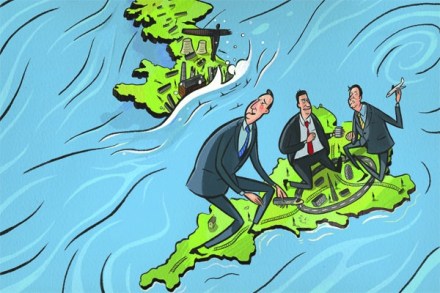
One of the problems with localism is that it sounds very grand and clever in opposition, and then turns out to be a nightmare to implement in reality. A minister recently remarked to me rather grumpily recently that 'all the good people left local government because Labour starved them of responsibility', and a lack of skills at the top does make it a little more risky to hand powers from Westminster to councils. But there are local authorities who are savvy and brimming with ideas who do want - and deserve - more control over policymaking, such as Manchester. Manchester has caught the eye of Chancellor George Osborne for being an experimental authority, and I look at its worker bee ethic in my Telegraph column today.

Conservative conference: Tuesday fringe guide

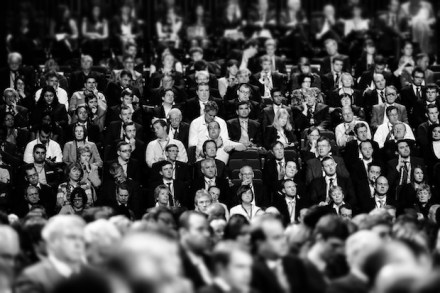
Every morning throughout party conference season, we’ll be providing our pick of the fringe events on Coffee House. It's the third day of the annual Tory conference in Manchester and like yesterday, today is jam packed with tens of  fringes with interesting party members, MPs and the like.

A warm welcome to Manchester from the TUC

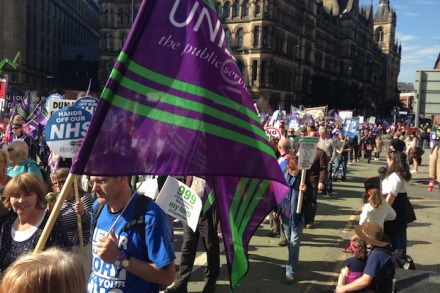
As it boomed, whistled and shouted its way past Manchester Central this afternoon, the TUC's Save Our NHS march seemed reasonable enough. If they want to disagree with the Conservatives on key policy issues, then so be it, that's government for you. But when I decided to watch and photograph what I thought was a peaceful protest, I found that some of the comrades joining in weren't so keen. A middle-aged man clutching a Socialist Worker grabbed me, demanding to know 'who are you taking photos for?'. I told him I was taking them for me, and tried to walk away. But then two of his companions joined us. The gang surrounded me beside a Costa coffee shop and demanded to know, again, who I was with. 'If you don't put you f**king camera way, we'll smash it off your face'.

Nobody takes a flight from London to Manchester. So why would we take HS2?

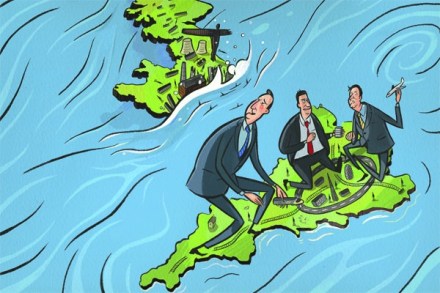
From Edinburgh airport there are more than 45 flights a day to London. And, I imagine, the same number back. You can fly from Edinburgh to London Heathrow, -London Gatwick, London Luton, -London Stansted and London City — even to the optimistically named -London Southend. Glasgow offers a similar choice. I have often used these flights. I live about 25 minutes’ drive from Gatwick, so when I go to Edinburgh my -favourite plan is to take a morning train up and then fly or take the sleeper back. Since Manchester is bigger than Edinburgh, I had naively assumed that I would be able to do something similar for an upcoming trip there. I decided to fly from Gatwick and take the train back. ‘You can’t. There aren’t any flights from Gatwick to Manchester any more.

At last! The snobbish Tate has finally overcome its distaste for L.S. Lowry

One day in Berlin, I saw the rerun of the RA’s Young British Artists exhibition at the Hamburger Bahnhof, Berlin’s equivalent of Tate Modern. After that, I saw a superb retrospective of Lyonel Feininger at the Neue Deutsche Galerie. In the evening, I ran into the onlie begetter of the YBA show (which, with the exception of Ron Mueck’s amazing sculptures, had not given me much pleasure), my (unrelated) namesake Norman. I had no wish to discuss Norman’s pride and joy, the YBA, so turned the conversation to Feininger and asked whether Norman had seen it. ‘Ah,’ said Norman, ‘what a bore; I won’t waste my time on him.

How do you define a ‘northerner’?

Obviously, now that every high street in England looks identical, and everyone under 30 uses exactly the same Australian rising inflection in speech, books of this sort are based on a false and wishful premise. But let us enter into Paul Morley’s game and ask the question he has asked again. What is ‘the north’ — or ‘the North’ — anyway? Obviously, as a geographical entity, we know (roughly) what we are talking about; we can argue about Derbyshire, but between Yorkshire and Scotland no one is going to dispute what the north is. Culturally, we may think we know what we are talking about, but all attempts to pin this down founder on the rocks of narrowness and outdated stereotype.

Taking Olympic history to Manchester

To Manchester for an address to the Manchester Literary and Philosophical Society for the Kilburn Lecture on ‘The Future of the Olympic Games’. The learned society is Britain’s second oldest, after the Royal Society, having been instituted in 1781. John Dalton, the father of modern chemistry, was one of its important past members. My NBF Peter Barnes (I had to explain to him that the acronym meant new best friend) picked me up at the airport and whisked me to Manchester Metropolitan University, and within 45 minutes I had changed into evening clothes and was facing a jolly gathering of bearded professors, smiling ladies and an all-round appreciative audience who laughed at my jokes and were extremely generous with their applause.

Are High Speed Railways for the North or for London?

I used to think High Speed Rail was an excellent idea. Now I'm not so sure. I suspect the economic case for the proposals is weaker than its proponents allow. More importantly, I'm not at all sure the government's plans for fast trains linking London and Birmingham are the right or most useful possible idea for high-speed rail. Knocking ten minutes off the London to Birmingham route seems like relatively little gain that comes at quite a price. Eventually, of course, the plan is to extend high-speed rail to Lancashire and, perhaps, Yorkshire too. Sometime, one would guess, towards the middle of this century. You can't accuse modern Britain of rushing large-scale infrastructure projects. It is good that the government is paying some attention to northern England. About time too.

Cameron’s Municipal Failure: All Hat and No Cattle

The first-time visitor to Manchester cannot fail to be struck by the grandeur of its Victorian civic buildings. The Town Hall, pictured above, is a mighty declaration of municipal pride and confidence. It is proudly provincial but there is nothing pejoratively provincial about it. Nor is Manchester alone: Newcastle and Leeds and the other great English cities built their own sandstone monuments to themselves. Hold up your heads, citizens, you come from nothing small. Never mind the wins and losses in yesterday's council elections. These are no more than the usual spins on the political merrygoround. Much more significant and much more depressing is the apparent rejection of locally-elected mayors in cities such as Manchester, Nottingham, Birmingham, Coventry and Bradford.

Let’s move the Lords to Manchester

Andrew Adonis, one of the policy brains of the Blair government and now seated in the House of Lords, has a letter in tomorrow's edition of the Spectator responding to Neil O'Brien's cover article of last week. In it, Adonis suggests one way that the political class could help purge the Londonitis from its collective system: move the House of Lords to Greater Manchester. Here's the full text of the letter, for CoffeeHousers: Sir, As Neil O’Brien rightly says, London is New York, Washington and LA rolled into one, which is unhealthy for our national politics. So I have a serious suggestion.

Cameron devolves the tricky issue of alcohol pricing

Politicians often get nervous around alcohol – and not just because, in these straitened times, a glass of champagne can broadcast the wrong image. No, the real concern is the more basic, fiscal one: how should it be taxed and priced? There's a difficult trade-off involved. Pushing up the cost of alcohol could halt the staggering advance of binge drinking and all its associated social and medical ills. But, depending on what booze is targeted, it could also hit the least well-off harder than anyone else. And who's to say whether the effect on drinking habits would be that substantial anyway? The trickiness of the situation was clearly demonstrated by Labour's internal ding-dong over minimum pricing back in January.