London

Three great myths of the sulking Remainers

From our UK edition

I think my favourite moment of the referendum campaign was John Major’s intervention, a couple of weeks before polling day. In that immediately recognisable tone of condescension tinged with snippy petulance, which we all remember and love so well from the time of his magnificent stewardship of this country, he said that people who didn’t want some degree of pooled sovereignty should go and live in North Korea, oh yes. No, John, that’s where you should go. I’m sure you can persuade the fat idiot who runs the place that his people need and deserve a motorway cones hotline, even if there are no cars on the roads. It’s time for a duck shoot.

Money for nothing | 30 June 2016

From our UK edition

Tate Modern’s new Switch House extension in London has been greeted with acclaim. It is a building designed in the distorted geometry of neo-modernist cliché, and offers a breathtaking array of piazzas, shops and cafeteria, with the added attraction of a free panorama of London that is much better than the adjacent Shard’s. There has been criticism of the contents, which are more appropriate to an experimental Shoreditch warehouse than a national gallery of 20th-century art. But who cares? The Tate attracts almost five million visitors a year. League tables now dictate how we judge London visitor attractions, just as exam results are used to evaluate schools and waiting times hospitals. Last year the British Museum drew 6.8 million visits, the National Gallery 5.

Britain’s great divide

From our UK edition

In Notting Hill Gate, in west London, the division was obvious. On the east side of the street was a row of privately owned Victorian terraced houses painted in pastel colours like different flavoured ice creams. These houses, worth £4 million to £6 million each, were dotted with Remain posters. On the west side was a sad-looking inter-war council block, Nottingwood House, which had dirty bricks and outside staircases and corridors. No posters there. But that is where my fellow campaigners and I headed — down to the basement entrances with their heavy steel gates. We looked up the names on the canvassing sheets and rang the bell of one flat after another until we found someone who would buzz us in. This was the hunting ground for the Leave campaign.

West End churls

From our UK edition

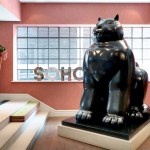
Cafe Monico, as if named by an illiterate playboy, is on Shaftesbury Avenue between The Curious Incident of the Dog in the Night-time and Les Mis, so if you want to be in an Asperger’s syndrome/-singing French revolutionary restaurant sandwich it is the café for you, and only for you. It is from Soho House, whose quest to make the whole of Britain a crèche-restaurant with table-tennis tables and photo booths for moronic remembrance goes on. There are more Soho House franchises now than Ivy franchises; even Chiswick has one. It is confusing, but if it upsets the media executive class, who must find new ponds to preen and fight in, I do not mind. Except that Cafe Monico does not work.

High life | 16 June 2016

From our UK edition

Marion, Baroness Lambert, was hit and killed by a London bus last month while shopping in Oxford Street, a cruel irony if ever there was one. ‘At least it was Bentley,’ was how Steven Aronson, the writer, put it. Marion was a very old friend of mine. She had endured the worst tragedy that can befall a mother, having lost a beautiful young daughter to suicide. Philippine Lambert had been sexually abused by a family friend, a sordid story that I first broke in these here pages and later in the Sunday Times. It was a vile affair and I won’t dwell on it, but it cemented a very strong friendship between us because the alleged abuser was a very rich man with powerful connections who actually warned me to desist. I did nothing of the kind, and wrote the story three times.

Gatton Park

From our UK edition

Gatton Park is probably Lancelot ‘Capability’ Brown’s least famous landscape. It is tucked away near Reigate Hill, just beyond the M25, and even in the 300th anniversary year of Brown’s birth it is an unlikely place to visit. Because it shares its plot with a school and stables, you can only go on the first Sunday of the month or if you arrange a tour in advance. A bother, I grant you, when there are so many glorious landscapes to explore elsewhere. But Gatton Park has other attractions, too. For more than 50 years, from 1888, this was the estate of the ‘Mustard King’, Sir Jeremiah Colman.

The pursuit of happiness | 16 June 2016

From our UK edition

There is a wonderful portrait of Kenelm Digby by Van Dyke. He is dressed in black. His hand is on his heart. Behind him is a vast, wilting sunflower. The sunflower is a symbol of constancy — it follows the sun. When his wife Venetia died in 1633, when Kenelm was 29, he went into a profound mourning that lasted for the rest of his life — another 30 years. The sun had gone out of his life. From the moment he discovered her dead body, seemingly asleep in her bed, his behaviour was, to say the least, a little odd. He took plaster casts of her hands, feet and face. He had Van Dyke paint a portrait of her in death. He commissioned a phalanx of poets, led by Ben Jonson (who was summoned to the deathbed so that he would be inspired by the sight), to write poems in her praise.

Sadiq Khan’s advert ban shows he is an illiberal censor at heart

From our UK edition

Six weeks ago I was one of the 1.3 million Londoners who voted for Sadiq Khan as mayor. Boy do I regret it now. Because he’s just shown what he really thinks of us inhabitants of the capital: that we’re so mentally fragile, so pathetic, so vulnerable to the wicked charms of advertisers, that he must censor allegedly sexist ads on our behalf and protect us from offence. In proposing a blanket ban on bus and Tube ads that make people feel bad about their bodies, Sadiq has revealed his authoritarian, paternalistic contempt for the people who swept him to power. I’m amazed there isn’t more fury about his extraordinary proposal. He has instructed Transport for London to stop running ads that indulge in body-shaming.

Un-Italian job

From our UK edition

I have been waiting, like a heroine in fiction, for the specialist lasagne restaurant. London has long been heading this way for the benefit of the consumer-simpleton who can only process one piece of information at a time. It is clearly a response to the glut of choice in late capitalism, and so close to Karl Marx’s home in Dean Street that I can almost feel his cackling shadow. Less choice for your aching head, child, but isn’t it really more choice? The choice not to choose? That phenomenon brought us the pop-up Cadbury’s Creme Egg restaurant, which only served food made with Cadbury’s Creme Eggs. Because people are mad, and getting madder, it had queues around the block.

No laughing matter | 9 June 2016

From our UK edition

Rossini is the meat-and-two-inappropriately-shaped-veg of summer opera; he’s the wag in the novelty bow tie, the two satyrs shagging enthusiastically among the lupins and lobster on the cover of this year’s Glyndebourne programme. His comic bel canto frolics are the natural soundtrack to this off-duty opera-going, a champagne-perfect combination of frothy plots and fizzing coloratura. So why are they so hard to pull off? Perhaps it’s the pressure of expectation. It has been more than 30 years since Glyndebourne last staged Il barbiere di Siviglia, and hopes were high for Annabel Arden’s new production. For the first half-hour it looks as though they’re going to be met.

Blue plaque blues

From our UK edition

Blue plaque spotting is one of the mind-broadening pleasures of British life. A walk to the dentist can be transformed into a serendipitous encounter with a forgotten genius from the past. ‘Luke Howard, 1772–1864, Namer of Clouds, lived and died here,’ says the blue plaque on 7 Bruce Grove, Tottenham. Even if you’ve never heard of Luke Howard, you instantly take a liking to him — and never again will you hear the word ‘cumulonimbus’ without thinking of him. ‘Lived here’ is the key: you’re passing the very house where the person woke up for breakfast each day, and the intimacy of that is what makes the encounter so much more affecting than merely reading about him or passing a statue of him.

Northern lights | 2 June 2016

From our UK edition

‘The only use of a gentleman in travelling,’ Emmeline Lowe wrote in 1857, ‘is to take care of the luggage.’ My sentiments entirely. The extract from Unprotected Females in Norway reprinted in this book recounts Lowe’s travels with her mother round the Dovrefjeld in the centre of the long country. Tramping through the valleys wearing mosquito veils, ‘solid plaid skirts’ and hobnail shoes, the pair reckoned that the only essentials were a driving whip and a fishing rod. Lowe (who published anonymously) is a spirited companion on the verdant plains and the snowy peaks, and her pleasure in the long boreal gloaming leaps infectiously from the page.

Cool and underground

From our UK edition

The Keeper’s House sits in the basement of Burlington House, a restaurant in disguise. It is quite different from the grand cafés of St James’s and Mayfair, which are raging exhibitionists with banquettes splayed like limbs. It is secretive and it knows, consciously or not, the tricks of children’s literature: the looking-glass, the wardrobe and the door. It is an 18th-century basement transformed, by magical whimsy, into a restaurant. To visit the loo is a quest for which you need a Gandalf, a hobbit and a lamp. Burlington House looks like an English mansion that stared at Palladio, had a panic attack and exploded.

Northern overexposure

From our UK edition

‘The shortest way out of Manchester,’ it used to be said, ‘is notoriously a bottle of Gordon’s gin.’ But that was a long time ago, when ‘Cottonopolis’ was the pivot of the Industrial Revolution, the British empire was expanding and life was cheaper. They tend not to drink gin any more in the bars on Deansgate. It’s cocktails, a tenner a pop. The hub of George Osborne’s ‘Northern Powerhouse’ is a much-changed city. Now they’re queuing to get in, even though the super-duper HS2 rail link may go no further than Crewe, which is in Cheshire, and only southerners think Cheshire is in the north. Andy Burnham is the latest chap to set his cloth cap at the rainy city.

Giving Tate Modern a lift

From our UK edition

Tate Modern, badly overcrowded, has built itself a £260 million extension to spread everyone about the place more. This means that there are more galleries and other big rooms for various modish activities — 60 per cent more space, they say. It opens on 17 June with a total rehang throughout. But having been shown round the place, I’ve become transfixed by the lifts. When it opened in 2000 they never expected nearly five million visitors a year — which is well down on its 2014 Matisse-driven peak of nearly six million, but still twice as many as it was designed for. So when they called back Swiss architects Herzog and de Meuron to extend the gallery that brought them fame, moving people around better was high on their to-do list.

Gaudy! Bright! Loud! Fun!

From our UK edition

In any epoch most of what is built is mediocre, though we may not realise it at the time because our neophilia persuades us of merit where there is none. Equally, we may fail to distinguish the few exceptions — those instances where architects and builders have ascended to a higher standard of mediocrity or have even escaped its dulling clasp. It takes time for public taste to catch up with architects’ taste. Today, 40 years after brutalism dissipated in an assault of bien-pensant hostility and oil crises, few weeks pass without a new book or blog hymning its sublimity, energy and gravity. It is, of course, all a bit late. Much of the finest work has already been destroyed.

How Rome did immigration

From our UK edition

Last week it was suggested that the questions asked of London mayor Sadiq Khan had nothing to do with racism, but more with multiculturalism. As St Ambrose could have said, ‘If you live in Rome, live in the Roman way; if elsewhere, as they do there.’ Until the large-scale irruption of Germanic tribes fleeing the Huns in the 4th century AD, eventually ending the Roman empire in the West, Romans had been fairly relaxed about immigrants, temporary or permanent. Many came under compulsion: hostages, prisoners of war and slaves, this last group keeping wages low across a range of service industries. Rome itself actively welcomed foreign doctors and teachers, while lawyers, diplomats, the power-hungry and soldiers smelled advantage there.

Bus battles

From our UK edition

From ‘The softening of street manners’, The Spectator, 20 May 1916: Generally the public opinion of the ’bus entirely upholds the conductor. The influence of the tyrant is too strong to allow of protest, but now and then cases of rebellion occur, and bold females who consider themselves slighted vow that they will write to the company. But an ordinary ’bus-load contains no such heroines…. Sometimes, however, the will of the passengers prevails by reason of unanimity. A few nights ago a drunken soldier got, late at night, into a West End ’bus. The conductor civilly asked him to get out. The man began to argue, and a number of elderly women took his part. ‘Let him stop,’ they begged, one after another.

Despite rumours to the contrary, the high-speed loco has left the drawing board

From our UK edition

There’s a lot of negativity around HS2, and I sniff a Brexit connection. You might think Leave campaigners whose aim is to boost British self-belief would promote the idea that we have a talent for grands projets such as the Olympic Park and Crossrail, rather than a propensity to deliver half what’s promised at double the cost. But there’s also an overlap between Tory MPs opposed to the northbound high-speed rail link, usually because it bisects their constituencies, and Tory MPs opposed to the government on the EU referendum. So I suspect that’s where the trouble lies. The spin is that cabinet secretary Sir Jeremy Heywood is reviewing the project ‘as fears grow’ that it will bust its already inflated £55 billion budget.

Soho in Somerset

From our UK edition

It is summer and the listless metropolitan thinks of grass. It cannot afford to stay at Durslade Farmhouse, Somerset, a branch of the Hauser & Wirth art gallery that serves food and plays cow noises in a former barn as authentic country folk rip their eyeballs out. Locals talk about Durslade Farm as a child that died. I think it is a Holocaust memorial for cows, but oblivious. Babington House is the country branch, and it is open to members, their friends, and hotel guests. There is a a spa called the Cowshed that sells ‘Lazy Cow’ and ‘Moody Cow’ beauty products (misogyny masquerading as irony), a restaurant and a church, which looks uneasy in the grounds, probably because it has to tolerate celebrity weddings.