Labour party

Bad news for the Tories: Corbyn has learned to love the centre

When Tony Blair was selling out the Labour Party by introducing a minimum wage, paid holiday leave and free nursery education, the hard left reckoned it had his measure. Semi-Trots and leftover Bennites, since decamped to one of the many exciting acronyms British Leninism has to offer, filled monochrome magazines and academish journals with tracts denouncing Blair as a Tory, a Thatcherite and both a neoliberal and a neocon. The charge sheet was echoed with righteous indignation by proud purists on the backbenches and in the columns of the Guardian and the Independent. New Labour was so far to the right it was indistinguishable from the Conservatives. What was the point, they asked, of a Labour Party that simply aped the policies of its opponents?

Will Labour split?

With parliament in recess and the Prime Minister on holiday, politics is calmer than it has been in some time. But Jeremy Corbyn’s comments on Marr yesterday about the EU and the single market are a reminder of Labour’s divisions over Brexit. At some point, this tension will have to be resolved. The 49 Labour MPs who voted for Chuka Umunna’s single market amendment to the Queen’s Speech will have to either back down or repeatedly defy the whip. The question is how does this division fit with the broader struggle for control of the party machinery between the Corbynites and the rest. Will those Corbynites who want mandatory re-selection regard defying Corbyn on the single market as grounds for challenging a sitting MP?

What will Jeremy Corbyn do next?

The Labour party has a troubling recess ahead of it. Many of its members just won’t know what to do with themselves. This is because for the first time in two years, there is no leadership contest. Those who had eschewed beach holidays in favour of spending their summer recess in windowless rooms listening to contenders for the top job fight over who would really, really nationalise the railways now have nothing to do. Even before Labour lost the election unexpectedly well, few anticipated an immediate challenge to Jeremy Corbyn.

Let’s keep up the Moggmentum | 16 July 2017

‘We need to talk about why the internet is falling in love with Jacob Rees-Mogg, because it’s not OK,’ warns a recent post on the Corbynista website The Canary. Its anxiety is not misplaced. Polite, eloquent, witty, well-informed, coherent, principled — Jacob Rees-Mogg is the antithesis of almost every-thing the Labour party stands for under its current populist leadership. And far from putting off voters, it seems to be a winning formula. Even sections of the elusive and generally very left-wing youth vote appear to be warming to the idea that our next prime minister shouldn’t be (alleged) man-of-the-people Corbyn but yet another plummy, Old Etonian millionaire… This ought to make no sense at all.

What’s Labour going to do with the middle classes?

Be fair. Theresa May’s plan actually half-worked. No, there was a plan. I know the consensus now seems to be that the entire election was motivated by little more a succession of senior Tories saying ‘Gosh yes, everybody loves you!’ to the Prime Minister while Fiona Hill and Nick Timothy stood behind her chair, slapping truncheons into their palms. Only that’s not how it was. Once, there was philosophy here. There was a plan to cut loose the liberal, urban, Remainiac middle classes, and draw in a new working-class Tory vote instead. And, like I said, it half-worked. As in, the working classes might not have got the message that the Tories were now a party for them, but the urban middle classes surely got the glaring hint that it now was not for them.

Jeremy Corbyn is Britain’s first truly post-modern politician

Does Labour want to leave the Single Market? Maybes aye, maybes naw, as we used to say in North Britain. Corbyn isn't saying. It might be one of the biggest questions of public policy of this decade, but the man who now has at least a non-trivial chance of being PM one day isn't saying where he stands on it. This matters. Of course, we think we know what he intends on the single market. We think he is hostile to it and regards it as a wicked capitalist plot. We think he also inclines towards leaving because he wants to keep inside the remaining chunk of the old Labour working-class vote that is persuaded by the Ukip argument that the single market means free movement which means immigrants.   But we don't know because Corbyn isn't saying.

Labour moderates should learn from the mistakes of Trump’s reluctant cheerleaders

Demagogues have had a good run of late but the tide may be turning. Geert Wilders and Marine Le Pen failed to pull off widely predicted electoral coups, while the Austrian far-right fell short in presidential elections. The SNP can no longer rouse a rabble like it once did and Ukip, out-Kipped by Labour and the Tories, is now an irrelevance. But none is as dramatic as the stalling of the Donald Trump bandwagon, which could yet come off its wheels. The President faces allegations of colluding with the Russians during the 2016 election. Springing into action, his son Donald Trump Jr. tweeted out campaign emails in an effort to refute the charges. In fact, the correspondence confirmed that Trump Jr. had met with a Russian lawyer offering dirt on Hillary Clinton.

Real life | 13 July 2017

‘What do you think it means?’ I asked the builder boyfriend as we stood in front of the sign. A huge placard, it had been hammered into the ground by the village action group. ‘Keep Our Village in the Green Belt’ is the gist of what it says. But behind it is another sign, which has been there since we arrived, and, we assume, long before that. This one says ‘No Horse-Riding’. The new sign has been put just in front of the first, slightly to the right, so that the two are unavoidably read together as you enter the village, and form a sort of double message, as impenetrably contradictory as any I have ever seen. We want to be in the green belt, says one sign, while the other announces an ambition to eradicate the sight of people on horseback.

Labour’s middle-class problem

Be fair. Theresa May’s plan actually half-worked. No, there was a plan. I know the consensus now seems to be that the entire election was motivated by little more a succession of senior Tories saying ‘Gosh yes, everybody loves you!’ to the Prime Minister while Fiona Hill and Nick Timothy stood behind her chair, slapping truncheons into their palms. Only that’s not how it was. Once, there was philosophy here. There was a plan to cut loose the liberal, urban, Remainiac middle classes, and draw in a new working-class Tory vote instead. And, like I said, it half-worked. As in, the working classes might not have got the message that the Tories were now a party for them, but the urban middle classes surely got the glaring hint that it now was not for them.

Watch: Jack Dromey turns the air blue on Daily Politics

Politicians have been busy swapping horror stories of the unacceptable abuse dished out to MPs and candidates running for Parliament. Fortunately for Labour frontbencher Jack Dromey, he appears to have escaped the worst of the vitriol. But when talking on the Daily Politics about his own experiences, Dromey resorted to some very unparliamentary language. Here's what he said: 'I personally don't get, if you excuse the language, that much shit. But the shit I get comes overwhelmingly from the right' Dromey's language has not gone down well on Twitter, where at least one parent complained that her child heard him swear. Mr S thinks Dromey doesn't really have a leg to stand on: after all, his swearing came at least eight hours before the watershed...

Did Jeremy Corbyn really save the Labour party in Scotland?

If a line is repeated often enough it becomes true. Or true enough, anyway. This, at any rate, is one of the axiomatic rules of modern politics. He who controls the ballyhooed “narrative” owns the truth. Which is why the interpretation of any given event swiftly becomes almost as important as the actual event itself. So up-pops Matt Zarb-Cousin, formerly Jeremy Corbyn’s spokesman and now one of his more charming outriders on social media, to claim that it was Jezzah what has saved the Labour party in Scotland. As he puts it, “Corbyn’s supporters have long argued that returning Labour to its socialist roots would be necessary if the party was to ever regain support in Scotland.” Well, up to a point Lord Spart.

Why do gay lefties hate Tories but ignore Corbyn’s ugly record?

Gay lefties have hated gay Tories ever since learning of their existence. The concept baffles them, like pro-life women or alcohol-free wine. Those with long memories are aware of the Conservative Party's ugly record on gay equality. This is the party of Section 28, of differential consent laws, of fretting about children 'being taught that they have an inalienable right to be gay'. But gay Tories, having largely rehabilitated their party and with many of the major gay rights battles settled favourably, hoped the rainbow flag might finally have space for a stripe of blue.

Damian Green calls for a new ‘grown-up way of doing politics’. Will it work?

Even before the election delivered a hammer blow to the Tories, their ‘strong and stable’ mantra was coming back to bite. Now, their warning of a Labour-led ‘coalition of chaos’ is also rearing its head once again. Fresh from wrapping up their deal with the DUP, the Government is calling on the opposition to come together on Brexit and lend a helping hand. Theresa May will say the other parties should offer up their ideas and be prepared to ‘debate and discuss’ with the Government - not only on leaving the EU but on a host of other areas of policy as well. Damian Green used his Today interview this morning to make it clear that this offer isn’t just reserved for those on the Labour benches.

Everyone in Labour is pretending to get along. It won’t last

Since Jeremy Corbyn’s surprisingly good election defeat, his MPs who previously plotted to get rid of him have been queuing up to pledge their allegiance to the Labour leader. They have been doing this partly because they did make some rather dire predictions about the impossibility of holding their own seats, or indeed of Labour surviving at all with Corbyn at the helm, and partly because most of them are under pressure from the Corbynites in their local party to apologise and show loyalty from now on. Luciana Berger’s local party is demanding an official apology from her to Corbyn for her previous criticisms of his leadership – something she has thus far steered away from offering.

Theresa May is slowly steadying the Tory ship

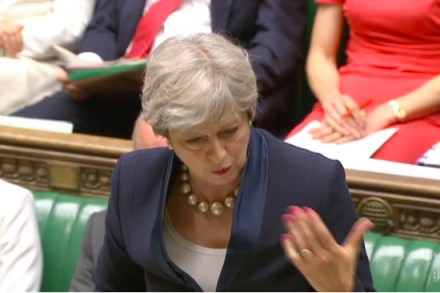
It was better from Theresa May today. She was combative, prickly and forceful at PMQs. The ship is moving on a steadier course. And two toxic enemies have returned to the fold. In the days following the election, both Anna Soubry and Nicky Morgan were ‘helpfully’ suggesting a possible timetable for Mrs May’s departure. Today they both asked supportive questions. And Mrs May read out the answers, tight-lipped. Only those within a yard of her could hear her molars grinding. The Labour leader got a rather glum cheer from his party. He suggested that the PM should fund a pay-rise for nurses because ‘she seems to have found a billion pounds to save her own job.’ As usual, he had a missive of woe to delight us with.

Why are some on the Left claiming a ‘bonfire on red tape’ led to Grenfell Tower?

Now that Labour councils have been shown to be as much up to their eyeballs in the tower block cladding scandal as Conservatives ones the Left has subtly shifted onto a different target: the ‘neoliberalist’ war on red tape. Writing in the Guardian today, George Monbiot accuses the Government’s Red Tape Initiative - set up to consider which regulations might be reformed once Britain is freed from having to abide by EU directives - of plotting to downgrade building regulations, so as to put the poor at risk while big business increases profits. ‘Red tape,’ he asserts for good measure, is a ‘disparaging term for public protections’.

May turns back the clock to the Cameron and Osborne era at PMQs

During the general election campaign, Theresa May was strikingly reluctant to defend the Tories’ economic record. But today at PMQs, Theresa May sounded like the man she sacked as Chancellor as soon as she became PM. She defended the Tories economic record with vigour, pointing out how much progress the party had made in reducing the deficit it inherited from Labour and even chucking in a reference to Greece for good measure. It was like going back to 2014. The Tory benches lapped up this return to the old religion. May was also helped by the fact that Jeremy Corbyn didn’t make as much of the money that the Tories have found for the DUP deal as he should have done.

Students are right to vote Labour

Almost everything which is said officially about student finances is obfuscatory and contradictory, starting with Damian Green’s assertion at the weekend that we need 'a national debate' on tuition fees, only for former education secretary Michael Gove to say the opposite the following day. A week before the General Election was called, the Student Loan Company announced that it was increasing interest rates from 4.9 percent to 6.1 percent, according to its formula of inflation plus 3 percent. Due to the effects of compound interest, that potentially takes the lifetime cost of a typical student’s debts from around £51,000 to £70,000, according to the calculator on the Money Saving Expert website.

What the papers say: It’s time for the Tories to stop panicking

‘The unexpected appeal of Jeremy Corbyn’s manifesto has thrown the Tories into panic’, says the Sun. With Damian Green suggesting a ‘debate’ may be needed over tuition fees and other ministers ‘piling in every day with demands for more spending’, the Conservative party seems to be making the assumption that the best way to tackle the threat of Corbyn is to copy him. This is ‘suicidal’, says the Sun, which argues that not only would it be wrong to try and take on the ‘hard left’ on their own terms, it would also be dangerous for the economy.

J.K. Rowling’s schizophrenic politics | 1 July 2017

On the face of it, there is nothing complicated about the politics of Harry Potter, who made his first appearance in The Philosopher’s Stone 20 years ago. Like his creator J.K. Rowling, who once gave £1 million to the Labour party, he is a left-wing paternalist in the Bloomsbury tradition — the love child of John Maynard Keynes and Virginia Woolf. He feels a protective duty towards the common man (‘muggles’ in the lexicon of the novels) and a loathing for suburban, lower-middle-class Tories like the Dursleys, his Daily Mail-reading foster parents. The arch-villain of the saga is Voldemort, a charismatic Übermensch who believes in purity and strength and in the final novel promotes his own version of the Nuremberg Laws through the Ministry of Magic.