King charles

Queen Camilla’s unusual phone app 

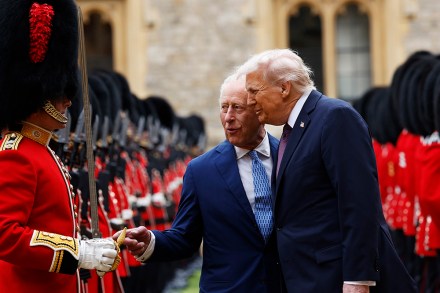
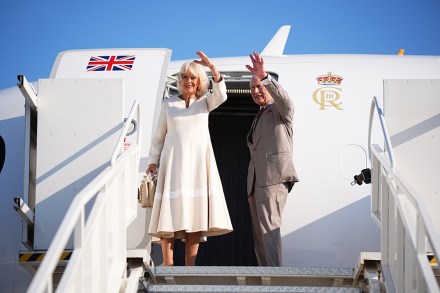
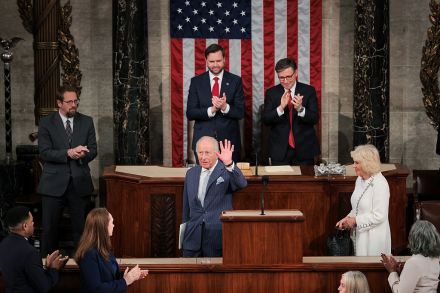
And so to the White House for a ringside seat at the Trump circus. Another assassination attempt on the President wasn’t going to stop the royal machine. After calls between Buckingham Palace, the West Wing and the secret service while the UK press pack nervously checked their phones mid-flight to Washington, praying for the British Airways wifi to hold, the King and Queen kept calm and carried on with their state visit. It was never in doubt. Despite the White House correspondents’ dinner shooting, there was too much fear behind Whitehall and Palace walls of disappointing the Donald to pull the plug. May I commend BA for its wifi and in-flight entertainment, which features The Royals, a lively podcast on the House of Windsor.
The shame of the coronation arrests

What century is this? I ask because today, in London, peaceful protesters have been handcuffed and arrested for daring to express disapproval of King Charles. For daring to believe Britain should be a republic, not a constitutional monarchy. This is a grotesque assault on freedom. It is borderline medieval. No one’s feelings, not even the King’s, should ever trump the people’s right to freely express their beliefs in public. ‘Give me the liberty to know, to utter, and to argue freely according to conscience, above all liberties’ The footage coming out of Trafalgar Square shames Britain. We’ve seen protesters in ‘Not My King’ t-shirts being arrested. Cops apparently seized hundreds of placards.

God save our Islamophilic King

Britain today celebrates the crowning of a new king, but the coronation will be watched and celebrated by millions across the Commonwealth. To an extent that is often not appreciated abroad, the Queen – who was Defender of the Faith – was revered by her subjects of all faiths. In our often sectarian world, she exerted a unifying force: one that her son recognised and exemplifies. King Charles is deeply informed of Muslim beliefs, culture and mores Muslims in Britain and the world over will recognise, in King Charles, a monarch who is deeply Islamophilic. He has spoken about his attempts to learn Arabic in order to understand the Quran in its original script.

Can the King handle Trump?

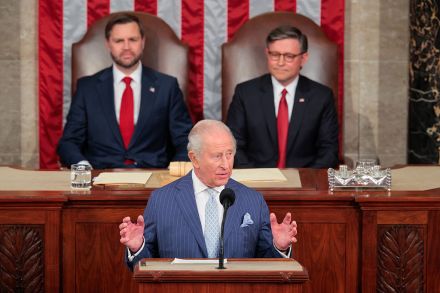
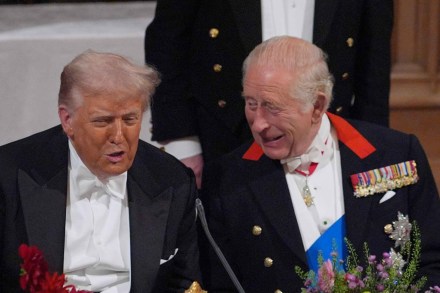
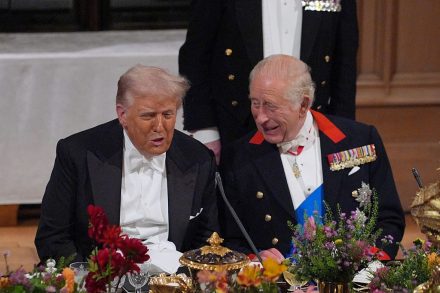
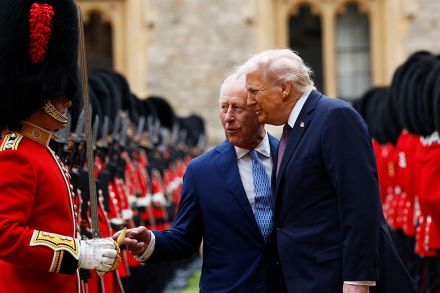
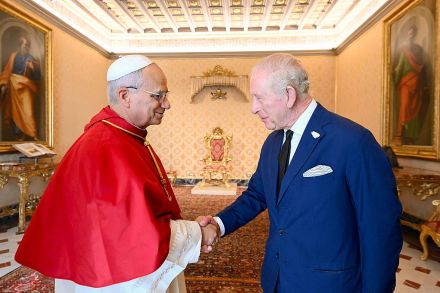
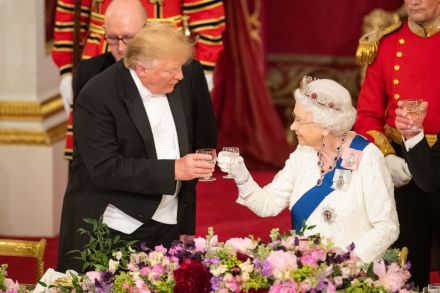
King Charles is about to travel to Washington to visit President Trump. The brief? Fix the strained relationship. No pressure! Can royal diplomacy steady relations? Will the trip be awkward given Trump's recent words on Starmer, Chagos, The Falklands, and Canada? Does the King have what it takes to navigate such a diplomatic minefield? Elsewhere, Morgan McSweeney will appear before MPs tomorrow to explain his actions relating to the appointment of Lord Mandelson as ambassador to the United States. Given he's already said he doesn't recognise portrayals of himself in the media, is he going to come out swinging? Tim Shipman and James Heale discuss.

Can the King handle Trump?

Let teenage boys discover the English countryside

When I was four, the progressive teachers at my primary school thought it would be wise to teach us how to type on a keyboard. When it was my turn to key out the phrase ‘Biff and Chip’ on the computer, they discovered, to their horror, that I was already capable of effortless touch typing. I have been using computers, and by extension the internet, since before my earliest memories were formed. Not only did I grow up online, I did so during the early 2000s when there were virtually no safeguards or restrictions on what children could access. I pirated my first film, Star Wars: Episode III – Revenge of the Sith, at the age of seven and bought my first (sadly wasted) bitcoin at 13.

The King is still our Trump card

George III has not been well remembered on either side of the Atlantic. Despite reigning for almost 60 years, in Britain he is known, if at all, for losing the Thirteen Colonies and his madness in his later life. But in America, he is the villain of the national story; in Thomas Jefferson’s phrasing, the ‘Prince, whose character is thus marked by every act which may define a Tyrant’. The Declaration of Independence is a lurid list of his alleged crimes against his American subjects. But 250 years after that document was signed by the Founding Fathers, George III has been going through a renaissance. In recent biographies, Andrew Roberts and Jeremy Black have argued that he was a much-misunderstood monarch.

Why British diplomacy needs the royals

Watching David Dimbleby watching the royal family, I am instantly reminded of the BBC’s other royal David. It is pure Attenborough as he examines the exotic plumage and rituals of rex Windsorianus in its natural habitat. In this week’s first episode of What’s the Monarchy For?, a three-part study of the sovereign for BBC1, Dimbleby examines royal power, engagingly prodding and poking fun at both sides. However, it ends as it starts, with our host still scratching his head. The monarchy is the first thing much of the world thinks about when it thinks about Britain Perhaps we will have an answer by the end of the final episode.

The comeback of George III

We no longer correct ourselves as we sing the first line of the national anthem. ‘Prince of Wales’ no longer means ‘Charles’. As we mark the third anniversary of his accession this week, it is possible to attempt useful comparisons between the reigns of Charles III and Elizabeth II. Set aside age and medical matters and the principal differences are pace and expectation. It was nearly a year before the UK heard a speech from the new monarch in 1952; in 2022, it took a day. Court mourning went from 16 weeks to one. Three years in, the late Queen was still on her first prime minister. The King is on his third. Family-wise, her main distraction was Princess Margaret’s passing passion for her late father’s equerry.

How Princess Anne is celebrating her 75th birthday

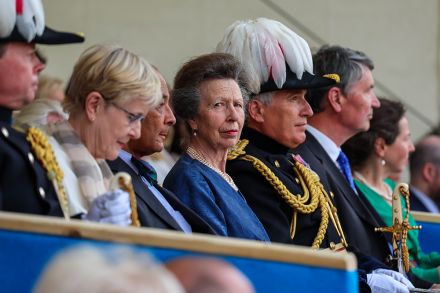
When a previous milestone was looming in the life of Princess Anne, her 21st birthday, the late Queen asked her where she would like to have her party. There was Buckingham Palace or Windsor Castle, of course, although, with a mid-August birthday, might she prefer Balmoral? ‘None of the above,’ came the reply. The Princess wanted to hold a ‘discotheque party’ in Portsmouth on board the royal yacht Britannia. And so it is this Friday, as the Princess marks her 75th, that the most nautical member of the family (patron of everything from the Royal Yachting Association to the Mission to Seafarers) will be at sea with a cake for two as she spends her birthday with her husband, Vice Admiral Sir Tim Laurence, sailing their Rustler 44, Ballochbuie, somewhere off the Outer Hebrides.

My memories of the royal train

It is the most civilised way to travel anywhere in the kingdom. Which is why I am so distraught that the King has cancelled it. This week His Majesty has agreed, reluctantly I can be sure, to decommission his royal train. The decision was announced by the Keeper of the Privy Purse, James Chalmers. Mr Chalmers brings to the Royal Household all the romance and lyricism you’d expect of a chartered accountant who spent 39 years at PwC, including time as something called a Global Assurance Leader. He justified the decision on the basis of the need for ‘modernisation’ and ‘fiscal discipline’. This is not so much letting daylight in upon magic as strangling it with a spreadsheet. It is a tragedy.

The mystifying process – and problems – behind choosing the next Archbishop of Canterbury

39 min listen

After Pope Francis died, it took the Roman Catholic Church just 17 days to choose a successor in Pope Leo XIV. It has been well over 6 months since Archbishop of Canterbury Justin Welby resigned and we are only just making sense of those chosen to sit on the Crown Nominations Commission (CNC), that will recommend his successor. Even then, it’s unlikely we will know more until the autumn. Why has it taken so long? Journalist, commentator – and quite frankly expert – Andrew Graystone joins Damian Thompson and William Moore, the Spectator’s features editor, to take listeners through the process.

For better, for worse: confessions of a rural wedding venue owner

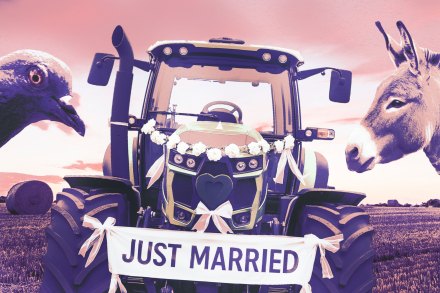
Employing a marksman to shoot pigeons inside our wedding barn on the morning of a ceremony was not something included in the venue-owner’s manual. For the animal-loving bride, blood-splattered dead birds were preferable to her guests being splattered later that day – an understandable moral sacrifice on her behalf. The birds had sneaked in via an open owl hole window in the roof, something we hadn’t spotted until the unwelcome visitors caused a flap. It was one of the many challenges we faced owning and running a rural wedding venue, a high-pressure business where expectations are enormous and responsibilities seemingly endless.

Defender of the Faith: how have the King’s religious beliefs changed?

31 min listen

As we approach the end of a uniquely painful year for the Royal Family, the King's trusted biographer, Robert Hardman, joins Damian Thompson to discuss the Monarch’s faith. As Robert recently revealed in his updated biography of Charles III, the cancer-stricken King has been drawing solace from a Christian faith that has become increasingly explicit over the years. He still thinks of himself as the ‘defender of faith’, but now also unapologetically uses his ancient title of ‘Defender of the Faith’, meaning Christianity. Specifically, he is more attracted than ever to the traditions of the Orthodox Church into which his father was baptised.

Why we need an Elizabeth and Philip museum

Driving up Royal Deeside last weekend, I spotted a harvest under way on that magical Hobbit-esque green/gold/purple hillscape. It all came flooding back. One year on from the death of Elizabeth II, it’s the sight of the tractors lined up next to the A93 which remains among the most enduring images. It wasn’t just that they all had their shovels dipped in tribute, like the dockers’ cranes saluting the Havengore as it carried Churchill down the Thames in 1965. It was the fact that they were all spotless. At the busiest time of the year in this lush agricultural belt of Aberdeenshire, farmers had paused their harvesting, taken their machines out of the fields and given them a very thorough hosing down before lining up for hours to salute the late Queen.

The art of the pocket square

When imagining a monarch’s wardrobe, what comes to mind? With the late Queen, it was bold-coloured dresses (as she famously said, ‘I have to be seen to be believed’), elaborate hats, silk headscarves and those black Launer handbags. Our new King is no less a style icon. For him it’s well-tailored double-breasted suits from Anderson & Sheppard (probably well-worn, for His Majesty is a great advocate of make do and mend – the suit he wore to Harry and Meghan’s wedding was 34 years old), Turnbull & Asser shirts, hats from Lock & Co. and probably the odd tartan kilt. But it is his collection of pocket squares that I would be most interested to see if ever allowed a peek into the King’s cupboard.

King Charles and the implications of oaths

After much debate it was decided that the people would not be ordered to reciprocate the King’s oath of allegiance. This was wise. As ancient Greeks knew, oaths have serious implications. For them, to take an oath was in effect ‘to invoke powers greater than oneself to uphold the truth of a declaration, by putting a curse upon oneself if it was false’. The Trojan war – the subject of the West’s first work of literature – happened only because Tyndareos, stepfather of Helen, compelled all her Greek suitors, on oath, to go to war on anyone who seduced her from her husband – which the Trojan Paris proceeded to do. Betraying that oath (Achilles was too young to swear it) would have meant divine punishment in the future. But the practice was open to abuse.

The battle to restore Britain’s hedgerows

‘I don’t know if hedgelaying is a dying art. But there’s a lot of old hedgelayers that are dying,’ says David Whitaker to chuckles from some of his fellow craftsmen. The occasion is the annual hedgelaying championship, organised by the National Hedgelaying Society, of which Whitaker is secretary. In a good year, the event draws around 100 competitors and a few curious spectators to a marquee in a muddy field in Hampshire. Britain’s oldest hedge dates back to the Bronze Age. Thousands of miles of hedgerow were laid in the late 1700s after the Enclosures Act carved up the countryside.

In praise of minor royals

On a scaffold hung with black cloth, on a freezing January day in 1649, the instinct for sumptuousness died in these islands. It was killed alongside Charles I, kingly excess and belief in divine right and, with intermittent exceptions, has never recovered. And so when, time and again since September, we’ve heard about our new King’s plans for downsizing the monarchy, the bulk of the population has calmly nodded its assent. Trim, slim, streamline, skimp. Time to dispense with peripheral royal family members! Farewell to the jostling chorus line of the Buckingham Palace balcony of yesteryear, all oversized hats, Ruritanian frippery and excitable small children! Away with the hangers-on!

How King Charles saved Cornwall

I’m a 30th generation Cornishman. I’m so Cornish my mum can make Cornish pasties blindfolded, my maternal grandmother was employed aged nine to break rocks in a Cornish tin mine (she was a ‘bal maiden’), and my second cousins founded Cornish Solidarity, which is the very-lightly-armed wing of Mebyon Kernow (the Cornish Plaid Cymru). Nonetheless my visits to the county are infrequent, probably because I am not overly fond of rain.  However, on my most recent visit I noticed that something in Cornwall has changed.

We don’t need a ‘diverse’ coronation

Refugees and the NHS, we are told, will be at the heart of King Charles’s ‘diverse’ coronation in May. You’d think that a thousand-year-old institution tasked with steering clear of controversy might seek to avoid such hot potatoes. But there is nothing unexpected about this royal foray into politics. LGBTQ+ groups will perform at ‘a star-studded concert at Windsor Castle’ as part of the celebrations marking His Majesty’s accession to the throne. A royal source told the Daily Telegraph the coronation ‘needed to be “majestic” but “inclusive” to reflect a diverse modern Britain’.  Unfortunately, this sounds like another example of the utterly banal EDI (equality, diversity, inclusion) events we’ve become used to in Britain.