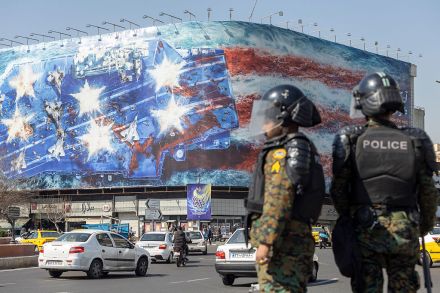
Iran

David Cameron has dropped his references to a 'reformed' EU. Will 'safer' be next?

Obviously the 198 business leaders who signed a letter to the Times yesterday explaining why Britain should remain in the EU are too busy and important to read what appears under their names, but surely someone in their enormous ‘comms’ teams should have pointed out to them that they were directly repeating David Cameron’s current slogan ‘Britain will be stronger, safer and better off remaining a member of the EU’. Might it not compromise their independence as top executives if they let words be put into their mouths by a politician? Irritated, I tried to order my stockbroker to divest my portfolio of all shares in all the companies concerned, but

Does Ken Livingstone really get his advice on Islamic theology from The Sun?

As some light relief from all this EU discussion, I thought readers might like to hear about Isis. Or at least what to do about Isis. The week before last I teamed up in London with General John Allen to argue that Western boots may be needed on the ground in Syria and Iraq to destroy Isis. We were opposed in the Intelligence Squared debate by Ken Livingstone and the journalist Rula Jebreal. A video of the event went out over the weekend on BBC World and is now available to view here. I should add a note to say that in order to fit the schedules the BBC edit has

President Hassan Rouhani needs to get over the shock of the nude

Has a new art installation opened up at the Capitoline museum? One might be forgiven for thinking so: nude sculptures were recently encased in white wooden boxes so that only their heads could be seen. So modern! So fresh! So radical! Except there was nothing radical about it. Instead, Italian authorities took the decision to cover up the ancient nude statues in honour of Iranian President Hassan Rouhani’s official visit to Rome, during his first trip to Europe since international sanctions against his country were lifted. Rouhani and his entourage could not, reportedly, cope with the sight of marble sculptures of naked women, including a Venus dating back to the second century BC. Nor could he

Portrait of the week | 7 January 2016

Home David Cameron, the Prime Minister, decided to allow ministers to campaign for either side in the referendum on membership of the European Union, once his negotiations had been concluded on Britain’s relationship with the EU. The government said it was commissioning 13,000 houses to be built by small builders on public land made available with planning permission. Junior doctors decided to go on strike after all, starting with a day next week, after talks between the government and the British Medical Association broke down. In an extraordinarily drawn-out reshuffle, Jeremy Corbyn, the leader of the Labour party, replaced Michael Dugher as shadow culture secretary with Maria Eagle, who was

Why we have to stand by the foul, brutal Saudis

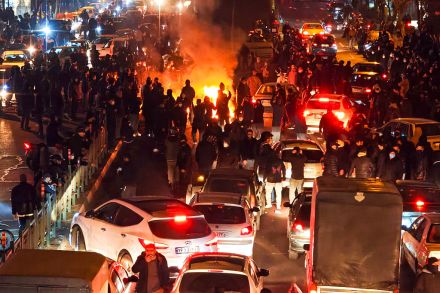
The Saudis have got the new year off to a busy start, haven’t they? The authorities executed 47 people, including a rather grim-looking Sheikh Nimr al-Nimr — leading Shia cleric and children’s party balloon sculptor (giraffes a speciality). OK, I made that last bit up. He was just a heavily bearded religious agitator and probably not much fun at parties. He’s dead now. In time I will overcome my grief and rebuild. As a consequence, Shia Iran has severed diplomatic links with the Sunni House of Saud and the usual furious and violent massed protests — which characterise both branches of the Religion of Peace™ — have taken place in

Iran may have the upper hand in the Middle East's power struggle

It isn’t just Iran who have been angered by the execution of Shia cleric Nimr al-Nimr. Protests have erupted in Bahrain, Lebanon, Pakistan and Iraq, all places where the 1400-year-old Shia-Sunni divide remains a faultline. Iran’s reaction may seem uncompromising, with Ayatollah Khamenei tweeting: ‘The unjustly spilt blood of this martyr will have quick consequences’; but they have also sounded a note of caution. President Rouhani called for the arrest of the mob who stormed the Saudi embassy buildings. Perhaps he knows that, in the long run, Iran’s star is rising and the Saudis’ is falling. In January of last year, Douglas Murray observed in The Spectator that ‘the region’s two most ambitious centres of

Iran has been at war with Britain for some time - it's time that we took notice

When British troops were on patrol in Iraq and Afghanistan, we faced many enemies, from jihadis to press-ganged civilians. But he most terrifying ones lay buried. Bullets usually miss. Improvised explosive devices – IEDs — don’t. They are frighteningly simple. Old munitions wired together or plastic bottles packed with fertiliser and ball-bearings could destroy a vehicle and kill its passengers. During the four years I served in Afghanistan, I saw IEDs evolve: first came remote triggers, then pressure plates and then low-metal-content devices. Curiously, IEDs evolved in a similar way in Iraq. This should be no surprise, since the groups trying to kill British troops shared one common resource: Iranian support.

The Middle East's 30 Years' War just took a turn for the worse

In January 2014, Douglas Murray explained in The Spectator how relations in the Middle East were becoming increasingly tense. With Saudi Arabia having now cut diplomatic relations with Iran, Douglas’s insight seems prescient. Syria has fallen apart. Major cities in Iraq have fallen to al-Qa’eda. Egypt may have stabilised slightly after a counter-coup. But Lebanon is starting once again to fragment. Beneath all these facts — beneath all the explosions, exhortations and blood — certain themes are emerging. Some years ago, before the Arab ‘Spring’ ever sprung, I remember asking one top security official about the region. What, I wondered, was their single biggest fear? The answer was striking and precise: ‘That the region

The caliphate strikes back

[audioplayer src=”http://rss.acast.com/viewfrom22/jeremyhunt-scatastrophicmistake/media.mp3″ title=”Douglas Murray discusses what Isis might do next” startat=1814] Listen [/audioplayer]When the creation of a new caliphate was announced last year, who but the small band of his followers took seriously its leader’s prediction of imminent regional and eventual global dominance? It straddled the northern parts of Syria and Iraq, two countries already torn apart by civil war and sectarian hatreds. So the self-declared caliph, Abu Bakr al-Baghdadi, appeared to be just another thug and opportunist ruling over a blighted no-man’s land, little known and still less revered in the wider Islamic world. He was surrounded by a rag-tag army of jihadis, whose imperial hubris seemed to reflect

'Death to America' is more diplomatic than you think, says Iran's supreme leader

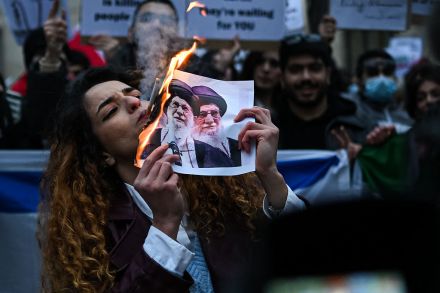
When the Iran nuclear deal was debated in Washington, the popular Iranian chant ‘Death to America!’ was a regular point of contention. According to the New Yorker, on one occasion the Texan republican Ted Poe asked John Kerry if the slogan meant that Iran’s supreme leader Ayatollah Ali Khamenei wanted to destroy the United States: ‘I don’t believe they’ve said that,’ the Secretary of State replied. ‘I think they’ve said ‘Death to America’ in their chants.’ ‘Well, I kind of take that to mean that they want us dead,’ Poe quipped. So happily today, Khamenei has stepped in to clarify just what is meant by the now infamous chant, which first arose

Iran’s hidden war with the West – and what we can do to fight back

When British troops were on patrol in Iraq and Afghanistan, we faced many enemies, from jihadis to press-ganged civilians. But for me, the most terrifying ones lay buried. Bullets usually miss. Improvised explosive devices – IEDs — don’t. They are frighteningly simple. Old munitions wired together or plastic bottles packed with fertiliser and ball-bearings could destroy a vehicle and kill its passengers. During my four years in Afghanistan I saw IEDs evolve: first came remote triggers, then pressure plates and then low-metal-content devices. Curiously, IEDs evolved in a similar way in Iraq. This should be no surprise, since the groups trying to kill British troops shared one common resource: Iranian

Now we know where the celebrated 'Ummah' is

Earlier this week I asked where the celebrated ‘Ummah’ is when it comes to Muslim refugees. I think we now have an answer. Here is a video of one Kuwaiti official’s response to the question of why none of the Gulf countries seem willing to take any Syrian refugees. ‘Kuwait and the other Gulf Cooperation Council countries are too valuable to accept any refugees. Our countries are only fit for workers. It’s too costly to accept them here. Kuwait is too expensive for them anyway. As opposed to Lebanon and Turkey which are cheap. They are better suited for the Syrian refugees. ‘In the end it is not right for

Where is the 'Ummah' now?

I have just returned from a trip abroad to find Britain and Europe in a state of madness. I will not reflect on any connections between these events. But perhaps a reader could enlighten me as to why in recent days Britain and Europe appear to have decided that Syria’s refugees are entirely ‘our’ responsibility. Other than a generalised sense that we are all human beings, Europeans are about as far down the list of those responsible as it is possible to be. Neither this country nor any of our European allies have made any significant intervention in Syria’s civil war. So why should Hungarians and Slovakians, Austrians and Poles

Philip Hammond: we are not ‘blind’ to Iran’s faults

Philip Hammond is the first Foreign Secretary to visit Iran in over a decade as he returned to reopen the Britain’s embassy in Tehran yesterday. But what has prompted this change in government policy? On the Today programme, Hammond explained that Britain needs the influence of a ‘very important country’ in the region to help with the fight against the Islamic State: ‘We’re trying to develop cordial relations with what is a very important country in a volatile and difficult region. We’ve had a difficult history between Britain and Iran but following the nuclear deal and after a couple of years in which relationships have been getting steadily better, we want to try and move to the next phase. ‘The

Just because European companies can trade with Iran doesn't mean they should

Iran uses cranes to hang citizens for offences such as ‘waging war against God’ and ‘crimes against chastity’. These cranes are often made in Europe. Now, with sanctions against the Iranian regime lifted, European companies are are clamouring to get back into the Iranian market. The CEO of the Austrian construction giant Palfinger last week called Iran a ‘promising market’. But after a human rights group in Vienna released a photograph of an Iranian dangling from a Palfinger crane, the company quickly backtracked on that statement. As Amnesty International noted last month, ‘Iranian authorities are believed to have executed an astonishing 694 people between 1 January and 15 July 2015.’

Letters | 23 July 2015

Don’t write off Assad Sir: Ahmed Rashid refers to our ‘Arab allies’ supporting al-Qaeda (‘The plan to back al-Qaeda against Isis’, 18 July). Clearly they are no allies of ours, so thank you Mr Rashid for pointing this out. Apart from that, his perspective is peculiar. He starts off by accusing Assad of plunging Syria into a bloody civil war. Clearly that is not the case. The civil war was started by Assad’s opponents, encouraged by the ‘success’ of the Arab Spring elsewhere. Of course we now see that the ‘success’ was illusory. He also suggests that Assad is finished. Now that his ally Iran has come in from the

There was a credible alternative to the Iran deal. Obama just chose to ignore it

President Obama has accused critics of the recently announced deal with Iran of having no credible alternative. According to Obama, it was this deal or no deal. And then, alleges the president, the options are either acquiescence or war. But this is a false choice, set up by the Obama administration to make its bad deal look like the best we ever could have hoped for. Yet, the truth is that the alternative to this deal was not no deal, it was a better deal, one that actually met the international community’s objectives in undertaking negotiations in the first place. The Iran deal presented at Vienna is both weak and

Portrait of the week | 16 July 2015

Home The government postponed a Commons vote on relaxing the Hunting Act in England and Wales after the Scottish National Party said it would oppose the changes. Scottish police admitted that a crashed car off the M9, reported to them on a Sunday, was not examined until the Wednesday, when one of the two passengers inside it was still alive. She died three days later. A case of H7N7 bird flu was found at a poultry farm near Preston, Lancashire, where 170,000 chickens were slaughtered. British people were being urged by the Foreign Office to leave Tunisia because ‘a further terrorist attack is highly likely’. Up to 5,000 were flown

Gambling on Iran

Iran is, beyond doubt, a sponsor of terrorism and this week it has been made much stronger. It has (again) agreed not to make a nuclear bomb and in return trade sanctions are being dropped — so money will start to flow in once more. We can be sure that the cash will soon find its way to Hezbollah in Syria, and to what remains of Bashar al-Assad’s regime. A stronger Iran means a longer and bloodier Syrian civil war, a more vulnerable Israel and a further injection of money and arms into the world’s deadliest war zones. None of this is in doubt. The question is whether, after this

Podcast: working with al-Qa’eda and the rise of Jeremy Corbyn

How has al-Qa’eda become the ‘moderate’ option in the Middle East? On the latest View from 22 podcast, Ahmed Rashid and Douglas Murray discuss this week’s Spectator cover feature on how a fear of Isis is leading Arab states to support the lesser of two evils. Is working with al-Qa’eda offshoots the only choice for Western countries? How significant was the decision not to bomb Syria in fighting Isis? And how does the new deal with Iran affect the West’s efforts? James Forsyth and George Eaton also discuss the momentum behind Jeremy Corbyn’s campaign to be Labour leader. Are some in the parliamentary Labour party regretting ‘loaning’ Corbyn MPs to put him on the ballot paper? How has his presence affected what the other candidates are doing? And