Iran

The Kurds are on their own

The routing of Isis in northern Iraq ought to be a time of international celebration, but as ever in the Middle East, there is no such thing as a straightforward victory. No sooner had Isis been driven away — though not quite vanquished — than the next great struggle commenced, this time between the Iraqi government and the Kurdish forces who for the past three years have been holding back Isis from the city of Kirkuk and its surrounding oilfields. This week, Iraqi forces stormed into Kirkuk and raised the country’s official flag, removing the Kurdish flag which was raised there in 2014. While Kirkuk lies outside the semi-autonomous Kurdistan

There's still some method to Donald Trump’s madness

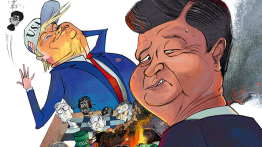
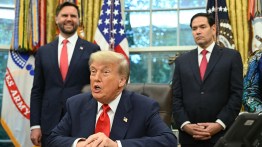
Donald Trump’s speech before the United Nations General Assembly was both an echo of George W. Bush and something original. At times, one expected the president to lapse into a Texas drawl and warn about ‘nuclear weapons’; at others he was distinctly The Donald. Despite the seeming contradiction, it was a fairly cogent and consistent address; it also overflowed with the customary bombast. Trump began firmly in carrot-top mode, gloating about how well the American economy had done since he was inaugurated. Then came an abrupt escalation: ‘Rogue regimes represented in this body not only support terrorists,’ Trump warned, ‘but threaten other nations and their own people with the most

Forget our misguided friendship with Saudi Arabia: Iran is our natural ally

The Saudi town of Awamiya — like so many countless cities across Iraq, Syria and Yemen that are witnessing an unleashing of the ancient hatred of Sunni for Shia — now exists in name only. Last month, days before an assault on its Shia inhabitants by the Saudi regime, the UN designated it a place of unique cultural and religious significance. But under the guise of fighting Iran-backed terror cells, the Saudis then subjected Awamiya’s entire civilian population to the indiscriminate use of fighter jets, rocket-propelled grenades, snipers, heavy artillery, armoured assault vehicles and cold-blooded executions. More than a dozen Shia, including a three-year-old boy, were killed. Hundreds of young

Iran's growing influence points to a bleak future for the Middle East

After six years of fierce fighting and with hundreds of thousands dead, the Syrian civil war finally appears to be settling down. The country is now divided into various pockets of influence, with Turkish-backed rebels in the north, US-backed Kurdish forces and their allies in the east and the Syrian regime and its Iranian-backed militias in the centre and the capital, Damascus. This now gives Iran, with the influence it already has in Lebanon and Iraq, a sphere of authority stretching from Tehran to the Mediterranean Sea. The spread of Iranian influence in the region is largely a result of the country’s ability to capitalise on the tumultuous recent history of the Middle East. The

Iran is our natural ally

The Saudi town of Awamiya — like so many countless cities across Iraq, Syria and Yemen that are witnessing an unleashing of the ancient hatred of Sunni for Shia — now exists in name only. Last month, days before an assault on its Shia inhabitants by the Saudi regime, the UN designated it a place of unique cultural and religious significance. But under the guise of fighting Iran-backed terror cells, the Saudis then subjected Awamiya’s entire civilian population to the indiscriminate use of fighter jets, rocket-propelled grenades, snipers, heavy artillery, armoured assault vehicles and cold-blooded executions. More than a dozen Shia, including a three-year-old boy, were killed. Hundreds of young

Portrait of the week | 17 August 2017

Home Regulated rail fares will rise by 3.6 per cent in January, bringing the price of annual tickets from Oxford, Colchester or Hastings to more than £5,000. The rise depended on the annual rate of inflation in July as measured by the Retail Prices Index, which had risen to 3.6 per cent; as measured by the Consumer Prices Index it remained unchanged at 2.6 per cent. A passenger train was derailed near Waterloo station but none of the 23 on board was injured. A train from Royston hit the buffers at King’s Cross. Richard Gordon, the author of Doctor in the House, died aged 95. The landlord of the Mallard in Scunthorpe

High life | 20 July 2017

I switch personalities at Spectator parties, depending who the guests are: for our readers’ tea party, I am a warm and gracious semi-host, swigging scotch, but graciously answering questions about my drinking, love life and writing habits. For our summer Speccie spree, I turn into a tight-lipped, street-smart tough guy, conscious of my brave obscurity but determined not to give in to the Rachel Johnson syndrome of self-advertisement. (Whew, that wasn’t as hard as I thought it was going to be.) The tea party for our readers is always a polite affair. After all, the ham better be nice to the knife, or else. I particularly liked meeting the father

High life | 29 June 2017

A major Greek ship owner, whose political knowledge matches his wealth and business acumen, explained to me what the Qatar brouhaha is all about. My friend Peter had the foresight to invest in liquefied natural gas (LNG) carriers, among the most expensive of ships to build but big-time money-makers. Why is it that it takes a major ship owner to tell us what’s really going on? Forget the bull put out by American hacks, whose minds no longer seem to function — at least since Trump’s triumph last November. Here goes: we sat on my terrace in Gstaad under the stars, watched the mountains turn from grey to dark blue,

An unholy alliance

Israel’s Channel 2 news station improbably made history last week by airing a brief interview with an obscure policy wonk named Abed al-Hamid Hakim. The subject was the blockade of Qatar imposed by the Saudis and a couple of other despotic Sunni Arab rulers to punish the country for its ties to Iran, Hamas and the Muslim Brotherhood. It obviously wasn’t what Hakim had to say — religion should not be used to justify violence and extremism; we should all try to live in peace and harmony — that aroused interest. Rather, it was where he was sitting when he said it: Jeddah, the commercial capital of Saudi Arabia. For

Iran attacks: Why can’t Trump get his head around the difference between a death-cult and a serious state?

‘The Iranian people are moving forward, and today’s fumbling with firecrackers will not affect the will-power of the people… the terrorists are too small to affect the will of the Iranian people and the authorities.’ There is something to be said for this imperious fly-whisk response, delivered by Ayatollah Ali Khamenei, Iran’s supreme leader, in reaction to yesterday’s double-suicide attack on Tehran, which cost at least 12 innocents their lives and caused dozens of injuries. Whatever therapeutic good it may do for the survivors of attacks on our own soil, there is for the IS barbarians and their would-be emulators a dangerous validation in our flags at half mast, our

The great Sunni-Shia conflict is getting ever closer to the surface

Several people have been killed in a terrorist attack in Iran today, with Isis claiming responsibility. This has potentially huge consequences for the wider Shia-Sunni conflict. In 2014, Douglas Murray wrote for the Spectator on Islam’s 30-year war. His piece seems particularly prescient in light of today’s events: Syria has fallen apart. Major cities in Iraq have fallen to al-Qa’eda. Egypt may have stabilised slightly after a counter-coup. But Lebanon is starting once again to fragment. Beneath all these facts — beneath all the explosions, exhortations and blood — certain themes are emerging. Some years ago, before the Arab ‘Spring’ ever sprung, I remember asking one top security official about the region.

There's a reason why Isis targets gigs: music is the enemy of fundamentalism

Until last night Ariana Grande’s fans, predominantly tweens and teens, were more preoccupied with the concept of friendship than the ripple effect of international politics. I witnessed this first hand when I was working at MTV and oversaw a Twitter Q&A with Grande, where she spent an hour or so answering questions sent in by fans. As Grande and I scrolled through the 90,000 tweets, I couldn’t help but marvel at how many were on the topic of friendship. ‘What do you look for in a friend?’ they clamoured to know. ‘Who’s your best friend?’ ‘Will you be my friend?’ Today, ‘Arianators’, as her fanbase call themselves, are tragically united in grief

How Donald Trump could decide Iran's election

Tehran Waiting to vote in Iran’s parliamentary election last year, Navid Karimi told me about his plans: to get a well-paid job with his recently acquired engineering degree, go on a road trip in the US and avoid dying fighting in Syria. Fifteen months on, as the country votes in a presidential election, I met him again in Tehran.  He is yet to find a job; the road trip, the result of being introduced to Jack Kerouac by an uncle educated in Illinois, is not going to happen anytime soon with the uncertainties surrounding Donald Trump’s Muslim travel ban; but he has so far managed to avoid conscription and being sent

Light in the East | 9 March 2017

Christopher de Bellaigue, a journalist who has spent much of his working life in the Middle East, has grown tired of people throwing up their hands in horror at Isis, Erdogan and Islamic terror, and declaring that the region is backward and in need of a thorough western-style reformation. As he argues in this timely book, the Islamic world has been coming to terms with modernity in its own often turbulent way for more than two centuries. And we’d better understand it, because it’s an interesting story, and often a positive one — the way vast crowds streamed onto the streets of Cairo, Istanbul and Tehran in demonstrations against authoritarian

The shameful hypocrisy of Sweden's 'first feminist government'

A couple of weeks ago I named the Labour MP Tulip Siddiq as my pious political hypocrite of the week, mainly for being silent on her bigoted aunty while strikingly vocal about a total stranger. I’m afraid that I was so overwhelmed by applicants for last week’s award that I have only just emerged from the pile of entries. However, I am now in a position to reveal the latest recipients of this increasingly coveted prize. Pipping even Speaker John Bercow to the award are the brave sisters of the Swedish government. Here is a photo from earlier this month of Isabella Lovin (Sweden’s Deputy Prime Minister, Minister for International Development

Arms and the woman

In August 1939, Clare Hollingworth, a 28-year-old aid-worker, had been employed as a reporter for less than a week by the Daily Telegraph when she landed her first serious journalistic coup. Using feminine wiles and diplomatic skills extraordinaire, she convinced a friend in the Foreign Office to lend her his chauffeured car. Stocking up with supplies in soon to be starving Poland, and charming the border guards, she crossed into Germany with nothing but her gut instinct and her smarts — the most important of a reporter’s tools (together with ‘ratlike cunning, a plausible manner and a little literary ability’, in the words of the late Nicholas Tomalin). She didn’t

Muslim magic

In 1402, when the Turkic conqueror Temur, better known in the West as Tamerlane, was poised to do battle with the mighty Ottoman Sultan Bayazid I, the greatest power in the Muslim world, he called in the astrologers. Knowing which side their bread was buttered on, the court officials duly pronounced that the planets were auspiciously positioned and gave a green light to attack. Temur was victorious. Not for nothing was he known as lord of the ‘Fortunate Conjunction of the Planets’. Half a century later, in 1453, Bayazid’s great-grandson Mehmet II stood at the gates of Constantinople. Anxious to galvanise his siege-weary troops, he summoned court astrologers, diviners and

Liam Fox is wrong to suggest that the EU controls the Foreign Office

Former Defence Secretary Dr Liam Fox told an audience at the Royal United Services Institute last week that the Foreign Office had been reduced to “little more than the EU embassy in Whitehall”. He is not the first person to accuse the FCO of promoting the interests of foreigners above those of Britain. But his analysis is way off target. Full disclosure: I am a recovering diplomat. I know the Foreign Office’s shortcomings – including its tendency to sit on the fence in a crisis until it is too late; and its habit (now changing, at last) of moving staff with expertise to deal with countries in which they are

Death metal

With its loud guitar riffs and even louder fashion, heavy metal has always been ripe for ridicule. In its mid-1980s heyday, it was epitomised by the fictional rock group Spinal Tap prancing on stage next to an 18-inch polystyrene model of Stonehenge while clad in ball-crushingly tight trousers and floor-length capes. In some parts of the world, however, metal is no laughing matter. In the Middle East, for instance, the potential punishment for wearing all black while wielding an electric guitar is death. These days, against a backdrop of authoritarian suppression in countries such as Iran and China, heavy metal’s trademark theatrics and widdly guitar solos have become less an

Linked in

What makes the World Service so different from the rest of the BBC? I asked Mary Hockaday, the controller of the English-language service. And how does it justify the additional £289 million funding (spread over the next five years) which the Treasury granted it at the end of last year? Will that money, which could after all otherwise go to welfare or the NHS, be well spent? ‘News is our core,’ says Hockaday. ‘It’s all about the now.’ Which sounds a bit Day Today. Anyway, isn’t this what BBC News and Radio 4 do already? It’s not just about presenting the news, Hockaday adds, but putting it in context. This