Iran

Video: Does Cameron have an Iraq policy? Or is he just making it up?

The Prime Minister has returned from his holidays, and yesterday wrote an intriguing piece in the Sunday Telegraph about the ongoing struggles in Iraq and Syria. ‘True security will only be achieved if we use all our resources – aid, diplomacy, our military prowess – to help bring about a more stable world’ he wrote, and this morning Defence Secretary Michael Fallon sounded distinctly hawkish about British involvement in Iraq. But what does any of this actually mean? Fraser Nelson tries to get to the bottom of things in our look at the week ahead, while Isabel Hardman wonders whether anyone – including Cameron – knows what our policy is anymore. Meanwhile Douglas Murray argues that an

Who would join the Iran lobby? MPs and Lords, it turns out

Who on earth would argue for a regime which hangs homosexuals, stones rape victims and sponsors terrorism across three continents? Who would act as a spokesperson or advocate of such a dictatorship? Well one answer appears to be ‘certain British Parliamentarians.’ In particular Labour MP Jack Straw, Conservative MP Ben Wallace and former Conservative Chancellor of the Exchequer, Lord Lamont. It appears that Britain has developed an ‘Iran lobby’. In a fascinating piece in today’s Wall Street Journal on Britain’s Iran lobby Sohrab Ahmari says: ‘Messrs. Straw, Wallace and Lamont have in recent months criticized the obstacles posed by American sanctions to U.K. banks that do business with Iran. “The

Please, Cameron – no moral grandstanding over Iraq

If there’s a bright spot in the murky mess of Iraq, it’s that finally we have a war that it is impossible to paint in simple terms, as a battle of good against evil. This time, even our PM, the self-appointed heir to Blair, can’t grandstand about defeating ‘terror’ or protecting ‘innocent civilians’ because there’s terror and innocence on every side. He can’t pose as world policeman; stand side by side with Obama and say ‘we must not let this evil happen’, because clearly we already have. Take ISIS, the Islamist group once affiliated to al-Qa’eda who’ve become the world’s new public enemy number one. ISIS have captured parts of

The West shouldn't be too soft on Iran during ISIS crisis talks

The choice in Iraq appears to be between the devil and the deep blue sea. On the one hand, ISIS need beating back. On the other, the West doesn’t want to further strengthen Iran’s grip over the Iraqi government. For the time being, though, the West appears to have decided to work with Iran. The Americans have already held talks with them about what to do in Iraq and William Hague announced this morning that the British Embassy in Tehran will re-open. But there is no guarantee that working with Iran will stop the emergence of a terrorist friendly, ungoverned space in western Iraq. As Steven Simon, a former Obama

The Middle East's own 30 Years War has just begun

In January, Douglas Murray explained in The Spectator how relations in the Middle East were becoming increasingly tense. With northern Iraq now in turmoil, following the advance of Islamist militant group Isis, Douglas’s insight seems prescient. Syria has fallen apart. Major cities in Iraq have fallen to al-Qa’eda. Egypt may have stabilised slightly after a counter-coup. But Lebanon is starting once again to fragment. Beneath all these facts — beneath all the explosions, exhortations and blood — certain themes are emerging. Some years ago, before the Arab ‘Spring’ ever sprung, I remember asking one top security official about the region. What, I wondered, was their single biggest fear? The answer was striking

World Cup diary: Iran vs Nigeria. Who to support?

So – Nigeria versus Iran, then. I wonder who Boko Haram were cheering for, surrounded by their infidel abductees in some sand-blown, bilharzia riven hellhole. I was cheering for our new allies, Iran. We are told every year – since about 1986 – that African teams will take world football by storm. And they never do. They’re as useless as were Zaire in 1974. But that won’t stop the BBC spending our licence fee money on the African Cup of Nations, for political reasons. And then earlier, an enormous pleasure to watch Portugal’s pouting moppets, each of them seemingly named after a seaside donkey, thoroughly thrashed by good ol’ dependable

Is Hamas finally losing its grip on Gaza?

 Gaza City Tattered green Hamas flags still flap above the streets in central Gaza and posters of its martyrs hang in public spaces. But these are tough times for the Hamas government, and not just due to the recent flare-up in tensions with Israel. In December last year, they cancelled rallies planned for the 26th anniversary of their founding, an occasion celebrated ever since they seized power here in 2007, and though usually secretive about their financial affairs, they revealed a 2014 budget of $589 million, with a gigantic 75 per cent deficit. So, what’s gone wrong for Hamas? Just a year ago, it seemed to be enjoying a honeymoon

‘Islamophobe’ of the Year

I have been honoured to receive a number of awards in my career. Yet one which I have especially yearned for has so far eluded me. Now it seems finally within my grasp. Since I began writing I have dearly hoped to catch the eye of the judges for the ‘Islamophobe of the Year’ title. There are a number of reasons. Firstly because one of its earliest recipients was Polly Toynbee. Anything that Polly wins is something I covet. Secondly, I have always desired the award because the term ‘Islamophobia’ itself is so fantastical and ridiculous. Winning an award with it in the title would be like waking up to discover I

Podcast: Islam’s 30 year war, Westminster’s wandering hands and the Tories’ NHS legacy

Is the Sunni-Shia conflict in the Middle East making a new great war ever more likely? On this week’s podcast, Douglas Murray discusses the battle involving Iran, Iraq, Syria and Saudi Arbia with Tom Tugendhat, a former solider and advisor to General David Richards. Why has the West failed to control the region? Can anything be done to save the situation? And how likely is it that the Sunni-Shia battle will end in a nuclear standoff? Do the men of Westminster also suffer unwelcome advances? Former Lib Dem advisor Miranda Green and Guido Fawkes’ Alex Wickham discuss the culture of Westminster’s wandering hands. How endemic is the problem for both

Iran, Saudi Arabia, and the Middle East's 30 year war

[audioplayer src=”http://traffic.libsyn.com/spectator/TheViewFrom22_23_January_2014_v4.mp3″ title=”Douglas Murray discuss Islam’s 30 year war with former solider Thomas Tugendhat”] Listen [/audioplayer]Syria has fallen apart. Major cities in Iraq have fallen to al-Qa’eda. Egypt may have stabilised slightly after a counter-coup. But Lebanon is starting once again to fragment. Beneath all these facts — beneath all the explosions, exhortations and blood — certain themes are emerging. Some years ago, before the Arab ‘Spring’ ever sprung, I remember asking one top security official about the region. What, I wondered, was their single biggest fear? The answer was striking and precise: ‘That the region will clarify.’ That is a fear which now appears to be coming true. The Middle East

The Navigators

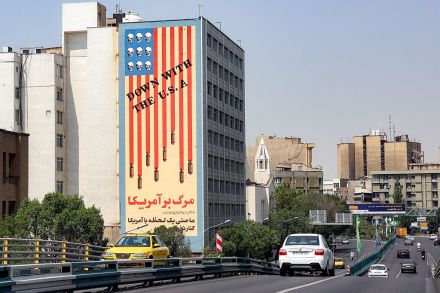
Tehran does not welcome pedestrians. It is eight o’clock on a July evening and the sun has plunged out of the air with alarming speed; the sky is the colour of wine, and the air is thick with the scent of heat and petrol. I have long forgotten where we are going. Dust-coloured buildings spill out to the horizon, many of them protected by barbed-wire gates. In this part of town it is so unusual for people to walk on the streets at night — I am told that only fools and prostitutes do so — that the pavements are unlit, and we rely on the rippling glow of the

Surprise, surprise, Iran has betrayed the Geneva deal

At the start of this week I hinted that the negotiations which went on in Geneva last weekend were not a meeting of equals. On one side were the Iranians, representing the clear wishes of their unelected Supreme Leader Ayatollah Khameini. On the other were the P5+1 countries joined by the unelected Supreme Baroness Catherine Ashton whose primary desire seemed to be to just declare some deal – any deal. So a wretched deal was done which has initiated the fraying and eventual collapse of sanctions, and Baroness Ashton and Secretary Kerry hugged each other for the cameras and got their moment of feeling like world saviours. Now it is business

The world is a safer place, thanks to the deal with Iran

Much though I like and respect Douglas Murray, I reckon he and other Ayatollohaphobes* are wrong about the deal struck with Iran. If Iran’s willingness to negotiate was evidence that sanctions were working, rather than a sudden flowering of the ‘let us all now be frenz’ spirit in Tehran – then the sanctions have surely done their job. That was the point of them. This seems to me so straight forward as to be almost tautological. There are risks with any deal, risks that the mullahs may indeed renege. But it is hard to argue on a basis of fact, rather than prejudice, even if you are living in Tel

William Hague: We will need to reassure Saudi Arabia and Israel about Iran deal

The Commons was in congratulatory mode this afternoon when William Hague gave his statement on the deal with Iran. Baroness Ashton, not familiar with heaps of praise falling on her, came in for congratulations from across the House, particularly from Hague and Douglas Alexander. Both men also agreed that this deal is the first step towards what Alexander called ‘that more difficult and complex agreement’ that will secure long-term stability in the region. listen to ‘William Hague’s statement on the Iran nuclear deal: ‘This is an important, necessary and completely justified step’’ on Audioboo

William Hague's appeasement of Iran's mullahs is a historic and terrible mistake

Well, I wondered in this place last week if David Cameron knew what he was doing in relation to the Iran nuclear negotiations in Geneva. And now the answer is clearly, ‘no’. America and Europe’s overwhelming desire to declare a deal meant that there had to be a deal to declare. The P5+1 countries, with the ludicrous Catherine Ashton speaking for Europe, have indeed made a historic and terrible mistake. The mullahs did not come to Geneva because they wished to give up their capability. And they did not come to the table because after 34 years of revolutionary Islamic governance they have seen the error of their ways. They

The Malala phenomenon - as seen from Pakistan

Mixed emotions stirred here in Pakistan when Malala Yousafzai came within kissing distance of the Nobel Prize. The reaction was reminiscent of how we felt when Sharmeen Chinoy’s Saving Face was up for an Oscar: great to be noticed by the world, but how tragic that the path to such recognition was paved with acid burnt faces. The deplorable act of attacking Malala increased the aversion felt for the Taliban among ordinary Pakistanis. But terrorists do not feed on public support; their demented ideology is sustenance enough. Pakistanis wept when Malala was battling for her life, and heaved a sigh of relief when she survived. We are proud that she has thrived.

Would you trust this man?

In Geneva, America and her allies are limbering up for another round of negotiations over Iran’s nuclear project. In a sign of the thaw Barack Obama and our own Prime Minister seem desperate to declare, David Cameron has spoken directly with President Rouhani for the first time. According to a Downing Street spokesman, the two men ‘agreed to continue efforts to improve the relationship’. Meantime, ahead of the Geneva talks, the man with the power in Iran, the Supreme Leader, has just given a speech to 50,000 Baseejis (government militia).  Here is some of what he said: ‘Is the Islamic regime after war with others? This is the statement that

Vive la France! Everyone else, led by Obama, is capitulating to Iran

President Obama’s flagship foreign policy of ‘leading from behind’ has had some surprising consequences. Not least among them is that France now appears to be leading the free world. During the current set of negotiations in Geneva between Iran and the P5+1 countries, America, Russia, Britain, China and Germany seem eager to declare a breakthrough. Iran is seeking an alleviation of the tough international sanctions against it and the right to continue what it calls its ‘peaceful’ nuclear programme. The Israeli prime minister, Benjamin Netanyahu, has warned of Iran benefiting from ‘the deal of the century’. Last weekend it took the government of François Hollande to call time on this.

A place of paranoia, secrecy, corruption, hypocrisy and guilt

‘Is he a good writer? Is he pro-regime?’ an Iranian journalist in London once asked me of Hooman Majd. Majd is an Iranian-American journalist who was born in Tehran in 1957, but is better known in America. His father was a well-travelled Pahlavi-era diplomat, and his grandfather was an ayatollah. His cousin is married to the brother of Iran’s former president Mohammed Khatami. Majd is not religious, but his criticisms of the Islamic Republic have tended toward the procedural rather than the substantive. He is married to an American, Karri, with whom he has a young son. Family is the great theme of his books. His writings give the impression

The Leveson Test – separating the 'Decent Left' from 'the Idiots'

If the Leveson Inquiry does nothing else, then it has at least provided a useful guide to the British Left for those of us on the saliva-speckled wastelands of British conservatism. Political tribes are complex but occasionally one issue will neatly divide a movement into easily identifiable clans, of which press regulation is one. And on one side you have one part of the British Left, the liberal tradition that values the liberty of all as a starting principle, and on the other the radical tradition that sees press freedom as a way for the rich to monopolise power. We might call them ‘The Decent Left’ and ‘The Idiots’; and