Iran

The ayatollah’s birthday surprise

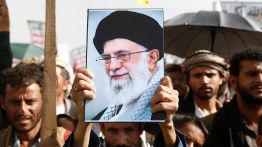
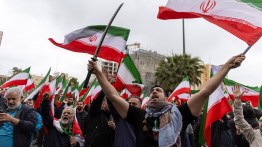
Did Iran’s ayatollah have the worst birthday ever? His eighty-fifth kicked off with a bang, as Israel retaliated after Iran’s unprecedented strike across the Jewish state that featured a failed barrage of lethal drones over the weekend. What comes next from Iran remains anyone’s guess — but the Israeli response, which struck an Iranian military but not nuclear site, served as an undoubted shot across the bow to the largest state sponsor of terrorism. The message was that it can’t attempt to directly attack Israel’s homeland without consequences and that Israel has the capability to attack Iran’s nukes if they so please. Iranian proxies, like Hamas, not only invaded Israel on October 7, but have been plaguing global shipping routes for months.

In defense of America the arms dealer

As the world enters a new era of great power competition, countries are arming themselves at a rate unseen since the end of the Cold War. The war in Ukraine, China’s increasing belligerence and angst over rogue states like Iran and North Korea are driving defense spending and weapons purchases the world over. Amid all this, the United States does not have the luxury of being too picky as to who among its friends gets the weapons they need to defend themselves. Nor can Washington continue to avoid drastic reforms to its arms export controls to face the challenges of the twenty-first century. Standards are necessary — they are what should set America apart — but they must not become so onerous that the security of the US and its partners suffer.

What Iran’s attack on Israel means for the Jewish state, America and the region 

Iran’s unprecedented attack on Israel Saturday night represents a dangerous escalation for three reasons. The first is its scale, some 300 drones and missiles. Second, it marks the first time the Islamic Regime has launched a lethal attack on Israeli territory from Iran itself, rather than through proxies. Most important of all is the combination of the first two: a major attack launched against Israel from Iranian territory. Although Israel, the US, the UK and, surprisingly, Jordan managed to shoot down nearly all the incoming drones and missiles, it was the thought that counts. And it was a very dangerous thought. Within hours, the Iranian attack changed the region’s strategic landscape.

israel iran

On the anniversary of the Iraq invasion, spare us the sermons

Twenty-one years ago today, the United States committed its worst foreign-policy mistake in generations: invading Iraq to overthrow Saddam Hussein, the despot who ruled the Arab country with an iron fist for nearly a quarter-century. The entire operation was supposed to be a “cakewalk,” in which the mighty US military, stocked with the best technology and weapons the world had to offer, would pummel a decrepit Iraqi army that was hobbled by international sanctions for the better part of a decade. The mood at the time was serious but stoic. Donald Rumsfeld, the US defense secretary, argued that the entire war wouldn’t last more than five months.

iraq war

Nixing BRICS: how to counter the China-led alliance

Americans are used to exercising influence through international entities such as NATO, the World Trade Organization or the World Bank. Each of these groups was set up with American leadership or at its instigation; all have been used to advance Washington’s vision of global liberal-democratic capitalism. No comparable international organization or collection of nations has been influential since the Soviet Union’s collapse. That may be changing. The so-called BRICS alliance (its founding countries were Brazil, Russia, India, China and South Africa) recently added new members Iran, Ethiopia, Egypt and the United Arab Emirates.

BRICS

Biden’s action in Iraq and Syria is merely delayed reaction

What do you think of the apothegm “Better late than never?” I think it is often dubious. For confirmation, I adduce the airstrike the Biden administration just conducted against eighty-five targets in Iraq and Syria. The attacks, against infrastructure associated with Iran’s Revolutionary Guard, are billed as the opening salvo in response to last week’s drone attack by Iranian assets in Jordan that left three Americans dead and more than forty injured. Taking a page from an earlier, square-jawed time, officials from the administration tersely commented that America’s “multi-tiered” response would continue at a “time and in a manner of our choosing.”  Spoken like a real administration. I wonder from what storeroom they got the script?

air strikes iraq syria

What are Biden’s options on Iran?

The drone strike that struck near the sleeping quarters of a small US outpost in northeastern Jordan, killing three American troops in the process, has landed like a thud in the corridors of the Biden administration. Hawkish lawmakers who have been jonesing to bomb Iran into the Stone Age for years, such as Lindsey Graham and Tom Cotton, are using the weekend’s travesty to push the argument to an even higher decibel. The logic: Iran and its proxies need to understand that the US won’t be pushed around. It’s an emotionally satisfying response, but one that could get the United States into a heap of trouble if not thought through and tailored appropriately. President Biden and his advisors have spent the last forty-eight hours talking through options.

joe biden iran

Senator Lankford defends his immigration deal

Senate Republicans who are negotiating an immigration reform bill with Democrats are defending their efforts after conservatives reacted angrily to leaked details for the deal. The lead negotiator, Senator James Lankford, said on Fox News Sunday that his detractors are relying on “internet rumors” to fuel their opposition to the bill.“This bill focuses on getting us to zero illegal crossings a day,” Lankford said. “There’s no amnesty, it increases the number of border patrol agents, it increases asylum officers, it increases detention beds so we can quickly detain and then deport individuals.

james lankford

Why hasn’t Hamas freed its American hostages?

Hamas’s most valuable assets are the American hostages it holds. That simple fact means the terrorist organization will demand the highest value in return. What can America give Hamas in exchange? Not prisoners, since the US doesn’t hold any Hamas fighters. That means the US cannot follow the Israeli pattern of giving Hamas three Palestinian prisoners in exchange for every one held by Hamas. Nor can America provide boatloads of cash, as the Biden administration has for Iran. Biden could continuing giving Iran money, but that is much harder in the midst of war. And it is untenable politically to pay Hamas directly while the fighting continues. The Biden team might promise to help rebuild Gaza later, but that’s not valuable to Hamas right now, as it fights for its life.

hamas

Facing the facts of the West

The century began with a global celebration — the West’s belief in liberal democratic capitalism had battled foes for centuries and emerged victorious. All that remained was for the rest of the globe to melt into the West’s soft and loving embrace. Two decades in, things look much less rosy. China’s rapid rise has not spurred democratization, as many suggested it might; instead it has nourished a massive ideological and political competitor that may supplant the West not only economically but as an arbiter of global culture and behavior. Western decline is not yet inevitable, but Western values will survive and spread only if leaders recognize two clear facts. The first is that the spread of Western values has in large part been due to the dominance of Western power.

west

Alan Dershowitz: when Israel must consider the nuclear option

Professor Alan Dershowitz is one of Israel’s most prominent defenders outside the Jewish state. He has just written — in record time — a book about the events of October 7: War Against the Jews — How to End Hamas Barbarism. It will be published next month and will argue, among other things, that the Hamas attack “has required Israel to consider its nuclear option as a last resort to assure its survival.” I spoke to Professor Dershowitz and asked him first, about another of the book’s arguments, that there should be no absolute distinction between civilians and combatants in Gaza, but instead “a continuum of civilianality.” "It existed in Nazi Germany," he said.

dershowitz nuclear option

Time for Biden to change course from Obama’s failed Middle East policies

When a long-silent former president finally speaks out, the public listens. So do foreign leaders, especially when the former president is closely tied to the current one. That’s why Barack Obama’s comments on the war in Gaza attracted attention.  Anyone who remembers President Obama’s foreign policy knew what to expect: criticism of Israel and a delicate dance around Iran’s malign behavior. In fact, he did not mention Iran at all. He totally ignored their role. His audience expected him to add a few words of moral self-righteousness, warning Israel about future civilian casualties, as if Israeli Defense Forces hadn’t taken enormous and costly steps to avoid them.

biden obama resize

Biden must rethink US policy in the Middle East

Responsibility for the catastrophe now unfolding in the Middle East belongs to Hamas and its sponsor, Iran. The atrocities we are now discovering — the deliberate killing of innocents, the capture of hostages — were an integral part of Hamas’s military strategy and grew directly out of its vicious hatred of all Jews — and of Western civilization. These are acts of true evil and, in committing them, Hamas has the full backing of Iran. President Biden spoke for America when he said, bluntly, “The brutality of Hamas’s blood thirstiness brings to mind the worst rampages of ISIS. This is terrorism.” It is important to begin with these basic points before discussing mistakes made by Israeli and American leaders.

joe biden middle east foreign policy

The truth about the US-Iran prisoner deal

Negotiating with Iran can be the diplomatic equivalent of a day-long migraine. While Iran policy often strikes a chord in Washington, DC, people across the political spectrum come together on this basic proposition: the Iranians are some of the best hagglers on the planet. Wendy Sherman, a career US diplomat who played a major part in negotiating the now-defunct Iran nuclear deal, referred to the Iranians as legendary for their skill at the bargaining table. Donald Trump alluded to their skill, too: “[T]]he Iranians, frankly, are great negotiators,” he said in 2016. And former ambassador (and now CIA Director) William Burns commented the same year, “The Iranians are very skilled negotiators, very tough.

The hijab is not a feminist symbol

The Women’s World Cup has tied a bow around a summer of own goals in feminist ideology. Barbie — yes, that plastic blonde with impossible proportions — became the feminist icon of the summer, trans women silenced the voices of biological females and the story of Lia Thomas’s prowess remains etched in our minds. But for the grand finale of this summer's theater of the absurd? White Western women elevating the hijab onto the pedestal of feminist glory. For those who may not know, the hijab is a religious headscarf traditionally worn by Muslim women. While the practice dates as far back as the fourth century AD, the popularity of the hijab is actually quite new, with a stark rise beginning in just the 1970s.

hijab

Will Biden make the same mistakes as Obama on Iran?

The Biden administration seems to be bumbling on all diplomatic fronts these days. Not only is it trying to magic into existence a thaw in the US-China relationship, while Beijing is only throwing on the liquid nitrogen, but it's also trying to resurrect a version of the nuclear deal with Iran. Concrete details are scant, but reporting from both the New York Times and the Wall Street Journal gives a decent sketch of what the White House is contemplating. It’s not pretty. Under the outlines of the agreement, the US would “avoid tightening sanctions,” stop impounding Iranian ships and release billions in cash currently frozen by US sanctions for humanitarian applications.

Iran islamic republic

Making a home through food

At the age of sixteen, chef and restaurateur Forough Vakili, now forty, left Iran to meet a brother she barely knew, eventually settling in America. She didn’t return for eleven years. As a member of the minority Baháʼí faith, which teaches the value of all people, regardless of gender or religion, Vakili had hit a wall in her homeland. “I came here so I could continue my education,” she says, when we speak over Zoom. “We didn’t have many rights back in Iran — there wasn’t a lot offered for us after finishing high school.” It was in Vienna, waiting for her American visa, that Vakili reconnected with her brother for the first time since she was a toddler. Six months later she moved in with him, his wife and three daughters in Atlanta.

Vakili
syria peace

After decades of waiting, China goes on the diplomatic offensive

China has been an epicenter of diplomacy over the last month and American officials can’t help but take notice of the shift. Statesmen flying to China, hat in hand, to sign business deals with Chinese firms or enlist Chinese diplomats to assist in solving international disputes gives the foreign policy graybeards ulcers. The general rule seems to be: what’s good for China is bad for the United States. There’s no question that China’s Xi Jinping has had a good few weeks. After being occupied with a nationwide Covid-19 disaster that lasted for three years, Xi, a man whose entire legacy depends on China transforming into a superpower on par with or perhaps even surpassing the US, isn’t wasting any time before injecting his country back into the diplomatic arena.

It’s time for Congress to take back its war powers

On March 29, more than twenty years after the United States commenced Operation Shock and Awe in Baghdad, the Senate made history by repealing the military force authorization that green-lit the operation. The bill, which also aims to kill a previous 1991 authorization for the use of military force, or AUMF, against Iraq during the Gulf War, now heads to the House of Representatives where it faces an uncertain future.  On the face of it, repealing both measures would seem like an ordinary event. Saddam Hussein, after all, has been dead for over sixteen years, hanged by an Iraqi court for a litany of crimes against his own people. His regime dissolved within three weeks of the 2003 invasion.

state of the union

The Middle East catches diplomacy fever

Peace isn’t exactly blossoming like rosebuds in the Middle East. The region is still host to a devastating civil war in Yemen, a humanitarian crisis in Syria, sporadic terrorist attacks in Iraq and an endless tit-for-tat between the US and Iranian-backed militias in Iraq and Syria. Indeed, just last night, President Biden authorized several airstrikes against three militia locations in retaliation for a drone attack on an American base in Syria that killed one contractor and injured six others. But for an area of the world so often regarded as hopeless, the Middle East is suddenly looking like an epicenter of diplomacy.

syria peace