Immigration

Why were the Abedis here in the first place?

In recent days parliament has been recalled on a Saturday to debate the renationalisation of the British steel industry. Then, after a month-long strike by binmen in Birmingham, army planners have been called in to help address the issue of large amounts of refuse piling up in the city. Absent a major ideological split on the right, it is hard to see how much more reminiscent of the 1970s Britain could become. I don’t however want to join the legions of people who are carping. Rather, I should like to suggest an answer to some of these things.

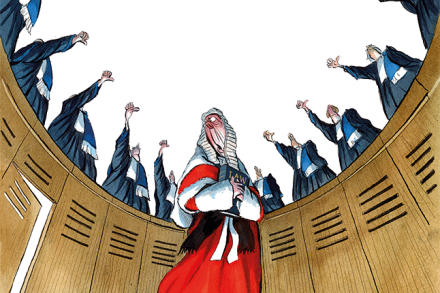
Sack the judges

The population of the United Kingdom was increased this week by the arrival of two Albanian lesbians who have been given the right to remain here by an deputy Upper Tribunal judge called Rebecca Chapman. The women insisted that they would face persecution in Albania for their sexual preferences. This is despite the fact that Albania decriminalised homosexuality 30 years ago and in 2010 adopted a law that prohibits discrimination based on sexual orientation and gender identity.  Rebecca was not impressed, however, pronouncing Albania to be a ‘patriarchal, conservative society in which homophobic attitudes still exist, particularly in rural areas’.

Mahmoud Khalil is not the victimized cuddlebear the media would have you believe

From our US edition

A federal immigration judge ruled on Friday that the government could deport Mahmoud Khalil, not a student, but a “Columbia University graduate.” Judge Jamee Comans, a former Mississippi police officer and a Biden appointee in 2023, said that Khalil’s political activities posed “potentially serious foreign policy consequences” for the United States, which is claiming that Khalil is undermining “US policy to fight anti-Semitism.”  Khalil supporters talk about him like he’s Nelson Mandela on Robben Island, Dr. King writing letters from Birmingham jail or Oscar Wilde staring wistfully at the moon from his cell in Reading Gaol. But anyone looking to ding the Trump administration on its deportation policy could find a better example of injustice.

The Everything, Everywhere All at Once presidency

From our US edition

The Supreme Court’s 5-4 ruling lifting the order blocking the deportation of accused members of the Venezuelan gang Tren de Aragua is a significant legal victory for the Trump administration. More importantly, it's also a policy vindication for those within this White House whose approach to government upon their return to Washington was to do everything, everywhere, all at once. The legal victory itself was hailed by every prominent member of the President's deportation team, with Attorney General Pam Bondi announcing she’d redouble her efforts, Homeland Security Secretary Kristi Noem declaring that all those here illegally must “LEAVE NOW” and Stephen Miller practically ebullient in his interview last night with Sean Hannity.

A novel in disguise: Theory & Practice, by Michelle de Kretser, reviewed

Michelle de Kretser, of a Sri Lankan family living in Australia, is an exceptional novelist – perhaps among the ten best at work in English today. She has been recognised with literary prizes, but it’s surprising that she hasn’t made quite the impact on the public she deserves. She is one of those writers who one presses upon intelligent acquaintances and whose books reward rereading. One of her regular subjects – she is a novelist of bookish, intelligent lives – is the inability of the Australian intelligentsia ever to read an Australian novel. As the author of The Life to Come, perhaps the best Australian novel since Tim Winton’s Cloudstreet, she does well to present this worrying disengagement with amusement.

French politician calls for return of Statue of Liberty

From our US edition

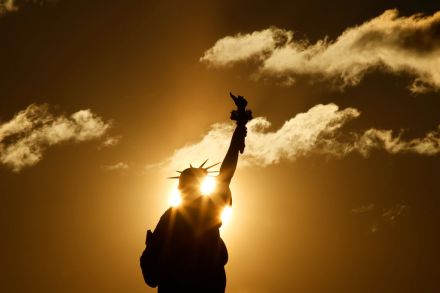
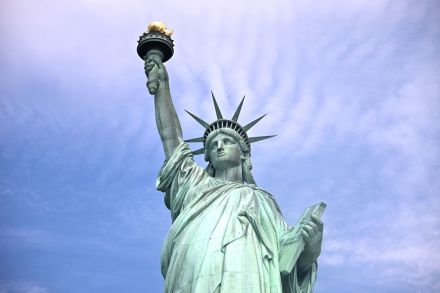
The Statue of Liberty was given as a gift by France, the United States’s oldest ally, to celebrate our centennial anniversary as an independent state. Now, as the US moves toward its quarter-millennial anniversary, Member of the European Parliament Raphaël Glucksmann is asking for it back. Glucksmann said to supporters he would tell Americans that, “We gave it to you as a gift, but apparently you despise it. So it will be just fine here at home.”  The statue was originally called La liberté éclairant le monde (Liberty Enlightening the World).

statue of liberty

America needs talent

From our US edition

Before Donald Trump’s inauguration, Elon Musk caused a huge controversy within the MAGA movement by advocating increased high-skill immigration. As head of the Department of Government Efficiency he wanted, for example, to expand the H-1B visa program, which many Trump supporters are against. The angry debate over the visa issue still rages on social media and both sides tend to talk past each other. The MAGA movement is against any increase in immigration, whether high- or low-skill. Musk has acknowledged that the existing H-1B program was subject to abuse by employers and especially by IT firms that rely on outsourcing: the workers they import are often no better than the Americans they replace.

statue of liberty new york

Why Nigel should listen to Rupert

I was thinking lately of Robert Kilroy-Silk. For younger readers, and people who were never students or unemployed, a quick refresher course may be needed. From 1986 to 2004 Kilroy-Silk was the presenter of a BBC daytime television programme called Kilroy. It had something of a cult following because of its unintentional hilarity. The live audience was carefully ring-mastered by Kilroy-Silk, who wandered around the studio with a microphone asking people what they thought about various ‘ishoos’ of the day. For some of us the main entertainment came from the fact that there was never quite enough room on the audience banquettes and so we watched for those moments when Kilroy-Silk would ask the opinion of an audience member and then inadvertently sit on them.

Canada can do more to address the fentanyl crisis

From our US edition

It was a field day for the Canadian freight industry on Monday. Every truck in the country, stuffed to the gills with product, was racing the clock to the border. The few drivers still available commanded ridiculous prices — up to $12,000 higher than normal. At the stroke of midnight, the 25 percent blanket tariff kicked in. Trucks that had yet to make it across the border hit the brakes and turned around. The party was over; the coaches became pumpkins again, it was time for Cinderella to go home. The whole week before, business owners, brokers and shippers were asking each other: "Have you seen anything official on this? Anything from the Canadian government?" They hadn't.

fentanyl canada

Trump’s $5 million immigration ‘Gold Cards’ could split his party

From our US edition

President Trump announced Tuesday that his administration is planning to unveil a program that lets foreigners acquire a path to citizenship for a one-time $5 million fee. Unlike the existing EB-5 visa program, which grants green cards to wealthy investors for about one-fifth of the cost, Trump’s “gold card” initiative aims to attract greater capital while using the revenue to help reduce national debt. “We’re going to be selling a gold card,” Trump said from the Oval Office during an Executive Order signing on price transparency in the hospital system.  “You have a green card. This is a gold card.

gold card

It’s time to scrap the asylum system

Whatever you think of the blizzard of executive orders howling from the White House, at least the new President doesn’t succumb to the seductive gravitational pull of the status quo. This is therefore a fitting juncture at which to not simply think outside the box, but in some cases to chuck the box. For example, Donald Trump wants to chuck the US Department of Education. Yet can’t he set his sights higher? Like, set an example for the rest of the West: chuck the asylum system. Having long ago predicted that the subject would dominate this century, I’ve written about immigration for 35 years. Although repeatedly approaching the radioactive issue with a certain frankness has incurred considerable reputational damage, I’ve no regrets.

Veteran journalist Edward Wong on his memoir of food and feud

From our US edition

From 2008 to 2016, Edward Wong reported on China for the New York Times, heading up its Beijing bureau. Last year, the veteran journalist, now the Times’s diplomatic correspondent, published his first book: a blend of family memoir, narrative history, political observation and personal reckoning. At the Edge of Empire tracks Wong’s father, Yook Kearn Wong, as he moves from fervent support of the Chinese Communist Party and its ideological goals to disillusionment and disappointment. It is also a book about what makes an empire. Born in Hong Kong before moving to Guangdong Province as a child, after joining the military as a young man Yook Kearn was posted to remote Xinjiang province, in China’s northwest corner.

Wong

Can we trust the Tories on immigration? An interview with Chris Philp, shadow home secretary

38 min listen

On this special episode of Coffee House Shots, economics editor Kate Andrews is joined by shadow home secretary Chris Philp to discuss the Tories’ newly announced plan to tackle immigration. On legal migration, their proposal includes plans to end worklessness in order to stop the reliance on low-paid migrant workers. And on illegal migration, the line is ‘zero tolerance’ on small boats, including a removals deterrent much like the Rwanda plan, as well as other changes to the legal framework. One of the more controversial elements of their strategy is on citizenship.

Pope Francis’s immigration letter was seriously imprudent

From our US edition

Everyone in the world, it seems, believes they’re entitled to an opinion on US immigration policy. That includes Pope Francis. The Supreme Pontiff made clear his displeasure with the administration’s resetting of America’s approach to immigration in a letter addressed to the US Catholic bishops, but clearly directed against the new Trump administration’s efforts to enforce existing US immigration laws — with a particular emphasis on deporting immigrants who are criminals or who have committed crimes as well as others judged not to have valid claims to refugee status.

pope

Europe should be careful in wishing for their own Trump

From our US edition

When I visited Toronto with a UK delegation last winter, conversation focused on the issues of immigration, housing and inflation that were contributing to the unpopularity of Justin Trudeau, who finally announced his resignation as prime minister last month. The prospect of Donald Trump’s return to the White House was the slumbering python in the chandelier above the conference table: I sensed our hosts preferred not to think about how bad it might turn out to be. Well, now they know. In response to Trump’s declaration of 25 percent tariffs on Canadian goods, plus 10 percent on imported energy, Trudeau retorted with tariffs on many billions worth of US products.

Trump

Have the Tories thought through their immigration policy?

12 min listen

The Bank of England has cut interest rates for the third time since the inflation crisis, taking the base rate to 4.5 per cent. The Monetary Policy Committee voted by seven to two to further reduce rates by 0.25 percentage points – a move that was widely expected by markets, but had been put into doubt after government borrowing costs surged in January and President Donald Trump announced his plans for substantial tariffs last week. Why have the Bank of England decided to cut rates? Also today, Kemi Badenoch has announced some policy! Ahead of the Labour government’s Border Security, Asylum and Immigration Bill being debated in Parliament next week, the Tory leader has unveiled her party’s latest offering on immigration. But have they actually thought it through?

How is round one of Trump’s deportations plan going?

33 min listen

Colombia has agreed to accept military aircraft carrying deported migrants from the US – avoiding a trade war between the two countries. Donald Trump had threatened sanctions on Colombia to punish it for initially refusing military flights following a rapid immigration crackdown. What are the challenges of deportation flights, and what's Trump's vision for Latin America? Freddy Gray is joined by Todd Bensman, Fellow at the Center for Immigration Studies, and author of 'Overrun'.

How will Trump take on the administrative state?

From our US edition

By the time you read this, the first raft or two of Donald Trump’s executive orders will have been promulgated. No one outside the charmed circle of his close advisors knows what is coming down the pike, but all indications are that the orders will be energetic and far-reaching. Colin Powell would probably have pulled out the phrase “shock and awe.” Most observers believe that there will be robust attention to immigration, the border, energy, regulation, taxes and the conduct of elections. There will probably also be orders touching the fate of some 1,500 people charged in connection with the self-guided tour of the Capitol on January 6, 2021. I would not be surprised if there were also orders regarding the conduct of some of the prosecutors involved in those cases.

administrative

Immigration’s theatre of the absurd

On the cusp of an almighty row over Trump’s planned mass deportations, let’s look to Europe for light relief. Last month, the pridefully left-wing management of the storied 19th-century Parisian theatre Gaité Lyrique, owned by the pridefully left-wing Paris council and traditionally the home of operettas, digital arts and musical performances, staged a free conference on ‘reinventing the refugee welcome in France’. The organisers literally invited their own downfall: 200 West African migrants who apparently felt very welcome indeed and refused to leave. Gaité Lyrique invited its own downfall: 200 West African migrants who refused to leave These passionate opera fans have since swelled to 350.

What Trump’s executive orders will do

From our US edition

The newly sworn-in President Trump had a busy inaugural day. Between swearing into office and waving a saber around while dancing to “YMCA” at an inaugural ball, he also signed several executive orders and proclamations. After signing his cabinet and other nominations, President Trump’s first order of business was to proclaim that all flags should be flown at full staff for this and all future inauguration days. Following the inaugural parade, President Trump signed a bevy of additional executive documents as thousands of his supporters cheered.