History

The Years of Robert Caro

From our UK edition

For political types there's little doubt about the publishing event of the year: the fourth volume of Robert Caro's mammoth biography of Lyndon Johnson. The New York Times published a swell piece at the weekend which, as such pieces must, made it clear that Caro is the most unusual, and perhaps the best, biographer of our age. If it is madness to spend nearly 40 years writing about LBJ then it is a special and useful madness. The new volume, The Passage of Power, is only 700 or so pages long (compared to the 1,200 pages of its predecessor, Master of the Senate) but only covers six years: It begins in 1958, with Johnson, so famously decisive and a man of action, dithering as he decides whether or not to run in the 1960 presidential election.

An elusive father

From our UK edition

In a large upstairs room of the YWCA building behind Tottenham Court Road, a group of actors were nervously waiting for the arrival of the director. There was the powerful whiff of a good cigar, the faint scent of expensive cologne and Orson Welles arrived. He had been in Paris cutting his film of Kafka’s The Trial and now here he was; a huge man, beautifully dressed in a dark suit and floppy tie, full of good humour, apologising for having missed a week of rehearsal. The room exploded with his laughter, an explosion so loud you feared for the windows, and everyone relaxed. He had prepared a version of the two parts of Shakespeare’s King Henry IV and he was going to play Falstaff. Most of the cast were young, and amongst them was a teenager who had been at Oxford.

Death comes for the archbishop

From our UK edition

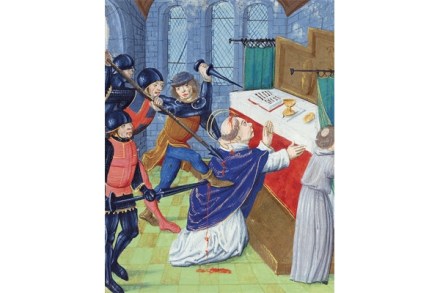
Posterity has always embellished Thomas Becket. After his death in Canterbury Cathedral in December 1170 the Church idealised and canonised him; his tomb inspired miracles and became the most famous shrine in Christendom; the local monks grew rich and fat on the tourist trade that would attract Chaucer’s pilgrims. The 18th century invented Henry II’s hint, ‘Who will rid me of this turbulent priest?’ Playwrights spice the dish. Tennyson’s drama about Becket was staged by Irving; everyone remembers Eliot’s chorus, living and partly living; and Anouilh’s play, which turned the Norman immigrant into a Saxon, gave him, in the screened version, a wide and charismatic appeal.

Figures in a landscape

From our UK edition

As you cross the Trent, you are very much aware that you have moved from the south to the north country. The next great divide is the Tyne, with the dramatic straggle of Newcastle stretching east and west. Beyond lies mile upon mile of Northumberland, all the way to the Scottish border, arable land for grazing (punctuated with coal mines) by the coast, giving way to heathery moors and countless sheep. The centre of this often wild and always beautiful land is Alnwick, with roads stretching out, to north and south the Great North Road, east to the fishing port of Alnmouth, westward to the Roman Wall and the Cheviots. Alnwick Castle was the centre of the defence against invaders from the north, seat of the Percy family, Earls and Dukes of Northumberland.

On the way to the forum

From our UK edition

In 150 BC, Cato the Elder arrived in the Senate House in Rome with an eye-catching basket of figs. This redoubtable statesman — often referred to as ‘censorius’, an epithet I have coveted since my childhood — was famous, apart from his censoriousness, for his conviction that the most important thing for Rome at any given moment was the military destruction of its enemy, Carthage. Yet here he was, instead of making another swingeing speech on that topic, apparently about to eat his lunch. Cato picked out an especially juicy looking fig. He took a bite. And then he asked, in his most censorious of tones, ‘Do you know where these figs come from?’ As was his habit, he answered his own question. ‘Carthage! That’s right.

Not quite cricket

From our UK edition

To the French, Albion’s expertise in perfidy will come as no surprise. But centuries of warfare have given them time to learn. With their experience only dating back to 1914, the Germans clearly found it difficult to grasp during the second world war that nowhere is the truth more expertly and instinctively spun than in the land of the gentleman. While a schoolchild soon masters the lie simple, and the lie financial merely requires a degree of brazenness easily developed by proximity to other people’s money, the lie belligerent demands an instinct for dis-simulation that must be bred in the bone of its practitioners to be carried off convincingly.

Prophetic times

From our UK edition

The subject here is colossal, covering a substantial stretch of the later Roman empire, the last years of the Persian empire, the conversion of the Arabs, the spread of Christianity and what happened to Judaism. The time span runs, effectively, from the death of Jesus to the moment in the eighth century when the Abbasids acquired through violence the vast empire of the Umayyads, stretching from the Loire to the Hindu Kush, and founded Baghdad. The title of Tom Holland’s book is rather studiously general, but his central topic is unmistakable: the founding and establishment of Islam and its political and martial setting. If Holland didn’t want to make a point of this in his title, one couldn’t blame him.

Special providence …

From our UK edition

When Ed Smith became a full-time professional cricketer for Kent in 1999 the county side was preparing for the new millennium by shedding anything that smacked of old-fashioned amateurism. Professionalism was to be a state of mind. Players were henceforth required to sign up to a new code of conduct. This Core Covenant consisted mainly of a succession of abstract nouns, though it also proclaimed its faith in the transformative power of setting targets by requiring a ‘pledge’ from all players that they would take at least 50 extra catches during every practice session. What was more, it took personal responsibility to a higher level by abolishing bad luck as a valid excuse for anything that went wrong.

A gruesome sort

From our UK edition

Everybody knows that the heart pumps blood around the body, and that a man called William Harvey somehow discovered this fact. Before Harvey, people thought that blood moved around the body in a sluggish fashion. But then Harvey — who was born 14 years after Shakespeare — noticed that, actually, blood shoots out of the heart with great force, travels through the arteries, and then makes its way back to the heart through the veins. To find this out, in an age before X-rays, sonograms or heart monitors, you would, if you think about it, have had to be a pretty gruesome sort of person. As soon as I started this book, I was gripped with a curiosity I should, I realised, have had all along. How did Harvey make his discovery?

Bookends: Terribly Tudor

From our UK edition

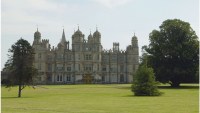
History publishers like a gimmick, so I assumed Suzannah Lipscomb’s A Visitor’s Companion to Tudor England (Ebury, £12.99) must be a cheeky rip-off of Ian Mortimer’s Time Traveller’s Guide series. Not so. In fact this is a rich, meticulously plotted field guide to the surviving architectural treasures of Tudor England: the houses, fortresses, palaces and battlefields that were trodden by our most famous royal dynasty, from Westminster Abbey and Windsor Castle to Kett’s Oak and Burghley House (pictured).But it is more than just historical I-Spy. Lipscomb is an eloquent tour-guide, and each of her 50 destinations allows her deftly to unfold a different chapter of Tudor history.

Who are the losers now?

From our UK edition

Keith Lowe’s horrifying book is a survey of the physical and moral breakdown of Europe in the closing months of the second world war and its immediate aftermath. It is a complex story and he tells it, on the whole, very well. Though the first world war took the lives of more uniformed young men, in the useless slaughter of the Flanders trenches, many more people, chiefly civilians, died in 1939-45. Soviet casualties were the greatest: 23 million killed, of whom two million came from Belarus and seven million from Ukraine. Next came the Poles, with losses of 6,028,000, the largest percentage of the population in any country. The Germans also lost six million, and the Yugoslavs over a million.

Architectural bonsai

From our UK edition

In the summer of 1961 I was in my second year at Magdalen College, Oxford with rooms in the 18th-century New Buildings. One of my neighbours there was a quiet man called Jonathan Green-Armytage. Sitting out on the steps of the building’s colonnade, in the sun, we became friends. He was already a distinguished photographer. He showed me photographs he had taken of Edith Sitwell, with her medieval face and gnarled, beringed fingers. They were at least as good as Cecil Beaton’s portraits of the old poet. One day, Jonathan said to me: ‘I think you’d enjoy to meet my god-mother, Vivien Greene; and I think she’d like to meet you.

Bookends: A matter of opinion

From our UK edition

In an age when the merely mildly curious believe they can get all they really need to know from Wikipedia for free, A. N. Wilson’s fellow literary professionals must take heart from his expectation that there is still possibl to charge for a work of such succinctness that it is essentially an extended Wikipedia entry enlivened by some opinions. Wilson’s Hitler: A Short Biography (Harper Press, £14.99)certainly trumps Wiki for stylistic brio and brims with the author’s customary zip and zing.

Lest we forget | 17 March 2012

From our UK edition

It was not possible, as Primo Levi memorably wrote, to convey the full horror of the Nazi extermination camps because no one had survived to describe death in the gas chambers. There were no ‘sommersi’ (drowned) left alive to speak for the men, women and children driven in naked to die.  Apart from Levi himself, one of the very few people to have got close is Claude Lanzmann, whose nine-and-a-half-hour film on the deaths camps, Shoah, transformed the way successive postwar generations have come to remember and perceive the Nazi killings. In his autobiography, The Patagonian Hare, Lanzmann provides much interesting material on the 13 years spent filming and editing, and on the life that first led him to Israel in the 1950s.

‘Viva la muerte!’

From our UK edition

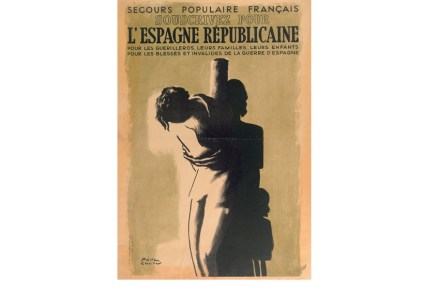
The Spanish Holocaust is a book that will give readers nightmares: it gave me two in a single night. Even people who think they have read enough about the Spanish Civil War to feel inured to its horrors will still be appalled by the intensity of the cruelty and repression here revealed. ‘Of the folly and wickedness of the military rising’, wrote Gerald Brenan in The Spanish Labyrinth, ‘there can today be no two opinions.’ Nor today, more than 60 years after he wrote those words, can there be two opinions about the sadistic and merciless repression planned and perpetrated by General Franco and his conspirators.  Reading Paul Preston’s narrative is like watching a Spanish Schindler’s List without a Spanish Schindler.

Patriot or traitor?

From our UK edition

The mighty convulsion that was the French Revolution has stirred the blood of historians from Thomas Carlyle to Simon Schama and consideration of it still inflames opinions. At its centre stood Maximilien Robespierre — 5’ 3”, stern, unaffacted in manner or dress, Spartan in his domestic habits — deified by his followers as the ‘Incorruptible’ and vilified by his opponents as a traitor to the ideals of 1789, bent on dictatorship. Peter McPhee spares us speculation (Robespierre left no memoirs or diaries) on his subject’s ‘inner life’.

Charming, cold-eyed cosmopolitan

From our UK edition

At last a diary as penetrating on Berlin as the Goncourt brothers’ on Paris has been translated into English. The author, Count Harry Kessler, resembled a character from Sybille Bedford’s masterpiece, A Legacy. Born in Paris in 1868, he was educated in England, France and Germany. His father was a Hamburg banker; his mother was an Irish-Scottish beauty called Alice Blosse Lynch, admired by the Emperor Wilhelm I. At once German and European, Kessler rotated, as freely as some do today, between London, Paris and Berlin. After a year in the army, and a voyage round the world, Kessler devoted himself to the arts. Exhibitions and parties, and  long descriptions of landscape, fill his diary. He did not find social life hollow.

His dark materials

From our UK edition

Like the dyslexic Faustus who sold his soul to Santa, the life of John Dee was a black comedy of errors. His vain and vulgar efforts to harness the occult for material ends often rendered him ridiculous. But there is a darker tale in Dee’s work for the Tudor state: a story of dodgy dossiers, fear-mongering and greed. During the Tudor period no clear distinction was made between science and magic. John Dee’s study at Cambridge of arithmetic, geometry and astronomy enabled him to become a navigational consultant, who worked with England’s greatest explorers. But it also helped him measure the rays of celestial virtue that emanated from the stars and influenced human affairs. Mathematics helped him predict the future — and that was a much sought-after skill.

Anglo-Saxon divide

From our UK edition

Philip Oltermann has set himself an almost impossibly ambitious task. In 1996, when he was 15 years old, he moved from Hamburg to London, so he has close experience of both England and Germany. In due course it occurred to him, as a man of wide cultural sympathies, that he ought to be in a position to write an interesting book about Anglo-German relations. But how to structure such a work? Oltermann is too polite to say so, but a great part of the problem is that modern English readers are abysmally ignorant of Germany. This used not to be the case: before 1914, to be educated was to be able to read German.