Gordon brown

Murdoch prepares to fillet Brown

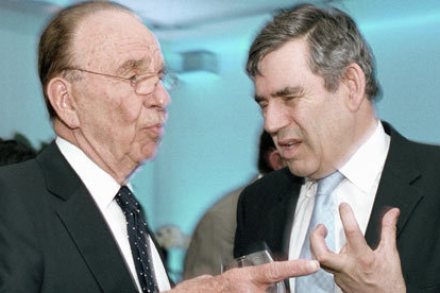
“He got it entirely wrong.” That is Rupert Murdoch's response to Gordon Brown’s singular account of his relationship with the Murdoch press. "The Browns were always friends of ours,” Murdoch added in an interview with the Wall Street Journal, in which he promised to set the record straight on the “lies uttered in parliament” when he appears before a select committee next Tuesday. It is going to be a moment of the most gripping political theatre. Murdoch also uses the interview to defend News Corp’s handling of the phone hacking crisis. He concedes that ‘minor mistakes’ have been made, but, fundamentally, all is well with the Kingdom.

Brown’s version of events

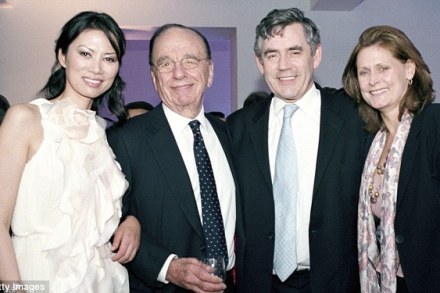
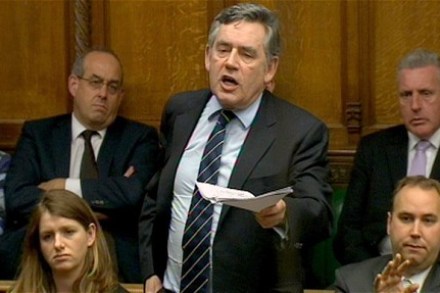
Gordon Brown’s speech in the House of Commons just now was remarkable. It was completely deluded, one of the most one-sided versions of history you’re ever likely to hear. Abetted by the Speaker, Brown spoke for what must have been at least half an hour trying to justify his record in office and depict himself as someone who was prepared to take on the Murdoch empire, which he certainly was not while News International was supporting Labour. Rather than acknowledging—as Ed Miliband and Peter Mandelson have—, that Labour got far too close to News International and was too scared of it, he presented an entirely self-serving version of history. To the fury of the Tory benches, he ignored that he and Sarah Brown assiduously courted Rebekah Brooks.

A day like no other

Was there ever a PMQs like this? The mood was like a revolutionary court. On the central issue – the judge-led inquiry into the hacking affair – there was general agreement. But the doors of justice have been flung open at last and hosts of other crimes are rushing in to receive an airing. Ed Miliband arrived convinced that he had a killer question for Cameron. Assuming his favourite expression of indignant piety he asked about a specific warning given to Cameron’s chief of staff last February that Andy Coulson, when News of the World editor, had hired an ex-convict to bribe the cops. The effect was feeble rather than fatal. ‘It wasn’t some secret stash of information,’ said Cameron.

The war between Brown and Murdoch heats up

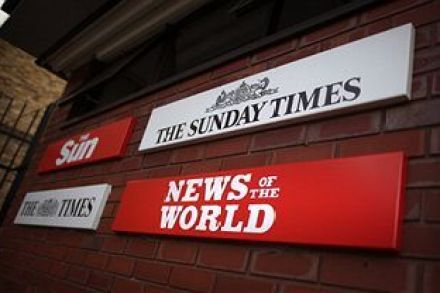
Gordon may have come carrying dynamite, but News International has some explosives of its own. In a pair of statements this afternoon, the Sun and the Sunday Times have set about undermining, or just plain denying, our former Prime Minister's testimony. By the Sun's account, not only did they get the story about his son's medical condition from a "member of the public [who] came to The Sun with this information voluntarily because he wanted to highlight the cause of those afflicted by [cystic fibrosis]," but Brown's colleagues also "provided quotes" to be used in the final article. By the Sunday Times's, their investigation into Brown's property transactions was pursued "in the public interest," and "followed the PCC Code on using subterfuge.

Brown speaks out

We'll try to post the video of Gordon Brown's interview with the Beeb soon. But, for now, here's the transcript of his remarks about News International and his son's medical records: Gordon Brown: [The Sun] told me they had this story about Fraser's medical condition, and that they  were going to run this story. Interviewer: How did that affect you, as a father? GB: In tears. Your son is now going to be broadcast across the media. Sarah and I are incredibly upset about it. We're thinking about his long-term future. We're thinking about our family. But there's nothing that you can do about it. You're in public life, and this story appears. You don't know how it's appeared. I've not questioned how it appeared.

Enter Gordon Brown, with dynamite

The clunking fist is descending on Rupert Murdoch. After rumours all afternoon about Gordon Brown giving a statement on phone hacking to the Commons, the Guardian has come up with specifics: News International, they allege, used private investigators to target our Prime Minister's phone, his bank account and his family's medical records. You should be able to watch it all go down in the Commons, very soon. As Guido has said, there is more than a hint of cold, cold revenge about this. For all his overtures to the Murdoch press, Brown never wound his way into their affections as Tony Blair did. The Sun's decision to shift over to the Tories, in 2010, sparked Brownite anger at the time. That anger still rankles.

Where we are on phone hacking

David Cameron’s speech on public service reform is being crowded out today by all the other news about hacking. First, there was there were the emails News International has allegedly passed to the police, which apparently contain information about payments to Royal protection officers. This was followed by an angry statement from Scotland Yard claiming that there is a ‘deliberate campaign to undermine the investigation into the alleged payments by corrupt journalists to corrupt police officers and divert attention from elsewhere.

Barroso’s EU confidence trick

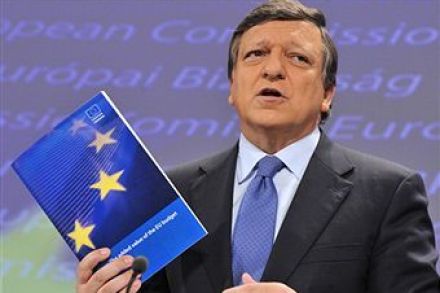
Say what you like about Jose Manuel Barroso, he's a wily old card. The European Commission president makes public demands for Britain to surrender its rebate in European Union membership fees. The government refuses. Then, hey presto! Headlines suggesting that Brussels has been seen off. "Brussels bribe to buy off UK rebate," says the Daily Mail. "Britain's rebate is fully justified and we are not going to give way on it," a Treasury spokesman tells the media. The quotation is true, Barroso did indeed offer £23 billion to tweak the UK funding formula, and a short-termist like Gordon Brown might have accepted. But the battle for Britain's EU spending was lost under Blair. In 2001-02, Britain was a net beneficiary of EU to the tune of £900 million.

Balls’ bloodlust gets the better of him

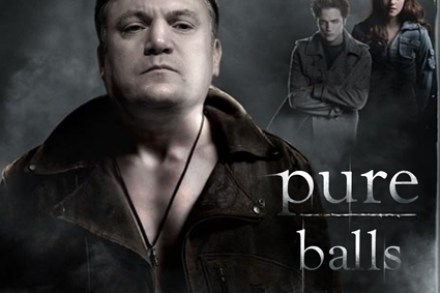
Ed Balls’ problem is his killer instinct. If he were a Twilight vampire, he’d be a Tracker: someone whose uncontrollable bloodlust takes him to places he should avoid. His position on the deficit is so extreme — more debt, more spending — that he’s pretty much isolated now. People are mocking him. John Lipsky, the acting IMF chief came two weeks ago and rubbished Balls’ alternative (as Tony Blair did) — so Balls, ever the fighter, has today given a long speech where he sinks his fangs into Lipsky and says (in effect) "I’ll take on the lot of you!" But Balls is brilliant. Often George Osborne seems not to bother arguing, and instead seeking approval from an alphabet soup of external agencies ("I must be right, the ABCD says so!

General outspokenness 

Recent wars have given rise to an unusual phenomenon in British civil-military relations: frequent, and often high-profile interventions, by serving or recently retired senior military officers in public debates. The latest has been the intervention of Britain's chief naval officer, Admiral Sir Mark Stanhope, who questioned the Navy’s ability to sustain the Libya campaign. Different prime ministers have dealt with this kind of outspokenness in different ways. Tony Blair was too weak to rein in Army chief Sir General Richard Dannatt, while Gordon Brown did not have the credibility, vis-à-vis the military, to do so either. David Cameron is different. He is at the height of his powers and determined that he, not the military leadership, should exercise command.

Labour’s blunt knives

According to the Observer, and a slew of other papers, "senior Labour figures are believed to have put their leader on a timer to 'up his game' in the next few months if he is to avoid a full-blown leadership crisis later this year." Which reminded me of all this: 20 April, 2008 "The Prime Minister, who is battling a growing rebellion over his abolition of the 10p tax rate, has been given until the end of the summer to turn things round by backbenchers angry at a string of image and policy failures." (here) 24 May, 2008 "It is that Mr Brown be given until the end of July to prove himself and restore morale.

Labour is working towards a decade of Opposition

Is Ed Miliband finished? That's the implication of many of the papers today — and David is portrayed as waiting in the wings, ready to claim his rightful inheritance. Dream on. Ed Miliband’s leadership of the Labour Party is hardly in crisis. If there was an election today, he’d win a Labour majority of 34. Dull men can win surprising victories, as John Major demonstrated in 1992. The Times’ notion that he has until party conference to save his leadership is just as fanciful. Labour Party Conferences are neverscenes of grassroots rebellion. The Tories are the ones who lay on fights, and some just turn up to Tory conference for the political violence. Tories can (and do) get rid of leaders to liven up a wet weekend.

Your three-point guide to today’s Ed Balls files

Less soap opera, and more policy grit, in today's batch of Ed Balls files. There is, for instance, a lot on Gordon Brown's proposed Bill of Rights (here, here, here and here), which is as ambrosia for future political historians, but is fairly turgid reading even for today's political anoraks. Likewise the charts and doodlings related to the structure of Brown's Downing Street. Yet some things do stand out. Here are a few of them: i) What the Treasury says, Brown didn't do. You've got to admire the Treasury's attempt to inject some realism into the fiscal calculus back in 2006. "Flat real" spending — i.e. public spending that rises only in line with inflation, and not more — will be the "rule rather the exception" in the years to come, they say.

From the archives: New Labour’s civil war

The Telegraph's publication of all those documents today has got everyone talking about that feud again. Here is what The Spectator's former editor Matthew d'Ancona had to say about the Blair-Brown wars when things were hotting up in the autumn of 2006: The great New Labour civil war, Matthew d'Ancona, 6 September 2006 Two days before David Cameron was elected Conservative leader, I asked one of his closest allies what the founding principle of Cameronism would be. He pondered the question. Would it, I wondered, be something to do with quality of life, the public services, the environment, social justice, nationhood? ‘Our starting point,’ he finally replied, ‘is that the Tory party can never beat Tony Blair.

Balls in the limelight

The most important political consequence of the leak of the Project Volvo documents is that it reminds everyone in the Labour party of what a divisive figure Ed Balls is. Ever since the leadership contest, where his reputation as a plotter crippled his candidacy, Balls has been trying to soften his image. He has sought to present himself as a more collegiate figure. But this leak is a reminder of how Balls used to operate and why some people in the Labour party will do everything they can to prevent him from becoming leader. We now wait to see what emerges about how these documents made their way into the public domain and whether retaliation follows. For the other Ed the challenge is to find a way to move Labour beyond the factionalism of the past.

Your five-point guide to the Ed Balls files

Intrigue, hilarious intrigue this morning, as the Telegraph releases a bunch of documents that clarify just how far the Brownites went to oust Tony Blair. They are, it is said, from the personal files of Ed Balls, and they are copious in both quantity and variety. From straightforward poll results to 31-page reports on how Brown is a Volvo not a BMW, this is a real insight into the numerous pathologies of party and government. Here's my five-point overview: i) The leadership coup in waiting. It starts only two months after the 2005 general election, and Balls' own ascent to Parliament, with a memo setting out the structure of Brown's leadership campaign team. And it soon crescendos.

Where we are in Afghanistan

I wrote back in November that as we approached the July deadline when President Obama promised to start drawing down troops from Afghanistan, the tensions between politicians and military would re-emerge, as “the military ask for more time to get it right, and Obama tries to hold them to the deal he thought he made in late 2009”. This is now coming to pass, in London as well as Washington. I also argued that having some sort of public timetable for the troop drawdown was a reasonable solution, perhaps the only solution, to the politicians’ problem of balancing conflicting messages to different audiences in Afghanistan and at home.

Meeting Christine Lagarde

The FT has been speaking to Christine Lagarde, the French finance minister tipped to become managing director of the IMF. A few salient points emerge from it. First, she has more than a dash of hard-nosed Gallic defiance. Responding to the charge of a lack of a qualification in economics, she reiterated the comments she made to the Today programme earlier in the years: “From what I know of the job, I think I can do it. One of the qualities that people recognise in me is my ability to reach out, to try to build a consensus, to bring people to the common interest while still being a very firm and no nonsense person.” Her empathy is well documented, as is her sympathy for all things American.