Gordon brown

Your three-point guide to today’s RBS report

After months of delay, and much hounding by The Spectator's Select Committee Chairman of the Year, Andrew Tyrie, the Financial Services Authority has finally released its report into the wheezing collapse of RBS in 2008. At 452 pages it is a behemoth of a document, and too much for me to have fully digested yet. But a few points stand out at first glance: 1) Don't blame us, blame Gordon. The Tories are making much of the fact that only three politicians are mentioned in the report: Tony Blair, Gordon Brown and, most relevantly, Ed Balls. And they're not mentioned in a particularly flattering context, either. All three are quoted to partially justify the FSA's regulatory approach in the run-up to the RBS debacle.

Woolf tucks into perfidious Albion

Yesterday night's news that a senior FCO official lobbied Oxford University on behalf of Saif al-Islam Gaddafi adds more ordure to the already fetid story of Britain’s role in Colonel Gaddafi’s rehabilitation. The Woolf Inquiry into Saif’s dealings with British universities and businesses found that, 'It was made clear [to Oxford] … that the FCO would appreciate help in this case since Libya was opening up to the West again.'  Oxford resisted; but this episode has hardly covered Britain’s elites in glory: the civil service, BAE and august universities are all criticised in Woolf's report.

Why infrastructure isn’t a magic tonic for the economy

Growth plans are a high growth industry — with every day bringing yet another set of ideas, from one quarter or another, for how the government can fix the economy. And one suggestion pops up quite frequently in all these plans: bring forward spending on infrastructure. This is often presented as a simple thing to do, with few (if any) downsides. But how realistic is this? We know that infrastructure is important for growth. Economic texts generally suggest that the ‘multiplier effect’ (when government spending leads to more private spending later on) from is higher for infrastructure spending than for spending in other areas, such as health and welfare. We also know that the UK’s infrastructure needs to improve.

How to untie the tax knot

Yet another HMRC scandal this week, as a new HMRC computer discovered millions who have paid too much or too little in tax. A letter from the tax man will land on their doorstep in the next few months. Some will enjoy the dubious pleasure of getting money back that should never have been taken in the first place. Others face the painful task of finding the money to catch-up on tax they didn’t pay before.   As Pete said in his post on Wednesday, this isn't the first time. When the House of Commons Public Accounts Committee looked at similar problems last year, they said that the Department had 'failed' in its duty to process people’s taxes 'accurately and on time'.

The centre ground’s there for the taking

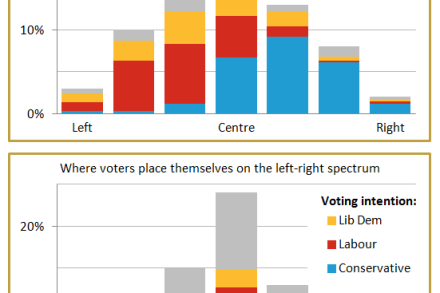
YouGov recently repeated its occassional exercise of asking people where they'd place themselves, the parties and the leaders on the left-right spectrum. Anthony Wells reported some of the findings on Saturday: Cameron is seen as slightly less right-wing than his party, while both the Tories and Labour appear to have moved away from the centre-ground since the election. One thing these YouGov numbers allow us to do is see where on the spectrum the parties get their support from. First, how people voted in 2010 and then how they say they'd vote now: This looks broadly as you'd expect, with Labour dominating among left-wing voters and the Tories doing likewise on the right.

The poverty of the poverty measure

‘400,000 children will fall into relative poverty by 2015, says IFS’ we read on The Guardian’s front page today — yes, one of the most pernicious ideas of recent years is back. It’s the definition of ‘poverty’ as being figures on a spreadsheet, households deemed to fall beneath an arbitrary threshold. It’s almost entirely meaningless, and diverts energy and resources away from a real fight against poverty. I really do believe that, as ideas go, this one has damaged Britain more than almost any other over the last two decades — and it’s high time it was confronted.

Osborne’s next trick: sub-prime companies?

About 15 years ago, Bill Clinton wanted to promote home ownership among the low-paid, but was annoyed that banks wouldn’t lend freely or cheaply to that group. So, the federal government intervened with Freddie Mac and Fannie Mae selling government-backed mortgages at knockdown rates. Nothing showed up on the national debt, because the loan would — in theory — be repaid. The seeds for the sub-prime crisis were sewn.   Today, George Osborne wants to promote recovery and is annoyed than banks won’t lend freely or cheaply enough to small businesses. So, the Treasury will intervene by lending money indirectly by backing a new bond market that lends cash to small companies.

Tories pray for no more from Europe

Tory strategists had hoped to keep Europe off the agenda at this year's party conference, but they seem to have failed already. The European Commission's threat about welfare claims has forced IDS into action. Ben Brogan reports that the work and pensions secretary was nothing short of visceral in his contempt for the "land grab", which will apparently cost £2.5 billion a year. But, IDS's rage is quiet compared to John Redwood's, who asks "Why won't he [William Hague] get on with renegotiating the UK position [in Europe]?" Next is the EU's Agency Workers Directive, which comes into force tomorrow.

Why all the apologies, Ed?

The Labour Conference 2011 has turned into a horrible misery-fest. What a daft idea to make the theme of the conference: “We’re really sorry, we won’t do it again”. At least it’s not the slogan, although it would have been more honest than “Fulfilling the Promise of Britain”. I agree with Steve Richards in the Independent that the pessimism is self-fulfilling. This does not feel like a platform for re-election I spent most of the New Labour era criticising Tony Blair and his government. I thought he was too cosy with the ultra-rich, cynical about criminal justice policy, disingenuous about the use of the private sector in providing public services and over-cautious about redistribution.

Is Osborne ready for the next crisis?

There is a strange pre-Lehman feeling in the air right now: the idea that something awful is going to happen, but no one knows what or when. This is laden with political ramifications. The problem for the Tories last time was not that George Osborne had been caught aboard HMS Deripaska. The greater problem was that a crash had arrived and the Shadow Chancellor had nothing to say. Brown, at least, seemed to have an agenda, and the Tory poll lead was reduced to one vulnerable point. I admire Osborne, but he can do far better in making the case for the government’s economic strategy. If there is a second crash, he’ll need all his skills to convey confidence – to sound as if he knows what he’s talking about.

Battling it out over Brown’s legacy

Gordon Brown is back in the news this morning, or rather his legacy of debt is (an issue examined in depth by Pete and Fraser in 2008). The disastrous £12.7 billion NHS computer project is to be scrapped and, more important than that, the Telegraph reports that the care budgets at 60 hospitals are being squeezed by the costs of repaying PFI contracts totalling more than £5.4 billion. Andrew Lansley has taken to the airwaves to explain that Labour left the NHS with an “enormous legacy of debt”; he was keen to point out that no hospitals were built under PFI before 1997, so that there was no doubt where blame should be apportioned.

50p tax isn’t just hurting the economy, but Treasury revenues too

So where were these 20 economists when Gordon Brown first set the 50p trap for George Osborne? Then, Brown's gamble was that the Shadow Chancellor was a political strategist with little interest or expertise in economics, so he'd be unlikely to work out just how much the 50p tax would lose the Exchequer, or guess it could be more than £3 billion a year – with further, less calculable damage on Britain's reputation as a home for entrepreneurs. This was when we needed those economists. At the time, all Osborne had to go on was the IFS which calculated it would cost £800m - assuming the rich were no more mobile now than they were in the 1980s. A ludicrous assumption, of course. What proportion of Britain's super rich are immigrants?

Darling lifts lid on Brown’s chaotic government

Tieless, Alistair Darling appeared on Marr this morning to discuss his memoir. As with so many of these New Labour autobiographies, there was the strong whiff of a therapy session. At one point, Darling said "if Gordon is listening to this" before remarking that he still felt a huge amount of "residual loyalty" to him. It is not news that the Brown government was dysfunctional. But it was striking that Darling did not dissent when Marr suggested that under Brown, Labour had – collectively – not been fit to govern.

The quiet man barks

Almost exactly a year ago, Tony Blair's memoirs wafted into bookshops to cause a stir ahead of conference season. Now it it seems that Alistair Darling's, due out next Wednesday, will do exactly the same. Judging by the extracts published over at Labour Uncut, the quiet man of the last Labour government will splash his simmering frustrations and enmities right across the page. Gordon Brown, he will say, became increasingly "brutal and volcanic". Mervyn King was "amazingly stubborn and exasperating". And Ed Balls and Shriti Vadhera will be accused of "running what amounted to a shadow treasury operation within government".

Osborne’s crusade

‘Tax evasion is morally repugnant. It's stealing from law-abiding people who face higher taxes to make good the lost revenue. Those who evade taxes, like benefit cheats, are leeches on society. And my message to those who try to hide their incomes from the Revenue in offshore bank accounts and false declarations is simple: we will find you and your money.’ That was written by George Osborne in today’s Observer. He promises that the deal with Switzerland is “just the start” of his campaign to close tax havens. The rest of the article then relates the coalition’s achievements at reducing tax avoidance by increasing charges on capital gains and non-domiciled taxpayers working in Britain.

Treasury agrees Swiss bank tax

First came the Germans and then came the Brits. The UK Treasury has secured an agreement with authorities in Zurich to tax the assets of UK citizens held in Swiss banks to reduce on tax avoidance and stamp out evasion. The deal will follow the lines of that which Switzerland made with Germany last month. The FT has details: 'Taxes on future income will be withheld at a rate of 48 per cent, corresponding to the top 50 per cent rate that now applies to Britain’s highest earners. A one-off levy of between 19 and 34 per cent will be applied to all Swiss accounts held by UK residents, with the exact percentage to be determined by the size of the deposit and how long it has been maintained.

From the archives – the great debt deceit

The news that the national debt is even larger than it appears ties a knot in the stomach, limiting, as it does, the state’s ability to cut taxes. Andrew Tyrie has called time on the PFI bonanza, but in many ways this intervention comes too late. Back during the financial tempests in the autumn of 2008, my colleagues Peter Hoskin and Fraser Nelson revealed the scale of Gordon Brown’s deceit over PFI. The great debt deceit, Fraser Nelson and Peter Hoskin, The Spectator, 20 September 2008 A few months before the general election which brought New Labour to power, Geoffrey Robinson had David Davis to dinner in his flat overlooking Hyde Park.

The politics of our discontent

Even by the normal standards of Monday mornings, this one reeks. Just sniff around you. That burning smell, it's either coming from the global stock markets as they strain against the US downgrade, or from those places in London where the rioting spread last night. Although the destruction in Brixton, Enfield, Walthamstow and Waltham Forest didn't match up to that on Saturday in Tottenham, it still involved fires, missiles and clashes between rioters and the police. Reading the reports and watching the footage online, looting appears to have been one of the most popular sports of the evening. In terms of the short-term politics — as opposed to the slightly more medium-term politics of what can be done to properly fix these problems — two issues stand out.

Brown still hovers over the 50p tax debate

A number of papers report today that George Osborne is minded to replace the 50p tax with Gordon Brown's original proposal: a 45p tax. How the ex-PM will be laughing. As he knows, even the 45p tax will lose money — that's why Labour didn't raise the top rate until the final four weeks of its 13 years. But the Tories haven't worked that out yet, and the Treasury is still working on the false assumptions he programmed into it. In short, the amount of money that either tax rate will raise depends on what's called the "taxable income elasticity," or TIE — a figure suggesting how responsive various taxpayers are to rate changes. It varies for income groups. The lower-paid are less able to move their labour or money around than the rich.

From the archives: When Gordon loved Rupert

Gordon Brown graced the political stage with a rare cameo this week – if half an hour of deluded invective masquerading as reasoned piety qualifies as a cameo. Brown would have you believe that he had nothing to do with Rupert Murdoch. This following piece by Peter Oborne says otherwise.   The murderous intent of Gordon Brown, Peter Oborne, 20 April 2002 This Friday a triumphant Gordon Brown flies to New York for a business conference. The Chancellor and his colleagues perhaps see the trip as a well-earned break.   In No.10 Downing Street there is a temptation to take a more jaundiced view, and interpret it as a quick exit.