Gordon brown

A world of her own

This book, written by someone whose husband was for three years prime minister of Britain, is impossible to review. Yes, it is dull, but it is so triumphantly, so ineffably, dull it enters a breezy little monochrome world of its own. There is no characterisation, for no value judgments are passed, except those on Mrs Brown’s husband, who is portrayed as such a force for good he is virtually an extra-terrestrial being intervening in the affairs of men. As for the rest they are ‘charming’ or ‘lovely’. This is Mrs Brown showing HRH Prince Andrew, as she calls him, round Chequers: Without thinking, I open the drawer that holds the wax death mask of Oliver Cromwell.

How much are we still paying for Brown?

The story today of a pregnant woman being downgraded so Gordon Brown and his six aides could travel business class from Abu Dhabi to London may ring a bell with CoffeeHousers. We revealed last August that Brown has a taste for freebies, and that he was offering himself for $100,000 at speaking and award-giving engagements. For an extra $20,000 he would throw in his wife, Sarah. The Mail on Sunday reports that one of the pregnant woman's co-passengers was "livid, asking why it was necessary for all of [Brown's team] to be travelling business — and if it was being paid for by the taxpayer." He raises an interesting point. Tony Blair notoriously claimed a "pension" of £64k, and an £84k contribution for the costs of running his office.

Balls and Miliband fail the credibility test

Eds Miliband and Balls gathered the press corps together this morning to broadcast a straightforward message: oh yes, we do have an alternative. And the shape of that alternative? A repeat of the one-off tax on bankers' bonuses that, Balls claimed, raised £3.5 billion last year. The money would be used for an entire buffet of economic delights, from the creation of new houses to the funding of job schemes for the young. The upshot, apparently, would be 110,000 new jobs. Nice work, as they say — if you can get it. But there are a couple of problems with all that, the first of which Labour has pre-empted. It is that last year's bonus tax may not have raised as much as £3.5 billion, after all.

The need to address National Pay Bargaining

National Pay Bargaining is one of the major impediments to rebalancing the national economy and improving the quality of public services. But as Julian Astle, the head of the Liberal think tank Centre Forum, notes the coalition is doing little about it. It knows that the public sector unions will go to the wall for national pay bargaining and so are holding off. Gordon Brown flirted with doing something about national pay bargaining, announcing a review of it in the 2003 Budget. But he then backed away from the issue. One area where the coalition is chipping away at national pay bargaining is schools. Academies and free schools have the right to set their own pay and conditions. But, interestingly, academies tend not to use these freedoms.

Will Cameron have a Brown moment over petrol?

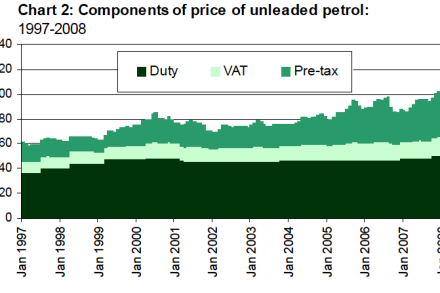
Remember when Gordon Brown came up against Fern Britton in a TV interview? I've pasted the video above to remind CoffeeHousers of two persistent truths: how tricky a subject petrol costs can be for a serving Prime Minister (watch on from around the 0:50 mark), and how Labour are hardly blameless when it comes to the current cost of fuel. As Britton asks in the interview, "How much tax do you put on the fuel?" And the answer that Brown mumbled to avoid, from a House of Commons briefing note at the time, was this: In other words, for a huge portion of the New Labour years, fuel duty accounted for over half of the petrol price at the pumps. For a typical litre of fuel, duty was 36.86 pence when Labour came to power, and 57.19 pence when they left.

Going for growth

The government says it has a growth strategy. Speaking to the Confederation of British Industry's annual conference last October, the prime minister said his government would adopt a "forensic, relentless focus on growth" in the coming years. The strategy has three elements: creating a framework for enterprise and business investment; directing resources into areas where Britain has a competitive advantage – such as wind technology; and making it easier for new companies and innovations to flourish. But for all this and the denunciation of Gordon Brown's legacy, the coalition still seems to be reading from a core part of Labour's pre-crisis script: businesses are spoken of primarily as agents for social work.

The 50p tax in action

Today, we have seen the 50p tax in action: reflected in January’s bumper tax receipts. A jubilant John Rentoul has just tweeted: “Where is Fraser Nelson when you need him? The 50p income tax rate has brought in a ton of money. He said it would probably reduce revenue.” He is absolutely right – but not for the reasons he thinks. Were John self-employed, he’d know that the tax paid last month was in respect of the 2009-10 tax year – when the top rate of tax was 40p. Of course, many of the super-rich are on PAYE – but that has happened since last April. It doesn't explain a January uplift. Today’s surprise tax haul can be partly explained by the fact that folk sucked forward their income, to avoid the 50p rate.

Coffee House Exclusive: McBride joins CAFOD

                  The penance of Damian McBride continues. After being ejected from No10, and disowned by his mentor Ed Balls, I can reveal that our antihero now has a new job – head of media at the Catholic overseas aid charity CAFOD. He will be doubtless be brilliantly effective at briefing against its enemies (in CAFOD's case, hunger and the devil). I imagine the pay is several leagues below what he'd get from cashing in on his notoriety and publishing a hit man's confessions. The weird thing is that McBride could have done so well, had he steered clear of Balls. He was a Treasury civil servant, specialising in VAT, before Balls trained him up in the art of character assassination.

Soon we will all be paying £1,000 a household for gold plated public sector pensions

Public sector pensions are grossly unfair. At a time when private sector pensions have collapsed, not least because of Gordon Brown’s infamous pensions raid on private pensions, public sector pensions have continued to be unreformed. The coalition was quick to recognise that this must change. And by appointing former Labour Cabinet Minister John Hutton to come up with suggestions for reform, there is a chance of some cross-party agreement in this difficult and sensitive area. In his recent Centre for Policy Studies report, leading pensions expert Michael Johnson gets a grip on the problem. And, to continue a favourite Coffee House theme, how is it best measured?

Osborne bests the Man With A Past

Balls is a bit like a vampire – he has bite, but he works best in the darkness. In the House of Commons, with those lights shining on him, his powers drain. George Osborne had the better of him in their brief exchanges at Treasury Questions. Balls led on the snow joke. But Osborne had pre-empted that earlier, when he first stood up. Balls teased him about going to Klosters in the winter, but these things only work in newspapers where you can run a picture of Osborne in ski gear. It leaves the House cold.   The key Osborne line was that Balls is “the man with a past” – and how. It was said with just the right touch of menace. And he had a fairly decent gag: that Eds Miliband and Balls both “know what's it's like to be people's second choice.

Doubts remain over al-Megrahi

The morning after the day before, it seems that some of the murk around Abdelbaset al-Megrahi's release has lifted. In particular, one thing is explicit that wasn't before: that the policy of the Brown government was to "do all it could" to facilitate the convicted Lockerbie bomber's transfer to Libya. We might have surmised the same from David Miliband's statements at the time. But now, at least, we know for sure. Naturally, this is tricky news for Labour, and especially for the Ghosts of 2008 whose names are splashed across the papers today: Brown himself, Jack Straw, Des Browne, etc. And yet Gus O'Donnell's report has also absolved them of the worst sin of all: lobbying the Scottish government to release al-Megrahi.

How much do we spend on the military?

As shocks go, Politician Uses the Correct Statistic is not particularly electric stuff. But I was struck nonetheless by Cameron's claim in his speech earlier that, "we still have the fourth largest military budget in the world." You see, Gordon Brown used to exaggerate this figure by various sneaky methods – and so, by his account, we'd be second in the military spending league table, rather than around fifth. Whereas Cameron had it spot on. Here's what the latest top ten looks like, going off the best measurement that the Stockholm International Peace Research Institute knows (see their explanation here): On the face of it, this would appear to be a strong point against the claim that we underspend on defence. But it doesn't close the case.

When will mass protest come to Libya?

As several seemingly permanent Middle Eastern autocracies tremble, Colonel Gadaffi’s Libya rolls on. So far, there have been reports of minor protests in the localities about housing shortages, nothing more. With unemployment standing at 30 percent, the Libyan people are just as impoverished as those in neighbouring Tunisia and Egypt. Gadaffi’s dictatorship is scarcely benevolent, and, as for liberalisation, Libya remains one of the few completely dry countries on Earth. The secret of Gadaffi’s success then would appear to be expressing aggressive anti-American sentiment, whilst suppressing Islamism and democratic opposition at home. And all the while he entices rich Western powers (Britain) with the allure of Libya’s virginal natural resources.

The coalition feels the squeeze

The Institute for Fiscal Studies are out prowling the airwaves again, and they bring happy and unhappy tidings for the coalition. On the happier side, at least presentationally speaking, is their assessment that, "those being hit the very hardest [by tax and benefit changes] are those on [a] higher level of earnings" – just as Cameron and Clegg suggest. But far less marketable is the IFS's claim that 750,000 people will be pulled into the 40 per cent rate of tax as a result of the threshold being reduced from £37,400 to £35,001 this April.   To be fair to the government, they have at least been upfront about this tax change.

Cameron’s gloomy brand of optimism

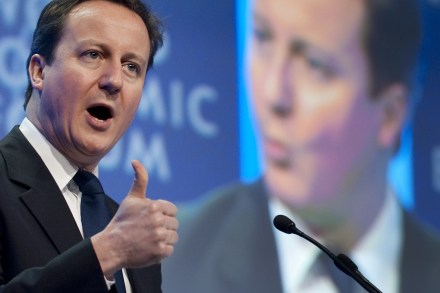
A weird, sprawling kind of speech from David Cameron in Davos this morning. It started off on an unusually, if expectedly, gloomy note: all talk of Europe's debt-induced decline in the face of competition from India, China and Brazil. And he emphasised, of course, that Britain would, and should, stick to its current trajectory of "tough" deficit reduction. But it's where it went from there that was more striking still. Cameron contrasted his position with that of "the pessimists". These people, he claimed, have a charter which includes propositions such as, "we in Europe are incapable of solving our debt and deficit problems," and, "we're attached to liberal values that are leaving us far behind the juggernaut of authoritarian capitalism".

Brown takes the opportunity to peddle his “global growth plan”

As Iain Martin and Guido have noted, Ed Balls – and, for that matter, Ed Miliband – could probably have done without Gordon Brown hovering from the political graveyard to cast judgement on today's growth figures. But hover he has, as the above video of his appearance on CNBC News testifies. It's almost as though he wants to remind people that his spirit lives on in Labour's rearranged top team. As for the content of his interview, it was stodgy mix of the arguments in his recent book and the attacks that Balls was making earlier. "Europe and America, but particularly Europe," he said, "are now implementing policies that are more reminiscent of the 1930s, than reminiscent of the lessons we should have learnt from previous decades.

Exposing the con man

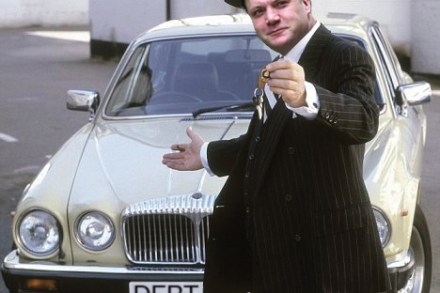
  To the chagrin of CoffeeHousers, I have long rated Ed Balls and his abilities. He has a degree of brilliance, albeit tragically deployed in the services of a destructive economic agenda. But as we welcome him back, it’s worth reminding ourselves that his abilities are of a specific type. He understands economics (even though he did PPE) but his speciality is in creative accounting. His only tactic is to spend, borrow and cover both up by cooking the books. He is a trickster, not an economist. More Arthur Daley than Arthur Laffer. In my News of the World column today (£) I say he is dangerous to Labour as well as the Tories, perhaps more so. But it’s worth recapping what we’re dealing with.

How things are different now that Balls is shadow chancellor

The timing could hardly have been more resonant. On the day that Tony Blair is paraded, once again, in front of the Iraq Inquiry, Team Brown is firmly back in charge of the Labour party. For, I'm sure you've noticed CoffeeHousers, three of the four great shadow offices of state are occupied by former members of the Brown coterie: Ed Miliband, Ed Balls and Yvette Cooper. The fourth belongs to someone who doesn't sit easily in either half of the TB-GB divide: Douglas Alexander. The question, of course, is what this means for Labour's economic policy. And the answer according to Miliband is "nothing much". The Labour leader has been keen to stress that his party's fiscal plans remain largely unchanged by Balls' ascension.

Labour may be doing alright, but Miliband is still dodgy on the public finances

Ed Miliband's leadership may be young, but his trickery on the public finances is already well worn. We got it all in his interview with Andrew Marr earlier – and then some. There was the claim that Labour "paid down the debt" (that I dealt with here). There was the claim that Labour's spending was responsible (my response here). And there was a straight-up lie about Miliband's forecast for a double-dip. So far, so Brown. What caught my ear, though, was this exchange: Andrew Marr: I mean Tony Blair said in his memoir that by 2005, he was worried that the party was spending too much. And Alistair Darling said actually it was about 2007, he was worried that the party had been spending too much - before the crash happened.

Miliband in denial

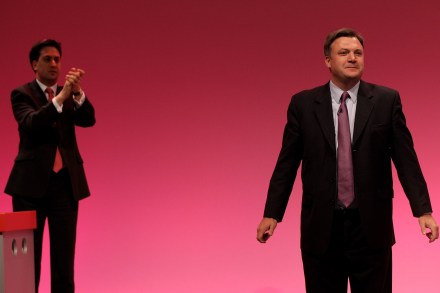
Did he get cold feet? Or was his new spin-team overenthusiastic in their pre-briefing? We were told we'd get an apology from Ed Miliband in today's speech, but instead he entrenched himself in his position that Labour did nothing wrong on the deficit. I'm surprised at this decision. Surely Ed Miliband understands, as his Shadow Chancellor understands, the central importance to an opposition party of economic credibility. That credibility will not return while Miliband bases his economic argument on a denial of the facts. First, and critically, he argues that Britain's deficit was not a problem going into the crisis. Not only is this disputed by an impressive array of domestic and international experts, from Tony Blair to the European Commission and Mervyn King.