Gordon brown

The austerity hasn’t started yet

Another month, and another all-time record for state spending in Britain. The government splurged £1.8 billion a day in April — of which £332 million a day was borrowed. Up goes the national debt. All of which leaves us with the question: where is this austerity that George Osborne keeps talking about? He's been in No.11 a year now, and each month state spending has been — on average — 4.9 per cent higher than the same month under Gordon Brown. He seems to be taking the St Augustine approach to fiscal conservatism: Lord, give me spending restraint. But not yet. The below graph shows state spending, per month. The amount in red is how much the government had to bum from the City: This does not look so much different to Labour's plans.

Stop Gordon Brown

Gordon Brown's friends have launched a shameless effort to compel the government into nominating him for the IMF post. The government would be mad if they did. Mad. This is not about petty score-settling, as yesterday's Evening Standard would have it. This is about qualifications to lead, and the former Prime Minister, despite his intellect, does not have those skills. He led the country to ruin and remains in denial about it: he saved the world, don't cha know. The UK should be smarter about using talent from across the House, but there are limits. And it is a bit rich for the ex-PM's friends to argue that David Cameron should back him. This is the man who gave lukewarm support to Paddy Ashdown's candidacy to run the UN in Kabul back in 2008.

Brown hasn’t contacted Cameron or Osborne about IMF job

‘Brown makes pitch for IMF job with plea to rich nations to meet education pledges’ reads the headline on page 3 of The Guardian today. This is all part of a growing body of evidence that Gordon Brown really does think he is in with a chance of succeeding Dominique Strauss-Kahn. Certainly, the usual suspects are out and about talking up his chances. Realistically, Brown is not going to get the job. But if Brown really does want to have a go, it is bizarre that he’s not tried to contact either David Cameron or George Osborne to reassure them about how he’d behave if he got the job; Danny Finkelstein gave a typically well informed take (£) about Cameron and Osborne’s worries about how Brown would use this bully-pulpit on Wednesday.

Debt as a security concern

Is Britain's growing national debt a matter of national security? In a speech this morning, Liam Fox said so. Sure, he said, you can protest at the defence cuts — but strength comes from having a strong economy and strong national accounts. "Those who are arguing for a fundamental reassessment of the Defence Review are really arguing for increased defence  pending. But they fail to spell out the  inevitable result — more borrowing, more tax rises, or more cuts elsewhere. The bottom line is that a strong economy is a national security requirement and an affordable Defence programme is the only responsible way to support our Armed Forces in the long term.

DSK resigns from IMF

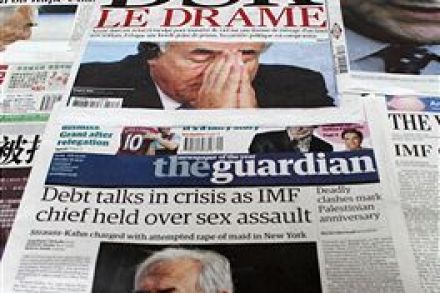
The IMF has issued three press releases on Dominique Strauss-Kahn since his arrest last week, but none more resonant than the latest. It contains this statement from their now former-Managing Director: Ladies and Gentlemen of the Board, It is with infinite sadness that I feel compelled today to present to the Executive Board my resignation from my post of Managing Director of the IMF. I think at this time first of my wife—whom I love more than anything—of my children, of my family, of my friends. I think also of my colleagues at the Fund; together we have accomplished such great things over the last three years and more.

Could a Briton run the IMF?

With Dominique Strauss-Kahn, known as DSK, undertaking scientific and forensic tests to determine if he sexually assaulted a hotel maid, the International Monetary Fund will be run by its No. 2 official, John Lipsky. A former banker, Lipsky was appointed “first” deputy managing director in 2006, and was expected to step down later in the year. But the change at the top will bring the former Permanent Secretary of the Department for International Development, Minouche Shafik, into the limelight.

The man who hopes to win English votes for Labour

Maurice Glasman and Ed Miliband do not think as one. But Miliband's Favourite Thinker™ is an undoubted influence on the Labour party — and, as such, it's worth tuning into his ideas from time to time, if you have a tolerance for such things. Glasman's "Blue Labour" philosophy has already enjoyed heavy exposure this year, and he has an interview in today's Times (£) to explain it even further. If you're not minded to buy, borrow or steal a copy of the Thunderer, then here are a few observations. First, it's striking just how much Glasman dwells on the personal. "If you want to know everything that was wrong about Scottish Labour and Labour," he urges, "then just look at the career of Gordon Brown.

Why David Blanchflower has it wrong

Gordon Brown may have gone, but advocates of his calamitous policies remain. David Blanchflower, the chief exponent of borrowing more, has a piece in The Guardian today which is worth examining. Written with his trademark chutzpah, it’s a very clear exposition of the Labour argument — along with its flaws. Here are some extracts, and my comments: "In his budget speech last month, Chancellor George Osborne suggested that he was hoping for 'an economy where the growth happens across the country and across all sectors. That is our ambition". Sadly, to judge by Wednesday's GDP figures, growth under this coalition remains just an ambition, a mere illusion." And why would that be? The GDP figures showed growth of 0.

The Royal Wedding by numbers

I know, I know, it's deeply unromantic to anticipate tomorrow's Royal Wedding through the prism of opinion polling. But as no one ever said that a political blog has to be romantic — and as there are some quite noteworthy findings among all the data — we thought we'd put together a quick round-up for CoffeeHousers. So here goes: 1) The guest list. There has, I'm sure you've noticed, been quite some hubbub over the fact the Gordon Brown and Tony Blair haven't been invited to the wedding — especially in view of the Syrian ambassador's invitation, since withdrawn. But some new polling from YouGov — highlighted by PoliticsHome — suggests that the public agree with the twin snub for our former PMs.

Cameron’s new cuts narrative

Aside from the "Calm down, dear" drama, there was something else worth noting from today's PMQs: David Cameron trying for a calmer debate on the deficit. He admitted that his government is not really being that much more aggressive than Gordon Brown would have been. They're cutting £8 for every £7 that Brown and Darling proposed for 2011-12, he said. It's a line that Nick Clegg road-tested in his speech to the IPPR last week, and it represents a new and welcome strategy. To date, the rhetorical differences have been stark. The Tories have said: we’re the big bold cutters, Labour are deficit deniers. Labour has replied: your cuts are too deep and too harsh, and the GDP figures prove it.

Labour spot the dangers and opportunities of the AV referendum

By some dark magic, the Ghosts of New Labour have been roused from their political slumber. Over the extended weekend, we had news of Gordon Brown's new job and Alistair Darling's new book. Today, it is Peter Mandelson and Alan Johnson who are haunting the newspapers. Both give interviews  – one to the Independent, one to the Guardian – with the same purpose: to rally the vote in favour of AV. Mandelson's is even front page news. "This is our chance to hurt Cameron," reads the headline, underneath a portrait of the man whom Labour learned to un-love after last year's election. Both interviews suggest that Labour are catching up with some of the risks attached to next week's referendum.

Brown reinforces his presence on the world stage

I'm sorry to do this to you, CoffeeHousers, at the start of a bank holiday weekend — but I thought you might have a morbid sort of interest in Gordon Brown's latest role. Turns out that, as expected, our former PM is to join the World Economic Forum in an advisory capacity. He won't be paid for his work, although the Forum will cover his staffing costs. One of his spokespeople has told ITV's Alex Forrest that his task is to "stop the next financial crisis." Which is to say, he'll be saving the world. Again. If nothing else, it's yet another demonstration of Brown's peculiar resilience. Our former PM may be electoral anathema in these parts, but he clearly still holds some allure for the technocrats of Davos, Geneva and Bretton Woods.

Cameron quells the storm

David Cameron turned in an emollient performance on the Today Programme this morning. He declined to stoke the coalition row over immigration, heaped praise on Vince Cable and stressed that the Liberal Democrats have been good coalition partners. Even when pressed on the question of whether Britain would block Gordon Brown from becoming director of the International Monetary Fund, Cameron spoke softly. The only line of questioning in the interview that discomforted the Prime Minister was when Evan Davis pressed him on why a localist government was placing restrictions on what local government could charge residents for recycling or rubbish collection.

Cameron: Gordon Brown could have remained as PM under AV

Here is David Cameron at this morning's event, arguing that FPTP produces decisive results, even in the event of a hung parliament. He argues that Gordon Brown's denuded Labour Party could have remained in office after the last election had AV had been used. Perhaps, but I'd point out that Brown could easily have remained as PM had Clegg and Cameron not reached an agreement last May.

How the banks were framed

A week that started with the Vickers review on banking has closed without another national explosion of banker-bashing. Thank God. Beating up on the banks has lasted almost three years now, and it’s blinding us to the real causes of the financial crisis. The banks are the perfect alibi: blaming them gets everyone off the hook. How, asks Gordon Brown, was a mere Prime Minister to know that banks were doing such fiendishly complicated things? How, asks George Osborne, was an opposition expected to detect what the government could not? How, asks Mervyn King, was the Bank of England governor supposed to know that these bankers had been so wicked? For all of them, the bankers have been the perfect scapegoat.

Brown to the IMF? Not with CoffeeHousers’ blessings…

What to do when you've already saved the world? Save it all over again, judging by Gordon Brown's latest reported manoeuvrings. Today's Mail claims that our former PM is "clear favourite" to be succeed Dominique Strauss-Kahn as head of the International Monetary Fund. Although, as the paper says, it's likely that the Coalition would operate against any such appointment. To remind the suits what they might be imposing on themselves, I thought I'd return to this post that we put up on Monday. It asked CoffeeHousers what Brown's biggest mistake in government was. And we received more than enough responses to vote on a Top Ten, as below. We'll keep the vote open until 1700 tomorrow, at which point we'll announce the results. In the meantime, just get clicking and commenting.

Why we should be concerned about debt interest

There's an interesting post by Éoin Clarke on debt interest doing the rounds. It originally appeared on his blog, but was soon commandeered by LabourList — and little wonder why. Dr Clarke's point is a perceptive and striking one. Debt interest, he says, is lower now than it was under John Major. The implication is that when George Osborne rattles on about the money blown on just "servicing our debt," we should take it with an almighty heap of salt. It's not, perhaps, as bad as all that. Or, rather, that's one way of looking at it. There are other ways, which I would list thus:   1) Going beyond 2011.

Nick Clegg meets Gillian Duffy

There's a new equation in British politics, and it's one that Nick Clegg came up against this morning: Politician + Rochdale = Gillian Duffy. The Deputy Prime Minister was quizzed by Gordon Brown's unassuming nemesis during his visit to the town earlier — and the results are in the video above. For what it's worth, he did fairly well, emphasising the pressing need to tackle Labour's poisonous fiscal legacy.

What was Brown’s biggest mistake?

“I have to accept my responsibility.” Who would have thought that Gordon Brown would ever breathe those words, let alone breathe them to a conference in America over the weekend? Our former PM has, it's true, suggested that his regulatory system was inadequate to the financial crash before now. But here he was much more explicit: “We set up the Financial Services Authority believing the problem would come from the failure of an individual institution. That was the big mistake. We didn’t understand just how entangled things were.” And that's event before he got onto the "responsibility" bit. I'll repeat it, just in case it didn't sink in the first time: “I have to accept my responsibility.