George osborne

The real 50p split

Nick Clegg’s interview on Andrew Marr this morning subtly shifted the Lib Dem position on the 50p tax rate. When Marr asked him what he would do if the George Osborne commissioned HMRC study showed that it raised no money, Clegg replied ‘then I of course think we should look at other ways in which the wealthiest pay the amount that we’d expected through the 50p rate.’ So, in other words, he’ll accept its abolition if something else is put in its place. But, crucially, Clegg wants any replacement to raise not what the 50p rate actually raises but what it was supposed to raise. This presages the next debate in government over 50p.


Clegg biography claims the Lib Dems want a new coalition agreement

Lib Dem conference this year brings with it the serialisation of Jasper Gerard’s biography of Nick Clegg. The focus will be on the claims that deputy Prime Minister has promised his wife he’ll only serve one term and that senior Lib Dems are interested in a soft electoral pact with the Tories. But, to my mind, the most interesting point is that the Lib Dems are keen on a new coalition agreement to cover the second half of the parliament. Coalition insiders have always admitted that the legislation mentioned in the agreement should have been mostly passed by 2012. But the Tories have been keen to spend the second half of the parliament concentrating on delivering on what’s already on the statue book rather than dealing with a whole new set of bills.

Osborne: I know what it’s like to be in business

George Osborne spoke to Telegraph’s Festival of Business this morning and he gave a speech that was dominated by the issue of growth, or rather its absence. He reiterated the tax cuts and entrepreneurial relief measures first unveiled in March’s Budget. Osborne didn’t limit himself to his list of accomplishments. It was an empathetic speech. He related his memories of the “ups and downs” of his father’s business, the drapers Osborne&Little. He acknowledged the pressures of running your own enterprise in conjunction with a busy family life; a constant struggle that is exacerbated during hard times. “I know the kinds of pressure you are under,” he said.

Britain sues the ECB

As the EU debt drama continues unspooling like a perversely watchable soap opera (the FT’s Neil Hume describes it as ‘eurozone crisis porn'), an intriguing sub-plot has emerged: Britain is suing the European Central Bank. The Treasury is unhappy with an ECB move to limit the kind of euro-denominated products that can pass through UK clearing houses, suspecting it’s a bid to shift financial activity from London to Paris/Berlin. So it’s taking legal action, the first of its kind by an EU member state. This is not the first UK-EU disagreement that has surfaced in recent months, underlining the tensions between Britain and the Continent as financial centres across Europe fight over a (shrinking) business pie.

A brutal no score draw at PMQs

Cameron and Miliband went six rounds on the economy at PMQs. Miliband tried to portray Cameron as just another Tory who thinks that "unemployment is a price worth paying". Cameron, for his part, wanted to paint the Labour leader as someone whose policies would send Britain tumbling into a sovereign debt crisis. At the end, it felt like a bit of a no-score draw. Interestingly, Cameron stressed that "every week and every month, we’ll be adding to that growth programme". We’ll have to see whether he’s talking about more small-bore measures, or something bigger on infrastructure investment. Labour had a new tactic today, trying to fact-check all of Cameron’s answers from last week.

A report to worry the two Eds?

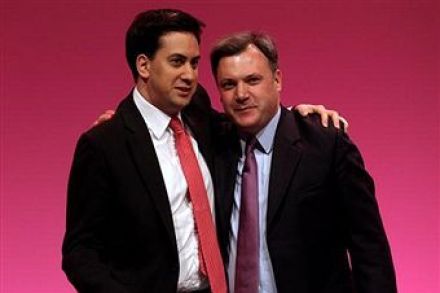
The Institute for Fiscal Studies enjoys quasi-divine status in Westminster: chancellors and their shadows bother it for its blessing, and Budget Day is never complete until its judgment has been passed. Both parties have bent a suppliant knee before the institute in the past, but the IFS became particularly important to Labour after it declared last autumn that George Osborne’s policies to be ‘regressive'. This is why the IFS report on the tax system, released today, is important. The review, conducted by Sir James Mirrlees, is a damning indictment on tax system that has fallen from 5th to 95th in the World Economic Forum’s tax competitiveness rankings.

Inflation target missed again

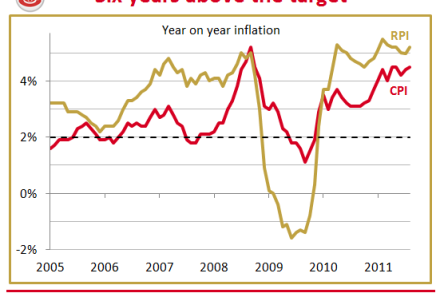
Today's inflation figures remind us of the trouble the Bank of England will have if – as most analysts suspect – it embarks on another phase of Quantitative Easing. CPI inflation was 4.5 per cent in the year to August, and RPI at 5.2 per cent, both up a touch from July.  CPI inflation has now overshot the Bank of England's 2 per cent target for 60 of the past 75 months. It has been at more than 3 per cent since the start of 2010. As a result of last month's figure, Governor Mervyn King wrote his now-standard letter to George Osborne to "explain" why inflation is above the target.

Osborne lays out his support for Vickers

George Osborne made a firm statement on the Vickers report this afternoon; if he felt uneasy about the proposed abolition of his seat or Natalie Rowe’s latest sally against him it didn’t show. As expected, he accepted Vickers’ proposals "in principle", giving himself and his coalition partners enough room to manoeuvre within an agreed timetable that is equitable to both parties. Osborne also said that the annual £7 billion burden of Vickers’ capital requirements “should fall on shareholders and the wholesale debt holders, not small depositors or taxpayers.” Politically, it’s imperative that he achieves that objective. There is yet uncertainty on the subject and Barclays sought a clarification earlier this afternoon.

Vice girl Rowe takes another hit at Osborne

“I said to George [Osborne] jokingly that when you're prime minister one day I'll have all the dirty goods on you, and he laughed and took a big fat line of cocaine,” says Natalie Rowe, a former madam of the Black Beauties escort agency, in an interview with ABC’s PM programme. She adds, "It's been said in the newspapers that he was at university. He wasn't. At the time he was working for [former Tory leader now foreign secretary] William Hague...I remember that vividly because he called William Hague insipid." This is not the first time that Rowe has made these allegations against Osborne, as the above picture attests. The chancellor has always vehemently denied her claims and at no point have they been substantiated.

Vickers provides the best of both worlds for George and Vince

It’s the moment of the truth for Britain’s banking sector: the publication of the Vickers report. The headline is as expected: the Commission recommends the imposition of a ringfence on banks' ‘core operations’ (such as consumer deposits and small business lending) from the riskier elements of their business. According to the FT (£), the banks will have discretion over where the ringfence will fall, giving lenders and users a degree of flexibility, which suggests that Vickers is not recommending the full separation of retail and investment banking, as some had hoped.

A reminder of two of the political battles ahead for the coalition

If anyone had any doubts about how difficult the politics of banking reform and planning would be for the Conservatives, they’ll be dispelled by a glance at a couple of tomorrow’s front pages.  ‘Osborne to let banks off the hook—for now’ screams The Independent. This a reference to the Chancellor’s plans to consult with the banks on the conclusions of the Vickers report—which the government has seen but is officially published tomorrow morning. The political problem for Osborne is that anything other than the immediate implementation of Vickers’ recommendations will be seen as a favour to the banks. But pushing the reforms through now could undermine an already weak economy.

Time for the QE gamble, again

It's time to warm up the printing presses. When growth evaporates and governments feel politically unable to cut spending or raise taxes, there's only one tool left: printing more money. We can expect more of it soon. As James says today, Osborne believes he has created the conditions where the Bank of England can do some more Quantitative Easing and it could start as early as next month; an unusual move, given how high inflation is. But the Bank is (as ever) forecasting a return to the 2 per cent target soon – and may now claim that economic weakness makes an undershoot likely. And so (the logic will run) it’s time for more QE so as to keep inflation to target. The other arguments for QE are harder to make.

Huhne ramps up the rhetoric on 50p

Chris Huhne’s comments to Prospect magazine about the 50p tax rate are typically provocative. The millionaire, former City boy accuses the Tories of wanting to abolish the 50p tax rate to help ‘their friends in the City to put their feet up’. He even suggests that the Lib Dems would not vote through any Budget that contained its abolition. Huhne’s intervention comes at a time when George Osborne is trying to build support for abolishing—or, at least cutting—the 50p rate. Tellingly, the letter from economists opposing the 50p rate was drawn up with the help of one of the Chancellor’s closest lieutenants.

Obama’s plan B: tax cuts

Washington, DC The clue is in the name. A stimulus is supposed to stimulate, and Obama's first attempt stimulated nothing more than the American national debt. So he's trying again, with a $447 billion package (he's careful not to call it a "stimulus") in what will probably be his last roll of the pre-election dice. But $245 billion of it would be debt-financed tax cuts.  Not sales tax cuts, the type of which Ed Balls is prescribing for Britain. It's all payroll tax cuts: reducing the tax on jobs in the hope of encouraging more hiring. Given the temporary nature of the tax cuts, I doubt this will be the pre-election silver bullet.

50p tax isn’t just hurting the economy, but Treasury revenues too

So where were these 20 economists when Gordon Brown first set the 50p trap for George Osborne? Then, Brown's gamble was that the Shadow Chancellor was a political strategist with little interest or expertise in economics, so he'd be unlikely to work out just how much the 50p tax would lose the Exchequer, or guess it could be more than £3 billion a year – with further, less calculable damage on Britain's reputation as a home for entrepreneurs. This was when we needed those economists. At the time, all Osborne had to go on was the IFS which calculated it would cost £800m - assuming the rich were no more mobile now than they were in the 1980s. A ludicrous assumption, of course. What proportion of Britain's super rich are immigrants?

A growing argument about the 50p rate

With the Eurozone and American economies both at risk of a double dip recession, how to get the British economy moving again is going to be one of the defining political arguments of the autumn. A first salvo in that fight has been fired this morning with a letter to the FT from 20 economists calling for the immediate scrapping of the 50p rate because of the harm that it is doing to the economy as a whole. This letter will, one suspects, be privately welcomed by the Chancellor who is looking for ways to, at the very least, cut the rate. He has become increasingly convinced that it is making it harder to get a proper recovery going. But, politically, offering a tax cut to the rich is a hard sell at the moment.

Osborne and Pickles defiant on planning reform

George Osborne and Eric Pickles’ joint op-ed in the Financial Times on planning reform is meant to send the message that the coalition won’t back down on the issue. They warn that "No one should underestimate our determination to win this battle". Allies of Pickles are pointing out that these planning proposals are different from the NHS reforms or forestry, both issues on which the government did u-turn, because they are crucial to the coalition’s growth strategy and fully supported by Numbers 10 and 11 Downing Street. One other thing that separates planning from the issues on which the government has u-turned is the confidence Numbers 10 and 11 have in the ministers charged with selling the plans.

Cameron’s energy price headache

The list of things that will be Big Politics when Parliament returns from its summer break is growing all the time: growth, the post-riot clean-up, the undeserving rich, multiple squeezes, and so on. But few will have has much everyday resonance as another item on the list: rising energy prices. This has been a problem for some time, of course, thanks to a toxic combination of trickle-down green measures, oil price spikes, and financial effrontery from the energy companies. But it looks only to get worse. This morning's Telegraph reports on an internal Downing Street document — entitled "Impact of our energy and climate policies on consumer energy bills" — which suggests that the coalition's policies will add £300 a year to Joe Public's bills by 2020.

More banking worries

George Osborne wrote a strident article for the Observer last weekend, in which he called rich tax evaders “leeches”. As James Forsyth reveals in the cover story of this week’s magazine, Osborne is not alone among Tories in hounding the ‘undeserving rich’ at present. James goes on to argue that the Tories are ‘becoming particularly worried’ about the callous rich because the Vickers commission is poised to bring the emotive issue of banks back to the ‘political frontline’. The Vickers report has already irritated the coalition’s sore points, with disagreement allegedly rife between George Osborne and Vince Cable. Today’s FT offers a fresh angle.

Cameron and Osborne wary of Vickers’ banking reforms

Banking reform has always been one of those issues that was going to test the unity of the coalition. Indeed, it was the subject of the very first inter-coalition wrangle when back in May 2010 George Osborne and Vince Cable tussled over who would chair the Cabinet committee on banking reform.   To date, these differences have been held in check by the fact that the coalition is waiting for the recommendations of the John Vickers-led Independent Commission on Banking. But with the final draft of the Vickers Report being published on 12 September, these splits are starting to open up again.   Cable and the Liberal Democrats would like, at the very least, a strict ringfencing within banks of the investment and retails arms.