Food

Like dining with Elrond in Rivendell: Corenucopia reviewed

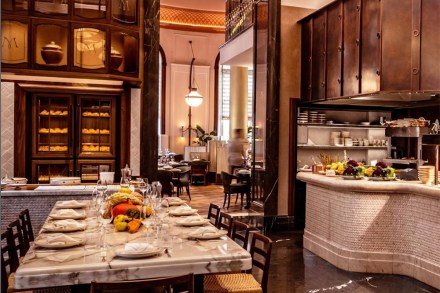
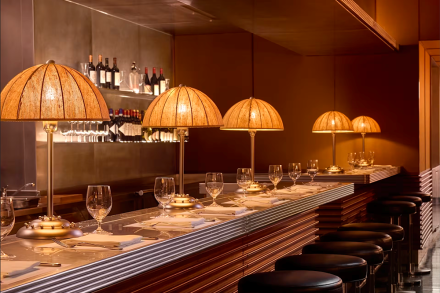
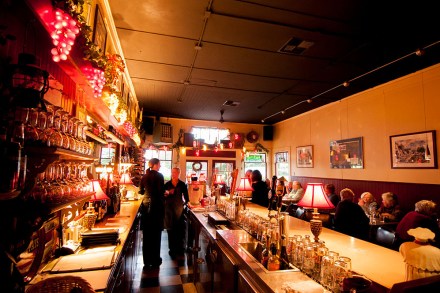
Corenucopia by Clare Smyth is in Belgravia, amid a line of interior-design shops, and it is prettier than all of them. It is a female paradise on the ground floor of a mansion block, dedicated to art nouveau and ‘comfort’ food. There are plaster tree branches peeking from the walls and the menu script looks elvish. It is rare that whimsy does not make me kick things, and few things are more whimsical than plaster forests, but Smyth, also of the three-Michelin-starred Core, is one of the great cooks working now. From her, whimsy is merely voice; or, rather, I forgive her. We eat malted sourdough with Ampersand butter and wild venison salami. Both are glorious There is a sanity to this restaurant, even if it is gilded for native Belgravia blondes.

A Brit’s guide to Mexican food

I’m in Mexico City and spoilt for choice as to where to go for a lunchtime taco. Taquerias are everywhere, each entrance best described as a hole in the wall: you step in from the street into a dark, cavernous stone vault and go past the bar, stocked with dozens of bottles of spirits and a fridge full of beer. I honestly feel like I’ve never had Mexican food before, except once in San Francisco. On that occasion, I went to a canteen close to the border with a friend, where we were the only two non-Mexican people eating. The salsas were bright as traffic lights and there was charred corn doused with chilli and lime salt, fresh white cheese and lime butter. The tortillas were the soft corn ones, unlike any I’ve seen in UK outlets, with hard, U-shaped shells made of wheat.

Criminal gangs have developed a taste for snails and seafood

From our US edition

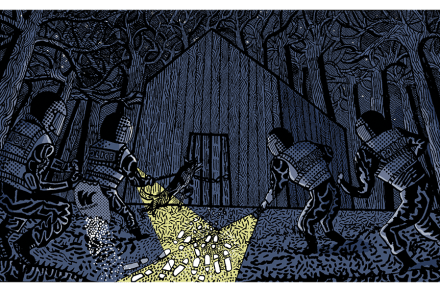
It was a dark night in November that the criminals stole softly upon the sleeping snails. They snipped away the fencing, pried open the door with a crowbar and knocked out the security lights. Then, they advanced upon their victims, who were lying, defenseless, in cold storage. No use for the snails to flee; heliciculturists breed them for flavor, not speed. The hapless gastropods could only pull in their horns, make themselves as small as possible inside their shells, and wait. The crooks worked with merciless efficiency. Some 450 kilos of snails soon found themselves shivering in the getaway vehicle as it sped off down a route départementale in northeastern France (where else?

snails

Dining out in Mysore

From our US edition

Long before “decolonization” was a glint in the eyes of left-leaning political scientists, Hyder Ali, an upstart mercenary soldier turned sultan of Mysore, and his nepo baby son, Tipu Sultan, fought four bloody wars to keep the British from controlling the south of India. If wars were like soccer league tables, the Hyder/Tipu team would have come out on top with an enviable record of three wins to one loss. That loss was the final match otherwise known as the Fourth Anglo Mysore War, in which Tipu was defeated by the inspired generalship of the future Duke of Wellington. Tipu died in battle and the general was soon comfortably billeted in his late adversary’s summer palace.

Loser’s: the campy and ironic bakery making made-to-order cakes

From our US edition

Going downtown in New York used to be cool. Before Soho became a glorified shopping mall, it was a haven for starving artists. Before Chelsea became family-friendly, Michael Alig was throwing Blood Feast parties at the Limelight. The rebel heart of downtown, which attracted generations of avant-garde creatives, is much harder to find today. All of Manhattan has seemingly “gone uptown.”  But Loser’s Eating House, a made-to-order bakery operating out of a tiny Soho ghost kitchen, is still serving up a little slice of downtown realness. Loser’s style is campy and ironic. The cakes rely on exaggeratedly large piping, done in a purposefully messy style Loser’s was launched in 2021 by baker Lizzy Koury, who was, until very recently, her company’s sole employee.

Beloved by Chinese tourists – and the Labour party: Phoenix Palace reviewed

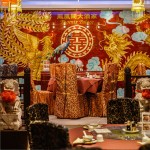
The exterior of the Phoenix Palace is cream with golden letters like the napkin and the Laffer curve, and it is squeezed below an Art Deco mansion block in Baker Street. The street is self-effacing, stuck between the Marylebone Road and the Sherlock Holmes museum, which exists because London is, among other things, morbid. The cuisine is Cantonese. Understatement is a feint here, though; the Phoenix Palace is famous, and always on the best dim sum lists. It is beloved by Chinese tourists and students, and, weirdly, the Labour party, whose grandees smile uneasily from photographs, like hostages to the economy, and rice. The food comes near instantly.

How dirty is your Michelin-starred restaurant?

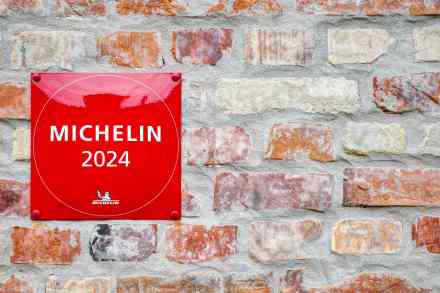
Michelin stars were pitted against hygiene scores when Gareth Ward, chef-patron of the two-Michelin starred restaurant Ynyshir, was recently given a hygiene rating of… one.  Ynyshir, which sits on the edge of Eryri national park near Machynlleth in Ceredigion, has held its second Michelin star since 2022, making it the first restaurant in Wales to receive two of the accolades. The restaurant offers a single 30-course tasting menu, to which changes cannot be made for allergies or preferences, at a cost of £468 per person. Its most recent food hygiene inspection found that its management of food safety required ‘major improvement’.

Hunting for the Pizza Hut of my youth

From our US edition

About 15 miles off the I-80, tucked away in the Cleveland suburb of Warren, you’ll find a delightful bit of yesteryear, preserved from the 1970s and serving up your childhood dreams. Here you’ll find a Pizza Hut that forgot to evolve into a quick counter-service and delivery outpost like almost all the others. I had heard rumors of Pizza Hut Classics for some time. For years I’ve wanted to find one. As a person who would live solely on pizza if it weren’t for the heart disease and kidney stones that would inevitably follow, I knew I had to find one. Lo and behold, one such restaurant happened to be in my path on a road trip to Detroit over the holidays.

The vast landscape of American barbecue

From our US edition

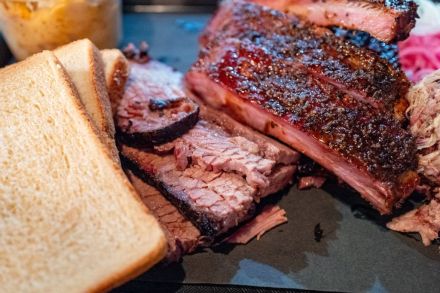
Some 25 years ago, I walked into the University of South Carolina library to check out a book on the history of barbecue. I had just finished a PhD in American literature, but had become more interested in culinary history. I had also taken to driving the state’s backroads, seeking out old-school barbecue restaurants. Researching the history of barbecue seemed the perfect next move. To my surprise, no one had published a book on the subject. The most that had been written about pre-20th century barbecue were a few sparse paragraphs in larger works on food history. I ended up having to write one myself. It took a while. The first edition of Barbecue: The History of an American Institution was published in 2010.

The mindfulness behind the cooking of Buddhist nun Jeong Kwan

From our US edition

I am somewhat allergic to food nomenclature: zero-waste, plant-based, seasonal, small plates, “live cultures,” foraged, farm-to-fork. It’s not that these are inherently off-putting concepts, but I associate them with “foodie” fads, gimmicks and big egos. All of those trendy labels could apply to the food cooked by the “philosopher chef,” a Buddhist nun called Venerable Jeong Kwan, plus you could throw in a dash of mindfulness and eastern spirituality for good measure. Yet Kwan, who is venerated by Le Bernardin’s Eric Ripert and Noma’s René Redzepi, and has featured in an episode of Chef’s Table, is the furthest thing from an ego-chef.

Why EU farmers would object to a South American trade deal

It was a weekend of mixed emotions for the European Union. There was the news from Donald Trump that he will impose a 10 percent tariff on eight European countries in retaliation for their opposition to his plans to take control of Greenland. But on a brighter note, the EU finally signed the Mercosur trade agreement with several South American countries. The European Commission hailed it as the creation of ‘a free-trade zone of roughly 700 million people’, one which they promise will save EU companies more than €4 billion a year in customs duties. Ursula von der Leyen, the Commission president, said: ‘We choose fair trade over tariffs, we chose a productive long-term partnership over isolation.

A restaurant so perfect I hesitated to review it

Sometimes you find it, H.G. Wells’s door in the wall, but to tapas: a restaurant so perfect you hesitate to review it. Each critic kills the thing she loves, because to love it is to change it. But I can’t just review palaces for psychotics containing lamps that should not exist, comforting though the idiocies of the very rich are. So here is a review of 28 Church Row, Hampstead. I will try not to make it read like a Hampstead novel about the unreliability of memory, but I might forget to do this. Church Row is the prettiest street in Hampstead: a ragtag of Georgian houses beloved by television stars who wake up one day, understand they are vulgar and buy a house that isn’t. I can’t afford one, but I saved a man from death in Church Row once, which is unusual for this column.

The EU vs the farmers

It was a weekend of mixed emotions for the European Union. There was the news from Donald Trump that he will impose a 10 per cent tariff on eight European countries in retaliation for their opposition to his plans to take control of Greenland. But on a brighter note, the EU finally signed the Mercosur trade agreement with several South American countries. The European Commission hailed it as the creation of ‘a free-trade zone of roughly 700 million people’, one which they promise will save EU companies more than €4 billion a year in customs duties. Ursula von der Leyen, the Commission president, said: ‘We choose fair trade over tariffs, we chose a productive long-term partnership over isolation.

Let’s bring back elevenses

Join me, if you will, for a short stroll down the Charing Cross Road, back in the days when it was festooned with bookshops and Morris Oxfords. At Cambridge Circus, there was a large catering equipment shop owned by my great-uncle, Bill Farnsworth. He made it big when he sold water coolers to the American military. Above the enormous ground-floor showroom was his counting house, where men in tailored suits laboured over ledgers on high sloping desks, dipping their nibs into ink pots. This would have been about 1960. Were you to have a meeting with Bill in his office, say in the late morning, he would invariably turn to his walnut drinks cabinet and offer you a glass of something reviving and strong; a sherry, port or brandy, perhaps. Armagnac? It’s very good.

France’s bistros are dying

Emmanuel Macron says France’s traditional bistros should be granted Unesco world heritage status. Speaking at the Élysée this week, the French president vowed to help save the country's traditional cafes. "This is a fight that we want to take on, because our cafés and bistros aren’t just selling croissants, baguettes and traditional products – they’re also on the front lines of preserving French craftsmanship and know-how," Macron told a group of French bakers at the annual Epiphany cake ceremony. France doesn't need to list its bistros. It needs to decide whether it still wants them Macron is right about what the bistro represents. For generations, it has been a shared meeting place as much as a commercial one; somewhere to linger and belong.

How to eat in Cuba

From our US edition

My apartment in Havana is on a rooftop overlooking the sea, which sounds grand and penthousey, but it’s not – it’s the former caretaker’s hut. It also sits above my parents-in-law’s place, which offers challenges, but does mean that most days I wander down for lunch. When I first moved in, I didn’t speak Spanish and so would enjoy these meals in ignorant bliss, smiling winningly as I guzzled down pork, rice and beans. I tried not to ask my now-wife to translate because I didn’t want to interrupt what I imagined were hugely erudite discussions; she’s a literary professor and her parents are both philosophers. Slowly, though, I began to understand, Spanish revealing itself like a song on the wind.

Scott’s vs Mayfair

Kingsley Amis was obsessed with Scott’s on Mount Street, Mayfair, and he knew a lot about food. He ate himself to death. In his unwise James Bond continuation novel Colonel Sun – Ian Fleming also loved Scott’s – Amis had Bond ponder that ‘every meal taken in those severe but comfortable panelled rooms [is] a tiny victory over the new hateful London of steel and glass matchbox architecture’. Bond then presumably dropped his knickers, because there is as much projection in Amis and Fleming as there is in this column. Even so, I know how they feel about Scott’s. Mayfair is now the UAE with democracy and rain. It is gold and pink for toddler princes, and Scott’s, which is the colour of a Barbour, remains a tiny victory in brown. Of course Amis loved it.

Italian food is revolting

About a week into an open-ended early pandemic stay in Ortigia, the antique, tourist-beloved spit off Siracusa on Sicily’s eastern coast, I had an epiphany. I hated the food. I’d just had a few bites of a clammy aubergine parmigiana, and a plate of oily tuna steak dressed with a bit of lemon was on its way to me. I felt sick and couldn't face another bite – and yet, supposedly, I was right in the heartlands of the finest continental gastronomy. This, at least, is the orthodoxy of the world, of tourists low- and high-end and home cooks everywhere – and especially in Italy itself.

I’ve been duped by the Toby hoaxers

Going to see QPR on Boxing Day has become a tradition in the Young household – and not because we hold out much hope of winning. The Hoops have only won 19 of the 71 Boxing Day fixtures we’ve played since 1882, when the club was founded. The last time was in 2018, when we beat Ipswich 3-0 at home, and we haven’t won away since 1967. But going to watch our team, however poorly we play, beats festering at home in that fallow period between Christmas Day and 1 January, so my three sons and I piled into the car for the 150-mile round-trip to Fratton Road in Portsmouth. We had an additional reason for making the journey, which was a special Christmas offer from Toby Carvery whereby anyone called Toby could eat for free.

I’m a Jew who loves Christmas

On more than one occasion, I have found myself being lectured by non-Jews (always men) about why I am incorrect in my Jewishness. Judaism is a religion and I can’t be Jewish if I am an atheist, some say. The ones that accept the atheism then feel compelled to categorise me as a ‘cultural’ Jew whose identity is defined by rituals and customs passed down over the centuries. And then there’s the stern mystification about the relatively minor role that Hanukkah plays in the spiritual calendar for Jews. It is hard for some to realise that while it involves lights and wintry nights, Hanukkah is not remotely the equivalent of Christmas. Nothing in Judaism is.