Family

The close friend I never really knew

I have just read an extraordinary new book. It’s by a close and old pal whom I’d count as one of my best friends. He was my lodger in London for ten years. His book is autobiographical. And I now realise I never knew him at all. In Don’t Ask Me About My Dad, Tom Mitchelson charts a life story that is entirely strange to me, and shocking. And yet the weird thing is that I know many of the people in it – or thought I did. His late father, Austin, who helped launch the Sunday Sport, I met and thought a likeable if flaky chap, and good company. He turns out to have been the most appalling wife-beater, liar, drunkard and debtor.

Picking daffodils with my ancestors

From our US edition

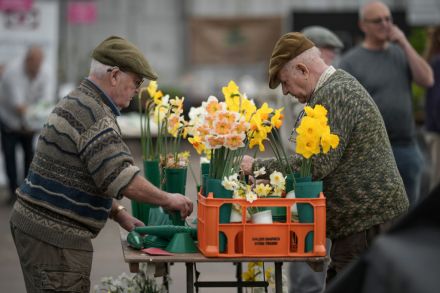
Pennsylvania winters can be unyielding. Though the extreme, single-digit temperatures and mounds of sometimes-onerous (but always beautiful) snow come and go, the bleak, overcast skies tend to overstay their welcome, hanging around like a monochromatic weight on one’s psyche. “Western Pennsylvania is known for two things,” UPMC psychiatrist Dr. Lawson Bernstein told CBS News, “producing linebackers and one of the highest prevalence of Seasonal Affective Disorder (SAD) in the entire country.” Sigh. While I grumbled this morning about having to continue bundling up well into spring (it was 36 degrees), a bunch of cheery golden blossoms near the edge of the woods reminded me this was no time to feel sorry my myself.

The tragedy of being a QPR fan

Normal families spend the Easter holidays by the seaside or in the Mediterranean. But not the Youngs. My three boys and I took advantage of the two-week break to criss-cross the country following Queens Park Rangers, going to Sheffield, Preston and Huddersfield. We lost 1-0 to Sheffield and 2-1 to Preston, but managed to draw 2-2 with Huddersfield, which made it a good day out by QPR’s recent standards. I’ve always enjoyed going to the occasional away game, but this season my sons and I have tried to go to as many as possible to compensate for the closure of football grounds during the pandemic.

Elegy in a country churchyard

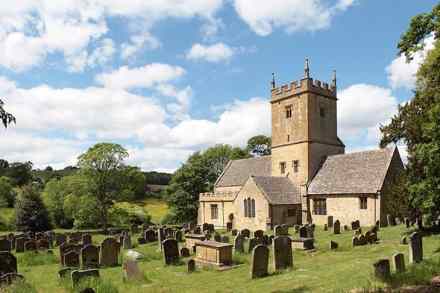
‘I love this old watering can,’ said my sister, sprinkling the miniature rose. ‘Though I do worry about soaking Mum. How far down is she? Do you remember?’ I said I thought about five foot. The country churchyard is sheltered by hedges and trees and the graves are decently spaced. On Mothering Sunday mown grass was scattered across the gravel path and graves and a chill sea mist billowed like smoke off the sea. Two months before Covid struck, I’d thrown my handful of soil in after her. This was my first visit since that day. The earth was still broken and heaped but now there was a grey headstone with her name and dates, her maiden name, and the phrase ‘Alive in Christ’.

When did brothers and sisters become ‘siblings’?

I never cared much for the word sibling, though I hardly knew why. The reason must be that it was introduced by a scientist, Karl Pearson, who in 1900 wrote of the ‘inconvenience of our language having preserved no word for either member of a pair of offspring of either or both sexes from the same parent’. So he reintroduced ‘a good Anglo-Saxon word’, and it stuck. It’s not quite that simple, for cultural anthropologists had, a decade earlier, adopted sib for a kindred group, apparently from the parallel German word Sippe. My aversion to sibling was merely its artificiality. We never used to use it in speech, but would say brother or sister.

Table talk

From our US edition

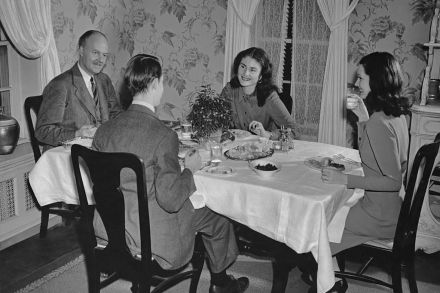
I grew up in rural Connecticut, in a remodeled cow barn where my family sat at an antique hutch table for meals. The table with four comfortable Windsor chairs fit into a niche. My sister Christina and I weren’t allowed to join my parents for dinner at the table until we could hold a conversation. For me, that was at five. The rule came from my father, as that was how he’d been brought up. Once, when we were in our early teens, I whispered to Christina, “It’s King Arthur’s round table” — our father’s middle name was Arthur. I must have learned some British history and was probably showing off. My firm but gracious father wasn’t a king.

table

Dear Mary: How do I stop my husband spying on me?

Q. My husband has developed an irksome habit whenever he goes abroad without me. We have cameras outside the house which are programmed to alert him by iPhone when anyone comes or goes. As soon as I go into the garden I receive WhatsApp messages commenting on my activities, such as ‘I’m not sure you watered the garden for long enough’ and ‘You forgot to bolt the shed door’. Mary, I find this ‘spying’ annoying – what should I do? — J.F., London SW12 A. An internet connection is required to allow security camera footage to be accessed remotely. Therefore, when you wish to enjoy some privacy in your own back garden, simply flick a switch to turn off the wifi.

The sad demise of Amish family-style restaurants

From our US edition

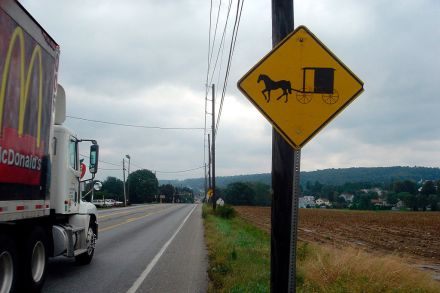
Every time I visit Pennsylvania Amish Country, it feels a little less like Amish Country. My parents were aghast when, in the mid-2000s, they visited for the first time since the 1980s (and for the first time with me) and found a massive outlet center along the main commercial drag. When my wife and I visited in 2017 — my first time since that childhood family trip — I was dismayed to see that the field in front of the Amish Farm and House had become a Target and its attendant parking lot. (I was only a little less dismayed when the landmark Congress Inn, with its out-of-place capitol-dome sign, met the wrecking ball.

Spare a thought for ‘Generation Sandwich’

Sunday was fairly typical. The police picked up Mum, 73, wandering in distress near Halifax bus station, cold, disorientated and lost. Son, 15, was walking with a friend in north London when two older boys stopped them and demanded to know if they were dealing drugs before scrolling through their phones to check. Daughter, 18 was determined to go see her boyfriend despite feeling ill and Dad, 77, sat in a pub on the Yorkshire Moors nursing a pint of ale and a failing heart. While all this was going on, I was mopping floors, cleaning dishes, hanging out washing, and trying to write a book. When Son, 15 arrived home panting because he’d run all the way home, my wife and I spent some time calming him down and reassuring him that such incidents are rare.

What really happened when my wife left me in charge

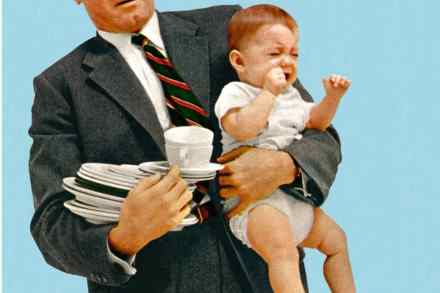
I’m currently standing at the top of Brownie Point Mountain, having spent the past two weeks looking after our three sons while Caroline has been sunning herself in Barbados. I’ve been cooking, cleaning, washing – you name it. As if that weren’t heroic enough, I spent the previous week with our 18-year-old daughter in Mexico City helping her find a flat and a job. In other words, I’ve had no help from Caroline for three straight weeks. I feel so virtuous, I’m almost tempted to throw myself off said mountain. A place in heaven would be guaranteed. I daresay some women reading this will be thinking: ‘Why should you get any points for doing what your wife has been doing for almost 20 years? Typical bloody man.

Fatherhood is a risk men aren’t willing to take

Recent reports that half of women in England and Wales are now childless by their 30th birthday reveal a worrying new attitude amongst Gen Z. Parenthood, to the younger generation, is the enemy of unfettered frivolity. Young women, we are told, would rather live for the moment than plan for the future. 'Being present' has become the mantra of the 'mindful' generation who see autonomy as the ultimate expression of a life well lived. But how complicit are men in this myopic 'me-only' utopia we have created for ourselves? Are women actively rejecting the sort of men who would like to settle down or have the sort of men who once yearned to settle themselves become cynical about taking the plunge?

Howard Jacobson superbly captures the terrible cost of becoming a writer

Howard Jacobson, who turns 80 this year, published his first novel aged 40. Since then he has produced roughly a book every two years, including The Finkler Question, which won the Man Booker in 2010. Given that he was put on Earth to write, why the wait? This is the subject of Mother’s Boy, a tale of self-persecution in the form of a monologue which includes interjections from the ghosts of his parents and one chapter, recording a period in his twenties that he drifted through in a dream state, printed in a font resembling handwriting. ‘How’s the novel coming along?’ his father would routinely ask after Jacobson graduated from Cambridge with a ‘poor degree’ in English. He was taught by F.R.

Black History Month and the usable past

From our US edition

This is Black History Month when we are invited to think through a certain spectrum of the people who came before us. As it happens, I am very much interested in black history. I wrote a book about it, 1620: A Critical Response to the 1619 Project, and several books about diversity, and I have been working for several years on a nearly completed documentary about the early days of black theater and film. But, lacking any black ancestors, I must make do with my own sketchy line of progenitors. When I was growing up in the Fifties and Sixties, my father attempted to find his great-grandfather — GGF in anthropological parlance. GGF had an air of mystery since all anyone knew about him was his last name and GGM’s inveterate reply when asked about him: “He was lost at sea.

black history month

Why a church in Jerusalem is the model for all family-owned holiday homes

Malindi, the Indian Ocean When I lived in Jerusalem a long time ago, I often visited the Church of the Holy Sepulchre, where the Catholics, the Greeks, the Syrians and Armenians had their separate territories within the sacred complex of Christ’s Calvary, tomb and Resurrection. (The Ethiopian priests were all unfairly banished to the roof.) Every year, one of the denominations would say: ‘The ceiling is blackened by candle smoke — we should clean it.’ And all the other denominations would say: ‘Noooo — this is a terrible idea. It should not be done.’ The next year, another of the denominations would also say: ‘The ceiling is blackened by smoke, let’s clean it.

The difficult decisions that come with downsizing

I’m perched on the bed reading an old Mothering Sunday card. It’s just one item in a box of miscellanea that I must sort and prune and I really can’t afford the time to linger. That box contains a fraction of what I have to deal with before I move house and I need to crack on. But I am sweating the small stuff. I’m sure I’m not alone in this. One of the legacies of lockdown has been a longing for more space. Across the UK, families with children are falling over themselves to find bigger places. It’s a downsizers’ market right now for those of us who feel ready to let go and to set about the sorting and binning of things. It’s good for us, they say. It’s liberating, they say. My home-moving history is not an unusual one.

The conflict at the heart of the migrant question

A friend, a Cambridge professor, passing my old college last week, was startled to encounter a young lady standing outside shouting something and carrying a placard exhorting Mathew [sic] Parris to [expletive deleted] off. He wondered if I knew what this was all about. I don’t, but suppose it relates to my Times column arguing (about asylum seekers) that we do not have an equal obligation to all, but rather concentric circles of obligation at the centre of which we stand, the first circle being to self and family, the next to close friends, neighbours and community, then to nation and, finally, to all mankind.

Why I’m paying my daughter to go to church

It would be weird if my 13-year-old daughter didn’t say she was an atheist. It’s what you say in our culture when you’re that age. To be honest it would creep me out a bit if she was all pious. But she is getting confirmed into the Anglican faith. This is a piece of hoop-jumping that her parents have decided to require of their children. I went for coffee with the vicar to ask if my daughter could join the classes. I admitted that she was a bit reluctant. In fact, it was a mixed picture. Whenever I mentioned confirmation she professed her atheism, but when I didn’t mention it for a couple of weeks she asked when the classes were starting. She is not entirely averse to attention, even if it is directed at her eternal soul. Her church-going to date has been patchy.

My family and the scars of forced adoption

I was nearly 40 when I discovered that I had an older brother. My lifelong family position as the eldest of four evaporated in a flash one Sunday afternoon in 2008 when my mother called us all together at her house, saying she had something she needed to tell us. She opened a box file and with trembling fingers pulled out a black and white photo of a baby. It turned out that my mum, who died suddenly and unexpectedly of Covid in February of this year, had been one of a number of unmarried women — there could be as many as 250,000 — forced to give up their babies for adoption between the 1950s and 1970s.

Why the baby doomers are wrong

Rarely does a piece of journalism bring a tear to my normally cynical eye, but I did find this happening when I read Tom Woodman’s piece (‘You must be kidding’) in last week’s edition. He and his wife would not have children, he wrote, because climate collapse means that ‘I can’t give them a future’. What made me weepy was his combination of obvious decency and utter mistakenness. How tragic that what he called ‘the facts and figures’ — in reality, contentious projections — have persuaded this couple that no little Woodman must come into the world. ‘Tree,’ I felt like shouting, in reversal of the Green order of priorities, ‘spare that Woodman!

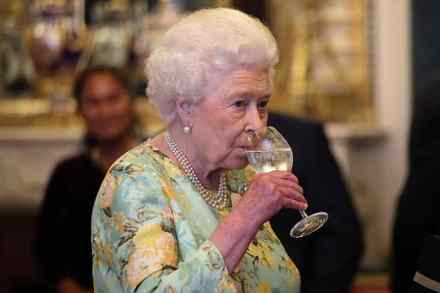
What are the Queen’s favourite tipples?

Drinks at the palace The Queen was reported to have given up regular drinking. What do we know about her drinking habits (or what she likes to offer her guests) to judge by the royal warrants she has issued? — These drinks firms currently hold warrants: Bacardi Martini; Berry Bros and Rudd; Britvic soft drinks; Bollinger; G.H. Mumm et Cie; Krug; Lanson Père et Fils; Laurent-Perrier; Moet & Chandon; Veuve Cliquot; James White drinks (tomato juice); Laphroaig distillery. Testing, testing From 24 October, travellers to Britain will no longer be required to present a negative PCR test for Covid, but will be able to use lateral flow tests. Will this mean extra cases of the disease getting into Britain?