Europe

The wisdom of Eurosceptic crowds

How much does public opinion on Europe matter? A poll for today's Sunday Times found that 41 per cent want out of the EU and on the BBC1 Politics Show today, Jon Sopel confronted Douglas Alexander with this statistic. Wee Dougie replied that, on Monday's vote, he was in the "no" lobby with the leaders of all British political parties – so of course he was in the mainstream. This raises a crucial issue: the vast disconnect over Europe between the political elite and the masses. To declare my hand: I'm in favour of our EU membership and regard the free movement of people, goods and services as a noble endeavour (albeit one which the EU has yet to live up to). But I'm in the minority.

American isolationism and its consequences

I've spent the last couple of days in the United States, far away from the brouhaha in Europe. What has struck me most during meetings with US officials is how low down their list of priorities Europe — and indeed Britain — comes. This is an Asian Century, and the US means to focus inwards and eastwards but not elsewhere. As an official put it to me, "we see Britain moving away from Europe and being distant to us." There is even talk of closing down US European Command. This new focus will have a number of consequences. Take Libya, for instance. The UK and France could have fought the war, and won, without the US, but American involvement allowed casualties and collateral damage to be minimised.

The Great Repatriation Question

And the word of the weekend is ‘repatriate’. Not only do we have yet another poll showing that the British public, when asked, would prefer to tug powers back from Brussels, but there's also this eyecatching story in the Daily Telegraph. No.10, we're told, is pushing Whitehall departments to determine just exactly where Europe's influence could be counteracted. There is also a backbench group of Tory MPs providing covering ideas.  So why hasn't this been happening before now, particularly given how frustrated those around David Cameron have become with the constant torrent of EU directives? Part of the answer is that the events of the past week have made all this more urgent. But part of it is that, actually, this work has already been going on in Whitehall.

From the archives: Cut off in Brussels

Let's end the working week how it began: with talk of a European referendum. The talk, in this case, is provided by Daniel Hannan, who wrote an article for us in 2008 about his efforts to promote a referendum on the Lisbon Treaty from within the European Parliament. Here it is, our latest excavation from the Spectator archives: For MEPs, public opinion is merely an inconvenience, Daniel Hannan, The Spectator, 22 November 2008 I’ve just done the most pointless thing an MEP can do: I’ve delivered a speech to the European Parliament. Actually, ‘speech’ is rather a grand word for my little soliloquy which, under the rules, had to be squeezed into 60 seconds.

Europe’s new battlefield

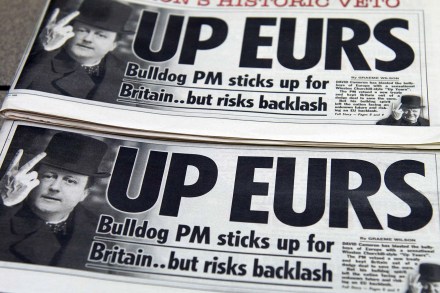
The long flight from Australia should give David Cameron plenty time to think about Europe, and how it just won't go away. He didn't want this battle — not now, not ever. But in the Daily Telegraph today, the first in what will be a weekly column, I lay out the battlefield that awaits him on his return. First, this bailout is not the end. A trillion Euros needs to come from somewhere, and today the Chinese are being tapped up — God knows what we'll agree to in return. But that doesn't address what is, as Mervyn King has said, a solvency issue rather than a liquidity issue. And the tighter these Eurozone countries squeeze together, the more tension we can expect.

The government’s European tribulations continue

It has been a fraught and ill-tempered week in Westminster. And — whether it is the rumour that Tory backbencher Andrea Leadsom told George Osborne to "f**k off", or David Cameron's dismissal of Ed Miliband as a "complete mug" — most of it has had Europe at its root.  So it is, too, with the latest news of government strife. Iain Duncan Smith, it's reported, had a ferocious row with the Tory chief whip, Patrick McLoughlin, over the EU referendum . Apparently, he warned that, “If you ever put me in this position again, that’s it”. As it happens, there is more on IDS's disgruntlement in Charles Moore's column for the latest Spectator, out today.

Summit for nothing?

The punchline to yesterday's eurosummit comes in the very first paragraph of the official statement, released in the darkness of morning: "The euro continues to rest on solid fundamentals." Now that you've brushed away the tears from that one, what was it that was actually agreed upon in the end? The main measure is effectively a fiscal target for Greece: its national debt, expected to peak at around 180 per cent of GDP in 2013, will come down to 120 per cent by 2020. And this will be achieved by cutting the value of bonds held by private investors in half, alongside further waves of privitisation and Greek frugality. Brussels will strengthen its "monitoring capacity on the ground," to ensure that Athens abides by these strictures.

Ellwood returns as PPS to the Minister for Europe

Tobias Ellwood has been appointed as PPS to the Europe Minister David Lidington. The vacancy had been created when Adam Holloway decided to resign from the job so that he could vote for the EU referendum motion. This appointment is a nifty piece of party management. Ellwood was Liam Fox’s PPS but when Fox resigned, the new Defence Secretary Philip Hammond decided, to the resentment of some Tory backbenchers, not to keep him on. Instead, Hammond chose to appoint Clare Perry, a member of the 2010 intake who had worked for George Osborne and Hammond in opposition. Some Tory MPs, and particularly those who felt passed over, saw this as evidence that the party was being run by a clique. Ellwood’s return will be seen as an olive branch from the Cameroons to the party.

Italian comic opera

Politics is serious business, especially when the world’s economy is at stake, but so much of what’s going on in the eurozone now – especially in Italy - resembles opera buffa. Today in Rome, amid rumours that Berlusconi would throw in the towel in January (but not because of bunga bunga, because of bungling over economic reform), a few deputies in parliament came to blows.   The fisticuffs was over that hotly contended if not-very-sexy issue – the retirement age. At least two members of the Northern League, a key party of Berlusconi’s coalition, fought with members from the opposition FLI. ‘Two deputies grabbed each other by the throat as other parliamentarians rushed to separate them,’ reports Reuters.

Miliband fails to connect

Easy-peasy at PMQs today. All Ed Miliband had to do was slice open the Coalition's wounds on Europe and dibble his claws in the spouts of blood. But his attack had no sense of bite or surprise. And his phraseology was lumpen. He used all six questions gently stroking the issue of Europe rather than driving a nail through it.  He asked about growth. He asked about the '22 committee. He asked about Nick Clegg's "smash-and-grab" phrase to describe the repatriation of powers. He asked about the social chapter. He asked about everything he could think of, and it was clear he couldn’t think of the right thing to ask. At the climax he sounded like a nursery-assistant scolding Cameron for "pleading not leading" on Europe. Desperately flaccid oratory.

Cameron battles it out

David Cameron came out swinging today at PMQs. Knowing that Ed Miliband would try and exploit the Tory rebellion over Europe on Monday night, Cameron went for the Labour leader. He called him a "complete mug" and mocked him as being detached from reality. At the end of the exchange, Osborne gripped Cameron's shoulder in congratulation – a sign that the pair knew that they needed a strong performance today to calm their backbenches. The other notable aspect of PMQs was its emphasis on the new political battleground: women. The Labour MP Gloria Del Piero asked the PM why the government was more unpopular with women than men, which gave Cameron a chance to rattle off the government's female-friendly initiatives.

Why this is not the time for an EU referendum

Having spent five hours in the debate last night, one thing was absolutely clear: we are all Eurosceptics now. So why did I choose to vote against the motion? It is because I believe that anger and frustration alone will not resolve our justifiable grievances towards the EU; we need a clear-eyed strategy to move forward.    We can all agree that Europe in its current form is not working for us. We have passed powers to Brussels at the cost of undermining the sovereignty of Parliament. Regulations that hinder our growth have not only been adopted but gold-plated, and with the Lisbon Treaty we are saddled with a constitution that no-one wanted and no-one voted for.

The coalition bares its tensions over Europe

Here's an irony: last night's EU fandango was the fifth largest vote in favour of the government this year. And yet there is little about the situation that is favourable to the government this morning, as the story moves on from Tory splits to coalition ones.  It started with Michael Gove's appearance on the Today Programme earlier. The Secretary of State for Education put in a much more conciliatory performance than William Hague managed yesterday; praising the "cordiality" of the Tory rebels, and reassuring them that the Tory leadership would like to see specific powers returned from Europe "in this Parliament".

The Rebels and Government Agree: There Will Be An EU Referendum.

In principle, I agree with Fraser's admirable post previewing Monday's debate (summarised excellently by ConservativeHome here) on an EU-referendum but I suspect that wily old Blairite John Rentoul is right to argue that there was no way the government could wash its hands of the affair since, whatever it chose to do, The headlines would be about a divided Tory party, come what may. Which is reasonable enough since the Tory party is divided. Granted, the primary division is between the Get Out Now team and the Renegotiate Everything team but the point remains: this has been a blunder. The government has mishandled this affair and been embarrassed by its own backbenchers. Nearly half the non-payroll Tory vote declined to back the Prime Minister yesterday.

Europe Minister’s PPS quits over referendum vote

Adam Holloway, PPS to the Europe Minister David Lidington, has just effectively quit his job by giving a speech setting out his intention to vote for the motion. That the Europe Minister’s PPS is walking over this issue is an embarrassment for the government and a sign of how strongly opinion on this issue is running. The most striking thing about William Hague’s speech was the near silence in which it was listened to on the Tory benches. When Hague mocked the motion, he didn’t draw laughs from even the most sycophantic backbenchers. Whatever happens tonight, this debate has widened divisions on the Tory side. There is a real danger that without urgent action, up to a third of the backbenches will become actively hostile to the Prime Minister.

Another voice: Why Cameron had no choice but to fight

Fraser performed a valuable service to the MPs currently debating a motion proposing a referendum on membership of the European Union by imagining what he thought David Cameron ought to have said: "Sure, guys, have your vote. It's a backbench motion, so the government won't take part and as you know I've booked a trip abroad next Thursday anyway so I won't be here. But I was serious when I said those petitions are a way to 'rebuild trust in politics'. If this reached the threshold I set — 100,000 votes — then I'm happy for this to be debated, with a free vote. If you ask me, it's an odd time to discuss a referendum. But hey, I run the government — not parliament. You guys work for your constituents, not for me. So go for it.

Cameron’s warm up act

David Cameron's statement on the European Council served as the warm up act for this afternoon's debate on the EU referendum motion. Cameron attempted to show his backbenchers that he is serious about bringing back powers from Brussels. He stressed that he had already prevented the transfer of further authority to the European Union without a referendum and that he "remained committed" to repatriating powers. In an attempt to flash a bit of leg to his own side, he said that when the debate about treaty change starts "every country can wield a veto until its needs are met." But Cameron remained vague about what powers he would like to see returned.

Whipping up a storm | 24 October 2011

It looks like about a third of Tory backbenchers will rebel in tonight’s vote on an EU referendum. 18 months into government, this is a massive rebellion and one that should make the Prime Minister think again about his style of party management. Those in Number 10 who claim that many of the rebels will ‘never be happy’ are missing the point that, while there may be a hardcore of MPs keen to rebel, many more are reluctant rebels who feel they have been pushed into it by Cameron’s failure to engage with the party on the whole issue of Europe. One reluctant rebel said to me over the weekend: if you write anything about this please say that the whips office needs sorting out.