Espionage

What we know about Beijing’s spies

32 min listen

Two years ago, Richard Moore, head of MI6, said that China was now the organisation’s ‘single greatest priority’. Parliamentarians and the British public have been starkly reminded of this by last week’s news that a parliamentary researcher had been arrested on suspicion of spying for China. On this episode, we won’t be commenting on the ins and outs of that case, but talking more generally about Chinese espionage. What forms does it take, what are its goals and how successful are the Chinese secret services at achieving those? I’m joined by a brilliant and knowledgeable guest. Nigel Inkster is the former director of operations and intelligence for MI6.

The forgotten world of female espionage

When the Germans occupied northern Italy in the autumn of 1943, they were pleased with the way that young Italian women, pedalling on bicycles around the country lanes in white socks and pigtails, smiled at them. The soldiers offered to help with their loaded baskets and gave them lifts in lorries. It took some months before they discovered that these smiling girls, known as staffette, were working as couriers, spies and carriers of weapons for the Resistance, then busy forming in the foothills of the Alps. When they realised their mistake, their reaction was often brutal. If caught, the women knew they would fare no better than the men.

Russia’s long history of smears, sabotage and barefaced lies

Russian politicians often refer to something called the Dulles Plan. This document purports to capture the future CIA chief Allen Dulles explaining, in 1948, the US strategy to destroy the moral foundations of the USSR and bring about ‘the death of the most intractable people on Earth... the definitive, irreversible dying out of its self-consciousness’. If this sounds like a fictional villain’s expository monologue then that’s because it is. The text was taken from an antagonist’s speech in a 1971 novel, Eternal Call, which itself recalled a much earlier Russian forgery, the anti-Semitic Protocols of the Elders of Zion.

Espionage dominates the best recent crime fiction

The best espionage novels cater to our fantasies while still persuading us of the authenticity of their worlds. Of the titles published this year, two stand out in the field, and each author understands that, in fiction, veracity is not the same as authenticity. In Hemingway’s words: ‘All good novels have one thing in common. They are truer than if they had really happened.’ An extended chase, beginning in Siberia, is a kind of Russian version of The Thirty-Nine Steps White Fox (Bantam, £18.99) is the concluding volume of a trilogy of thrillers by Owen Matthews, one of the best of many western writers on Russia. It can happily be read on its own, though it is sufficiently gripping to send readers back to the earlier two books.

Lawmakers demand Vladimir Kara-Murza’s release

From our US edition

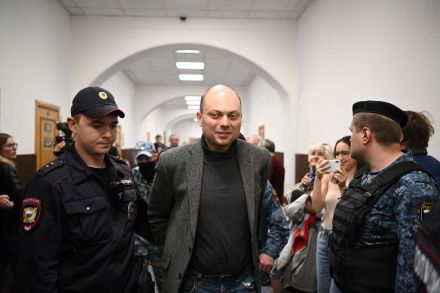
The legacy of John McCain was on full view in the halls of Congress this week, where a bipartisan group of lawmakers repeatedly invoked his legacy to demand that Russia release a journalist detained for criticizing Vladimir Putin. One year ago, Vladimir Kara-Murza, a Russian political dissident and journalist, was arrested by Putin’s regime on trumped-up charges of spreading false information about Russia’s military during a speech he gave in McCain’s home state of Arizona. To commemorate his detention, and to call for his release, the McCain Institute hosted an event in the nation’s capital where lawmakers from both parties — who served jointly with McCain for almost 100 years between them — rallied to Kara-Murza’s defense.

vladimir kara-murza

The security state says jump. The media asks ‘how high?’

From our US edition

The tacit alliance between operatives of the national security state and corporate media burst into view last week when the New York Times and the Washington Post did the FBI’s job for it by tracking down the leaker of documents that detailed, among other things, the extent of American and allied involvement in the Ukraine war.  That Bellingcat, the shadowy, government-funded open-source intelligence group, played a role in helping to identify the twenty-one-year-old Air National Guardsmen Jack Teixeira proves (once again) that many media outlets are now de facto agents of the national security state.

media leak tows security state

Jack Teixeira and our crisis of trust

From our US edition

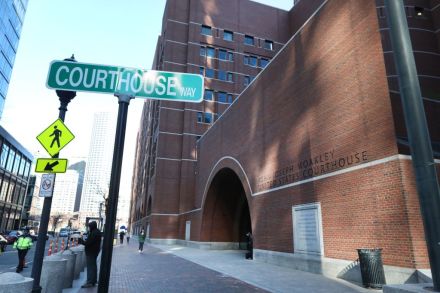
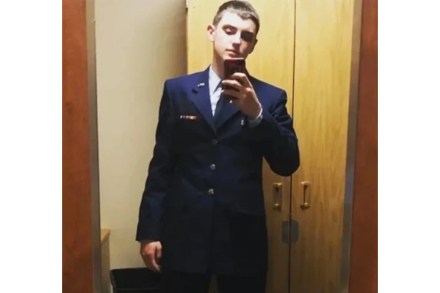
Despite all the precautions and double-checks, at some level everything ends up a matter of trust. And in the case of Air National Guardsman Jack Teixeira, much of that trust was violated. Why couldn't the military trust him? Why do we have to trust him? The documents against Jack Teixeira, the twenty-one-year-old airman first class who is accused of leaking classified documents, indicate that he was granted a top secret security clearance in 2021, which was required for his job as a computer network technician in the Massachusetts Air National Guard. While that may sound like an exceptional degree of access for such a junior service member, having top secret/SCI (sensitive compartmentalized information) clearance in that kind of job is standard.

jack teixeira
spy

The imperfect spy

From our US edition

On one level, Lis Wiehl’s enthralling and grimly astonishing A Spy in Plain Sight is simply the story of Robert Hanssen, an FBI agent whose espionage activities were described by the Department of Justice as “possibly the worst intelligence disaster in US history,” a crowded field even at the time of his arrest in February 2001. “Over twenty-two years,” explained the DOJ in a 2002 report, Hanssen had “given the Soviet Union and Russia vast quantities of documents and computer diskettes filled with national security information of incalculable value.” And his betrayals had cost lives.

Banning TikTok is not about the booty videos

From our US edition

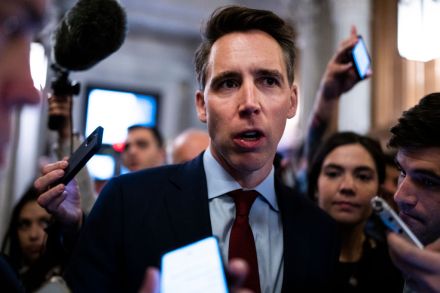
Missouri senator Josh Hawley's attempt to pass his "No TikTok on United States Devices Act" resulted in a clash with Kentucky senator Rand Paul that made for a rare moment of actual debate on the Senate floor yesterday. The conservative senators were at odds over whether the government should ban the Chinese social media app. "I have never before heard on this floor a defense of the right to spy," Hawley responded. "I didn’t realize that the First Amendment contained a right to espionage. The senator from Kentucky mentions the Bill of Rights. I must have missed the right of the Chinese government to spy on Americans in our Bill of Rights. Because that’s what we’re talking about here." "The company has bent over backwards to work with our government,” Paul claimed.

josh hawley ban tiktok

Spy planes and infiltrators: a history of the CIA in China

47 min listen

The Chinese Communist Party likes to blame its domestic political problems on foreign interference, and it has done so since the days of Chairman Mao. But sometimes, does this paranoia, this narrative, have a point? Or at least during the depths of the Cold War, when the United States, via the CIA, was countering communism across the world through so-called ‘covert operations’. My guest today is Professor John Delury, a historian at the Yonsei University in Seoul, and author of a new book looking at the history of the CIA in China. It’s called Agents of Subversion, and I’d highly recommend it because some of the incredible exploits detailed in there are nothing short of what you'd find in a spy thriller.

Shoot down the balloon!

From our US edition

Like many of you, Cockburn has been following the developing story involving the Chinese spy balloon currently hovering over Montana. For those unaware, sometime over the last few days a spy balloon has floated over the Aleutian Islands in Alaska, across Canadian airspace and entered into Montana, where it's been for several days. It traveled at an altitude of around 50,000ft and is currently not far from the 341st Missile Wing at Malmstrom Air Force Base, which houses a portion of America's intercontinental ballistic missiles, among many other key military assets.

spy balloon

Colleges join the war on TikTok

From our US edition

TikTok likely hasn't been too bothered about a bunch of crusty old senators and governors denouncing their social media platform. But Cockburn thinks the Chinese-owned company may be a little concerned by the latest wave of resistance as it directly affects their core demographic: young Americans. One of the South’s largest universities, Auburn, has banned TikTok from campus WiFi. The move was ordered by Alabama governor Kay Ivey, one of many Republican governors to bar the use of TikTok on state devices in December. “China doesn’t care if they are building a dossier on a nine-year-old or a ninety-year-old," Ivey said. "They will build it on all of us and really that’s a part of their five-year plan and really part of how China conducts their global affairs.

tiktok ban

All I want for Christmas is a TikTok ban

From our US edition

What do Santa Claus and the Chinese Communist Party have in common? They both see you when you’re sleeping, and they both know when you’re awake — especially if you have communist spyware like TikTok installed on your phone. Whether you’re a teenage girl or a government employee with a top secret clearance, TikTok wants to brainwash you and steal your secrets — maybe even both! While spending all your time on any social media platform can’t be good for your health, TikTok in America is specifically programmed to hook its users, with documented mental health problems plaguing teenage girls. A recently viral “blackout challenge” on the platform literally resulted in kids dying while they strangled each other — or themselves.

tiktok

A complex, driven, unhappy man: the truth about John le Carré

It is often said that the age of letter-writing is past. This forecast seems to me premature. I have edited three volumes of letters, in each case by writers labelled (though not by me) as ‘the last of their kind’. Yet here is another one, and I feel confident that more will follow. Few now write letters, but those who still do tend to take care what they write. And it will be some decades before we have used up the legacy of the living. John le Carré, who died almost two years ago at the age of 89, was one such. His work is likely to be reassessed over the next few years and his place in the canon is not yet secure. But he is undoubtedly the pre-eminent spy writer of modern times, and arguably the definitive chronicler of the Cold War.

The Clintons actually broke the laws Trump is accused of breaking

From our US edition

It always ends up back with the Clintons, doesn't it? The laws Trump may be charged under at Mar-a-Lago appear to have been violated by both of the Clintons, yet the two were never searched, never mind charged and never prosecuted. Any action against Trump must account for that to preserve what is left of faith in the rule of law applied without fear or favor, or risk civil disenfranchisement if not outright civil unrest. The more obvious case involves former Secretary of State Hillary Clinton, who maintained an unsecured private email server that processed classified material on a daily basis.

hillary clinton laws

What is a classified document, anyway?

From our US edition

What is a classified document? Donald Trump seems to have lots of them — and the FBI sure wants them back. In the wake of my first book critical of the State Department’s Iraq Reconstruction program, Diplomatic Security began a deep dive into my life in an attempt to find something over which to prosecute me. A colleague passed on a bit of personnel gossip via his official email to my Yahoo! Account — and the chase was on. Diplomatic Security claimed I was in possession of “classified” material at home and referred my case to the Justice Department. The email in question was simply labeled “For Official Use Only,” or FOUO, a standard tag then automatically applied to all email sent by State in the unclassified system.

classified

A belter of a podcast, featuring a mad South African: Smoke Screen reviewed

I go back and forth on tobacco companies. On the one hand, they are merchants of death. On the other, cigarettes are fun and delicious. On the one hand, they push cigarettes on children, which is unconscionable. And on the other, I remember how I would gather in the park with other children to collectively venerate a ten-pack of Marlboro Lights, our soft, pink fingers shivering and struggling with the lighter mechanism, our untutored lips puffing ineffectually at the speckled filter, all of us beginning to grow woozy from the acrid smoke filling our virgin lungs as we stood there and thought: this is the life. Luckily, Smoke Screen sidesteps this question to focus more squarely on corporate espionage within the tobacco industry.

Berliners were punished twice – by Hitler and by the Allies

‘Nationalism is an infantile disease. It is the measles of mankind.’ Albert Einstein’s deft avoidance of the question put to him in 1929 – whether he considered himself a German or a Jew – was prophetic of what would happen to his country in the following decade. He was just one of the many stars of Berlin, Europe’s dazzling, decadent centre of the arts and culture, whose spark would be dimmed or extinguished by Adolf Hitler. Capturing the history, people and spirit of Berlin, arguably the beating heart of Europe, can be a tricky proposition, as I know. Sinclair McKay has wisely kept to analysing the city through the prism of the last century – or at least from the end of the Great War to the end of the Cold War.

Snafu at Slough House: Bad Actors, by Mick Herron, reviewed

Reviewers who make fancy claims for genre novels tend to sound like needy show-offs or hard-of-thinking dolts. So be it: here’s mine. Anyone who tries to understand modern Britain through its fiction but overlooks Mick Herron’s satirical thrillers merits a punishment posting to the critics’ version of Slough House. That noxious midden of a building opposite the Barbican, its leprous chambers groaning like ‘the internal organs of some giant, diseased beast’, is a sort of landfill site for failed spies. Herron first opened its flaking doors in 2010 with his novel Slow Horses. Seven books later, his squad of borderline sociopath rejects from polite espionage has risen to the dignity of a luxury cast series on Apple TV+.

‘Slow Horses’ is thriller television at its best

From our US edition

It may come as a surprise to anyone who has read Mick Herron’s peerless Slough House novels, but Slow Horses, Apple TV’s high-profile adaptation of the first book in the series, is not funny. Instead, it takes Herron’s uproariously comic premise — that a group of misfit British spies, cast out of MI5 for misdemeanors exaggerated and accurate alike, have been reduced to grubbing about in a grim office on the periphery of the City of London — and plays it almost entirely straight. Gone are the laugh-out-loud one-liners and endearingly witty pieces of throwaway badinage. Instead, we have a big-budget spy thriller, polished and scripted to within an inch of its life. It’s a bit like seeing the Fresh Prince of Bel-Air reinvented as a gritty urban drama.

horses